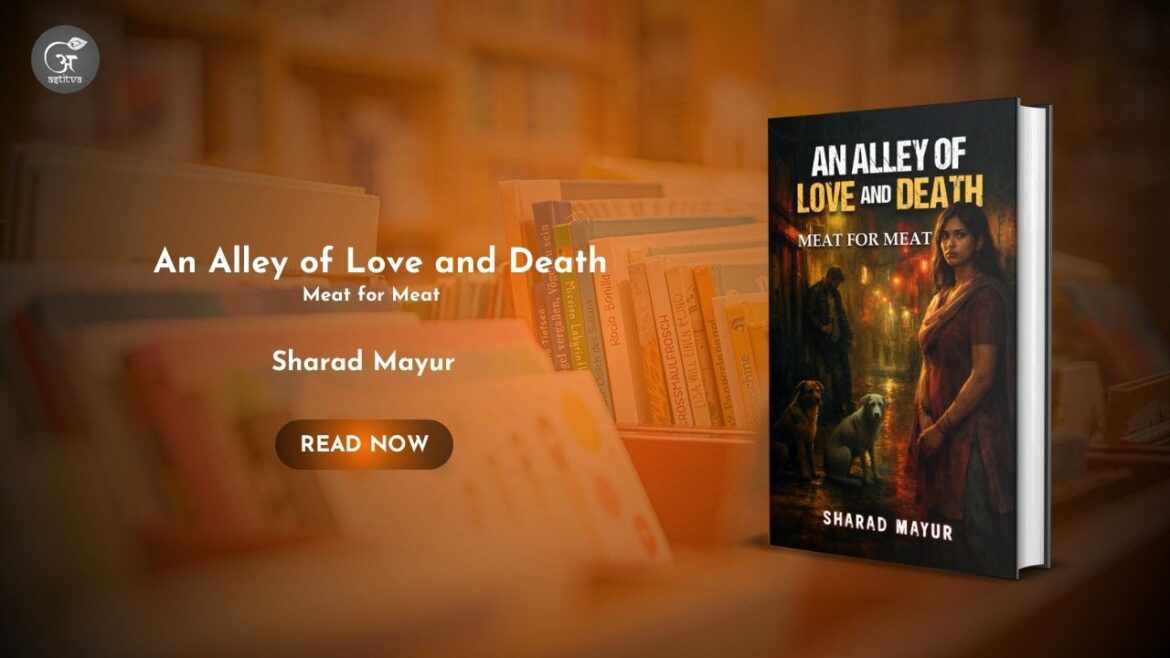
An Alley of Love and Death: Meat for Meat arrives as a bruising, unflinching work of fiction that refuses comfort and rejects easy moral distance. Set in the margins of society where survival is negotiated daily and dignity is often a luxury, the novel tells the story of Shabana—a young woman born into an alley that teaches its children hard truths far too early.
At the heart of the narrative is a mother’s quiet rebellion against fate. Shabana’s mother, herself shaped by deprivation and social neglect, dares to believe in escape—not for herself, but for her daughter. Education becomes her only weapon against a system designed to keep them invisible. Every sacrifice she makes is an act of faith, a wager that love and perseverance might rewrite destiny. Yet the novel is painfully honest about how fragile such hopes can be in a world that preys on innocence.
Shabana grows up carrying her mother’s dreams, but also her own longing—for affection, for security, for a life that feels chosen rather than endured. When a man enters her life presenting himself as a rescuer, she does what many are taught to do: she trusts. His words sound like salvation, his attention like love. What follows is not sudden violence but something more insidious—manipulation disguised as care, obsession masked as devotion. Addiction, greed, and control slowly surface, revealing a carefully constructed lie.
Sharad Mayur handles this descent with restraint rather than sensationalism. Shabana’s tragedy is not written as shock value but as a gradual narrowing of choices, showing how vulnerability is exploited when society fails to protect its most fragile members. Her decision to run toward what she believes is a better life becomes the novel’s most devastating moment, because it is rooted in hope. That hope is betrayed in the cruelest possible way when she is sold into the very hell her mother spent a lifetime trying to shield her from.
The novel’s power lies in its refusal to soften this reality. An Alley of Love and Death confronts human trafficking, exploitation, and moral decay without turning away or romanticizing suffering. Love, the book argues, can be lethal when poisoned by possession and entitlement. Here, love does not redeem—it destroys. And when justice finally arrives, it does not come dressed as law or social reform. It comes as consequence. Brutal, inevitable, and deeply unsettling.
“Meat for Meat” functions as more than a subtitle; it is the novel’s moral core. It speaks to a world where human lives are reduced to currency, where cruelty feeds on itself, and where those who believe they control violence ultimately become consumed by it. The ending does not offer comfort, but it does offer reckoning. Every sin leaves a mark, the book insists, and some marks are written in blood.
Sharad Mayur’s transition from music to fiction feels both natural and necessary. As a singer, lyricist, and composer, his artistic voice has long explored love, pain, faith, and human struggle. Those same themes pulse through this novel, but with a darker, more confrontational intensity. His storytelling carries a lyrical sensitivity even in its harshest moments, allowing emotion to surface without diluting the truth.
An independent artist with multiple self-written and self-composed songs released on YouTube, Mayur lives and breathes storytelling in its many forms. His work with children as a music teacher and his initiative, rangshalaindies, an open stage for artists in Noida, reflect a commitment to creative expression as both survival and resistance. Originally from Saharanpur and now based in Noida, this debut work of fiction marks a bold expansion of his artistic landscape.
An Alley of Love and Death: Meat for Meat is not an easy book to read, nor is it meant to be. It is written for readers who refuse to look away from uncomfortable truths, who understand that silence enables violence, and who believe literature must sometimes wound in order to awaken. This is a novel that lingers long after the final page—not because it offers hope, but because it demands accountability.