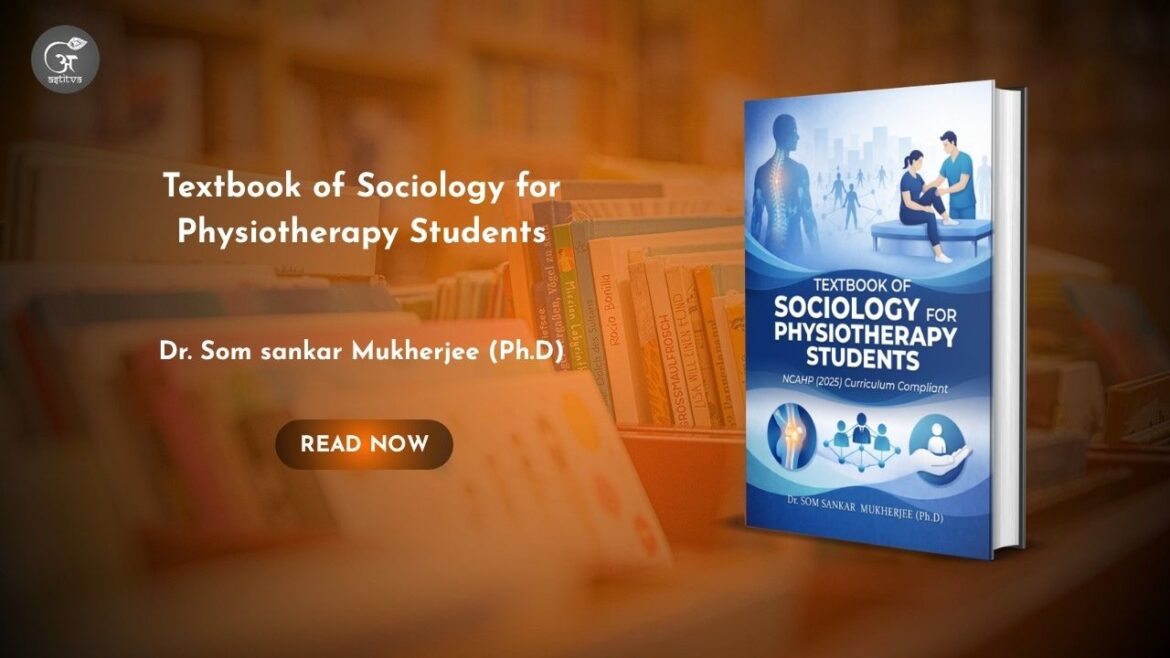
The release of Textbook of Sociology for Physiotherapy Students: NCAHP (2025) Curriculum Compliant marks an important contribution to physiotherapy education in India. Authored by Dr. Som Sankar Mukherjee, this comprehensive textbook has been thoughtfully developed to align with the curriculum guidelines prescribed by the National Commission for Allied and Healthcare Professions (NCAHP), ensuring that Bachelor of Physiotherapy (BPT) students receive a well-structured and academically relevant understanding of sociology within the context of healthcare.
In the evolving landscape of modern healthcare, physiotherapy is no longer confined solely to the study of anatomy, physiology, and therapeutic techniques. Healthcare professionals today are expected to understand the broader social environment in which patients live. Recognizing this essential need, this textbook introduces physiotherapy students to the principles of sociology and highlights how social, cultural, economic, and psychological factors influence health, illness, recovery, and rehabilitation. By bridging the gap between social science and clinical practice, the book helps future physiotherapists develop a more holistic and patient-centered approach to care.
Sociology, as a scientific discipline, examines human society, patterns of social relationships, and the ways in which individuals interact within social structures. For physiotherapy students, this understanding becomes particularly valuable when dealing with patients from diverse social and cultural backgrounds. The book explains how factors such as family structure, cultural beliefs, socio-economic conditions, education, occupation, and community environments can significantly affect health behaviors, treatment adherence, and rehabilitation outcomes. By gaining insight into these aspects, physiotherapy professionals can deliver care that is not only clinically effective but also socially sensitive and culturally appropriate.
The structure of the textbook has been carefully designed to guide students through a progressive learning journey. It begins with fundamental sociological concepts including society, culture, social structure, socialization, and social institutions, which form the foundation of sociological thinking. As the chapters progress, the book explores the dynamic relationship between sociology and healthcare, addressing topics such as social determinants of health, health inequalities, patient behavior, communication within healthcare settings, and the role of community health in improving patient outcomes. Special emphasis is placed on understanding the role of physiotherapists as members of multidisciplinary healthcare teams, where collaboration, empathy, and effective communication are crucial for successful rehabilitation.
To enhance the learning experience, the textbook integrates theoretical explanations with practical perspectives. Case studies, real-life examples, and reflective exercises are included throughout the chapters to encourage students to critically analyze social influences on health and healthcare delivery. This approach not only strengthens conceptual understanding but also prepares students to apply sociological knowledge in real clinical situations.
The author, Dr. Som Sankar Mukherjee, is a respected academician, researcher, and author in the field of physiotherapy. Currently serving as the Chairperson of the Arunachal Pradesh Allied and Healthcare Council for the term 2025–2027, he has made significant contributions to physiotherapy education and professional development. Prior to this role, he served as Professor and Head of the Department of Physiotherapy at Indira Gandhi Technological and Medical Sciences University (IGTAMSU), Ziro, Arunachal Pradesh, from 2017 to 2025. His academic journey also includes international experience as a Lecturer and Sports Physiotherapist in the Department of Sports Sciences at Mekelle University in Tigray, Ethiopia, where he contributed to both teaching and clinical training.
Dr. Mukherjee holds a Master of Physiotherapy (MPT) specializing in Sports Physiotherapy along with a PhD in Physiotherapy, reflecting a strong blend of clinical expertise and academic scholarship. His research interests focus on evidence-based rehabilitation, sports injury management, and physiotherapy education. Through various studies, he has explored topics such as the comparative effectiveness of static stretching and muscle energy techniques for improving hamstring flexibility, as well as the benefits of Pilates-based rehabilitation programs for managing low back pain. His work also extends into educational methodologies, where he has applied frameworks such as Bloom’s Taxonomy and Schön’s Reflective Model to strengthen clinical reasoning and improve curriculum design for physiotherapy students.
Beyond clinical research, Dr. Mukherjee has actively engaged in community-based health studies, examining how factors such as livelihood, education, and social awareness influence the prevalence and understanding of non-communicable diseases among youth. These efforts highlight his commitment to public health, preventive care, and the integration of social perspectives into healthcare practice.
As an accomplished author and editor, Dr. Mukherjee has contributed to numerous academic publications and research papers that are widely referenced in physiotherapy education and professional training. His work consistently reflects a commitment to advancing evidence-based practice, improving healthcare education, and fostering interdisciplinary understanding among healthcare professionals.
The publication of Textbook of Sociology for Physiotherapy Students: NCAHP (2025) Curriculum Compliant represents a significant step toward strengthening the academic foundation of physiotherapy students in India. By integrating sociological insights with healthcare education, the book equips future physiotherapists with the knowledge and perspective required to understand patients within their social realities. This holistic understanding ultimately enhances the quality of care, promotes empathy in clinical practice, and supports the broader goal of building a more inclusive and effective healthcare system.