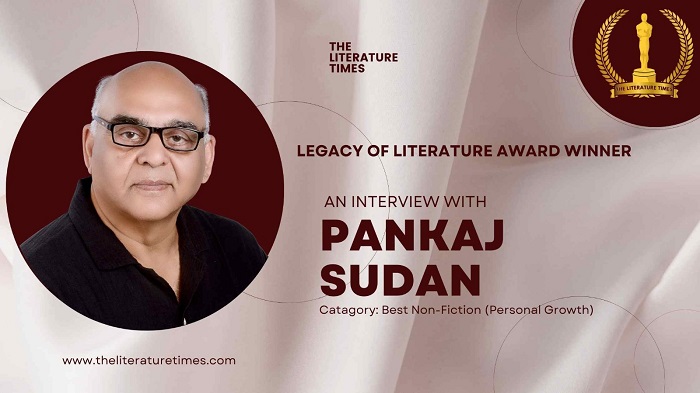
Pankaj Sudan is a spiritual seeker, writer, educator, banker, poet, and researcher in the fields of parapsychology and inner transformation. At a young age, he embarked on a profound journey into the Himalayas in search of life’s deeper meaning. His spiritual inclinations led him to the Sri Ramakrishna Mission in New Delhi, where he joined as a brahmachari and later served as the vice president of the executive committee at the Sri Ramakrishna Ashrama, Meerut. For over two decades, he has conducted free meditation sessions, touching the lives of countless aspirants. His writing reflects his lived experiences, blending humor, mysticism, and deep introspection. He published his first book, Zero, at the age of 21, and his recent work, Deep Mind and Whispers of Eternity, serves as a layered and evocative exploration of self-knowing, spiritual insight, and the subtle whispers that guide the soul.
The Literature Times: Your book Deep Mind and Whispers of Eternity is filled with philosophical and spiritual reflections woven into personal experiences. What inspired you to write it in this unconventional, memoir-like format?
Pankaj Sudan: I have a firm belief that people relate easier to the first-hand experience than somebody else’s narrative. Therefore, I chose to write it in the form of a memoir rather than in the form of a traditional spiritual or philosophical treatise. Moreover, I wanted my book to act as a mirror where the reader might discover himself spurred by a sudden insight or through some relatable deep psychic experience than a sterile roadmap where everything is prefixed and preachy.
The Literature Times: You went to the Himalayas in search of purpose at a young age. Can you share one pivotal experience from that journey that significantly altered your perspective on life or spirituality?
Pankaj Sudan: Though I got a flurry of insights during my Himalayan sojourn, one pivotal experience which made things easy for me was a sudden intuition, which could appear quite naive to the critics, as I was in my teens and quite impulsive and without any proper spiritual guidance from a master, of not allowing my ego to decide the course of my journey. I took a vow to visit the place the name of which was uttered by any stranger to me or in any ways mentioned to me. I had no warm clothes with me nor enough money. Moreover, I took away the last resort of the ego to assert itself and that is through removing its ” decision making power or through likes or dislikes”. Therefore I inadvertently stumbled upon the great practice of the ascetics and yogis of practicing -” Ishwar pranidhan” which is total surrender to god and shutting up the insistences of ego.
The Literature Times: The book emphasizes subtle “parallel clues” rather than direct teachings. Why did you choose this approach, and how do you believe it affects the reader’s engagement?
Pankaj Sudan: Spirituality is something where the approach of direct instructions is a failure. The intellect and mind cannot fathom it, cannot touch it. As they are limited and operate through ” known ” whereas the spiritual field deals in ” unknown”. Direct instructions require use of established or memory – oriented actions. Spirituality is actually a constant exploration, a discovery, an uncovering of oneself. And it is impossible to discover anything if you ” know “beforehand what is there to be discovered or what ” probabilities ” are there. That’s why the Vedas cautioned to use the method of ” Neti, neti ” meaning – ” not this, not this” only. Therefore, you can only hint at it using parallel clues, nothing more.
How does it affect the reader’s engagement? Surely it affects the reader in a very constructive way. A parallel approach spurs the reader’s mind and through the apt usage of insight – triggering, specially designed words take it at the brink of a possible intuition. This approach actually readies the mind to discover the truth through a sudden realization instead of an authoritative, laid down, prefixed and therefore a stale approach.
The Literature Times: How has your time with the Sri Ramakrishna Mission influenced your spiritual outlook and the way you present ideas in your writing?
Pankaj Sudan: My stay at the Ramakrishna mission, New Delhi was for a short period so not much of that period influenced my ways of expression. But later when I joined Sri Ramakrishna ashram, Meerut and subsequently became Vice President of its Executive committee, I began to conduct free meditation classes. During these sessions which lasted for more than two decades, I had various experiences coming from my interactions with students, scientists, professors, doctors and even a few saints and monks. These formed the basis for the plot of my book.
The Literature Times: You’ve also worked as a banker and educator, and explored parapsychology. How do these seemingly diverse roles inform your understanding of the human mind and spiritual experience?
Pankaj Sudan: The question is how did I manage to carry on such a diverse plethora of roles like of a banker, an educator, a house holder, an experimenter of parapsychology etc?
See, diversity in any matter is invariably at the surface but below the superficial surface there is a single matrix – which is adwait – nondual. Similarly, one can act in multiple roles if he is good at acting. If you happen to be deeply sensitive and strive for the excellence, you can play and fit in any role simultaneously.
The Literature Times: In your view, what is the biggest misconception people have about the spiritual path or the process of self-knowing?
Pankaj Sudan: The biggest misconception prevelant among the masses regarding spiritual path is that it is quite tough and that they are not made for it and that it is quite boring and strenous. Also, this path is only for a few gifted or spiritually inclined special people and ceratinly we are not one of them.
The truth is, surprisingly, just the opposite. It is very funny and interesting. You were led to believe that everything that exists or around you is real and you suddenly realize that you were the characters of a video game or a Virtual Reality game and were unnecessarily and quite foolishly experiencing all sorts of emotions like sorrow, anger and fear etc, would you not explode in a roaring laughter? Realization of truth is such an exhilarating and freeing experience! But people are terrified. They are terrified of the unknown. If you don’t have guts for venturing in the unchartered territory, how would you be worthy to discover anything new and worthy to be called an adventurer? Spirituality is like an adventure. You don’t need to anything extraordinary. Just be with you, with real you. Honestly! That’ s the problem actually. We are hesitant to be honest and free of all sorts of hypocrisy.
The Literature Times: You’ve conducted free meditation sessions for over twenty years. How has your approach to meditation evolved, and what key insight would you offer to beginners?
Pankaj Sudan: In the beginning, I used to stress upon concentration and one – pointedness and upon recitation of certain mantras to calm the mind and bring it back.
Gradually, I began to highlight the importance of awareness – pure awareness, which included not ” excluding” anything from the perceptions. When we concentrate, we exclude all distractions other than the desired target. This creates a dichotomy – a dwait and see the irony! We were striving for adwait.
Therefore, I taught them to open up all the gates – all the gates of our senses. They were told to listen to all sounds coming to their ears but with a caution! Never to name the sound. For example – never say that this sound is of a car’s horn or of passing of a scooter in the street or the sound coming from the rotating blades of the Ashram fan etc. They were supposed to just receive without censor, without filter all the sensory inputs coming through their ears, nose, skin etc. Gradually I taught them how to catch the signals from the river of consciousness for remote viewing, telepathy and precognition etc.
The same thing which I have said above is my advice for the beginners – which is to sit silently, just watch everything, don’t resist any thought, just beware to the World outside as well as inside. That is the beginning!
The Literature Times: What message or feeling would you most like readers to carry with them after finishing Deep Mind and Whispers of Eternity?
Pankaj Sudan: After reading this book, the readers will surely realize that a spiritual life is not out there somewhere in the distant mountain caves, jungles and caves of the hermits. It is intertwined with our daily life. Spirituality opens up new avenues, new channels in the brain and one begins to see that our life is not this shoddy affair of daily routines of stress and conflicts. There are other energy channels. We can tap them and make our office and family life better and meaningful in many ways. Once we realize the meaning and purpose of life and how to life it in optimal and majestic ways is the most enriching and joyous experience one can have.