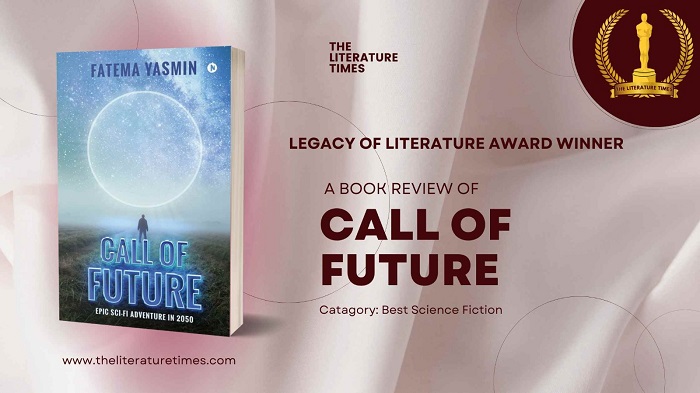
Call of Future by Fatema Yasmin is a time-bending, ethically charged science fiction novel that explores the possibility of reversing humanity’s self-inflicted doom. Set in a future on the brink of environmental and social collapse, the novel introduces readers to Dr. Philip—a visionary scientist who dares to challenge the linear flow of time in order to alter a bleak and irreversible fate. Through the lens of retro-causal theory, the story boldly asks: what if we could travel back and undo the mistakes that cost us our future?
The narrative begins in the year 2050, where Earth is gasping for breath—pollution has ravaged the environment, ecosystems have collapsed, and civilization teeters on the edge. In this dystopian setting, Dr. Philip creates a breakthrough technology based on retro-causality, allowing him to alter past events in the hopes of fixing future catastrophes. This premise is not just scientifically intriguing but morally weighty, grounding the novel in a web of cause and consequence that keeps the reader intellectually engaged.
As Dr. Philip embarks on his journey through time, the novel unfurls as both a scientific mission and a human story. He teams up with six generations of scientists, each contributing unique perspectives and expertise. This intergenerational alliance adds depth to the narrative, suggesting that long-term change is not the work of a single mind but a legacy built across eras. These scientists act as moral mirrors to Dr. Philip’s motivations, challenging him—and the reader—to examine whether the ends truly justify the means when rewriting history.
What elevates Call of Future beyond a conventional time-travel thriller is its grounding in ethical realism. The novel doesn’t simply romanticize the idea of fixing the past; it grapples with the unintended consequences of such interference. Every alteration Dr. Philip attempts has ripple effects, some devastating, others unexpectedly redemptive. These complications bring richness to the plot and emphasize the difficulty of solving problems caused not by ignorance, but by deliberate choices rooted in greed, apathy, and shortsightedness.
The love story between Dr. Philip and a sixth-generation scientist adds emotional gravity to the tale. Far from being a superficial subplot, their relationship provides a human anchor to the high-concept premise. She is not merely a romantic interest but a vital collaborator and moral compass, helping Philip navigate the darkness within and around him. Their bond grows not just out of attraction, but shared purpose and resilience—a refreshing take in a genre where romance is often underdeveloped or overshadowed.
Fatema Yasmin’s writing is direct and clear, serving the fast-paced, idea-heavy narrative well. There is a purposeful rhythm to her storytelling—urgent when disaster strikes, contemplative during moments of moral tension. She manages to explain scientific theories like retro-causality without bogging down the prose in jargon, making the concept accessible to readers regardless of their background in physics. More importantly, she uses science as a tool for introspection, not spectacle.
The strongest moments in the novel come when the story shifts from global threats to individual decisions—moments that explore personal greed, betrayal, courage, and loss. These character-driven interludes allow the reader to see how large-scale destruction is made possible by countless small moral compromises. Yasmin skillfully demonstrates that environmental collapse is not merely a result of technical failure, but ethical decay—a theme that resonates strongly in today’s climate-conscious world.
A turning point in the narrative occurs when Dr. Philip successfully returns to 2014 to initiate his mission. His optimism, however, is quickly tested. The mission’s derailment in 2024 is a sobering reminder that knowledge alone cannot overcome systemic corruption and resistance to change. Yasmin avoids simplistic solutions; instead, she confronts the bitter truth that even with foresight, reform requires collective willpower, not just technological intervention.
In the final act, when Dr. Philip reunites with the sixth-generation scientists to relaunch the mission against greed and evil, the novel strikes a tone of hopeful defiance. This conclusion is not a neat resolution, but a powerful invitation to action. It affirms the idea that the future is not a fixed endpoint, but a field of possibility shaped by courage, cooperation, and vision. Yasmin doesn’t claim that science can save us on its own—she argues that only when paired with conscience, empathy, and unity can it steer us away from destruction.
As a debut or early-career work, Call of Future is impressively layered. It succeeds in combining elements of speculative fiction, romantic drama, and philosophical inquiry without losing coherence. Its scope is ambitious, perhaps even grand in its thematic reach, but it never feels ungrounded. The pacing is brisk, occasionally moving too quickly through subplots that could benefit from more development, especially in the middle chapters. Nevertheless, these moments are few and do not detract from the overall impact of the story.
Yasmin’s world-building—both futuristic and historical—is rich without being overbearing. She balances the urgency of ecological collapse with quiet moments of reflection and intimacy. Her characters, though occasionally idealized, serve the narrative purpose and emotional resonance of the story well. Most importantly, she writes with conviction, and it shows. The moral core of Call of Future is unshakable: that the choices we make today are shaping a future we cannot afford to ignore.
In conclusion, Call of Future is a compelling, timely novel that blends science fiction with human drama to pose one of the most critical questions of our age: can we act before it’s too late? Fatema Yasmin has crafted a thoughtful, urgent, and emotionally intelligent work that challenges readers to not only imagine a better future—but to take responsibility for it. It’s a clarion call wrapped in narrative—a call to conscience, to action, and ultimately, to hope.