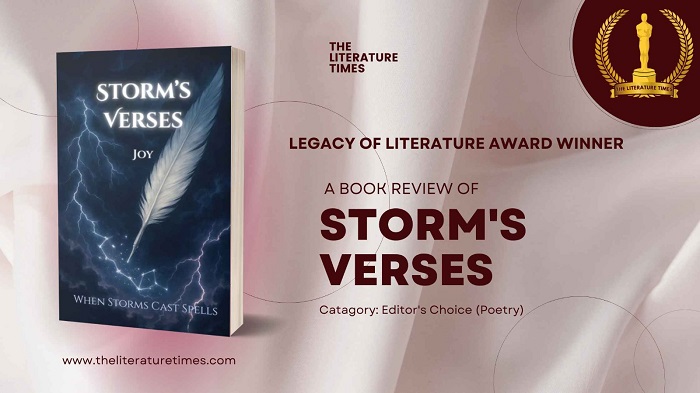
Storm’s Verses by JOY is not simply a poetry collection—it’s a celestial incantation, a riddle disguised as a storm, and a love letter written to the cosmos by a 16-year-old poet with an old soul and a galaxy-sized imagination. From the very first page, it becomes evident that this is no ordinary compilation of poems. Instead, it is a lyrical cartography of emotions, dreams, metaphors, and forgotten languages that chart an internal universe shaped by wonder, vulnerability, and myth.
The collection begins not with a whisper but with a birth—“the birth of a poet beneath stardust”—and from that point on, the reader is swept into a series of poems that defy linear storytelling. JOY crafts each verse as though it were an echo from a parallel realm or a spell cast in the twilight between dreaming and waking. These poems are layered, not just in meaning, but in texture. They feel aged yet alive, distant yet deeply personal. The voice behind the verses speaks like a messenger of otherworldly truths, carrying fragments of ancient lore in a tone that is reverent, fierce, and at times disarmingly tender.
What sets Storm’s Verses apart is its commitment to immersive world-building through poetry—a rare and ambitious undertaking. JOY doesn’t just write poems; he constructs an entire poetic mythology. With the inclusion of a fictional poetic language called Noctherin, he moves beyond metaphor into the realm of linguistic creation. The use of Noctherin is not gimmicky; it is subtly woven into the narrative as a sacred tongue of memory and prophecy. Though readers may not always understand its literal meaning, its presence deepens the mystical aura of the text and creates a sensation of encountering something ancient and powerful.
Despite the fantasy elements, the emotional core of this collection is unmistakably human. Underneath the layers of stardust and prophecy are themes that resonate on a deeply personal level: longing, loneliness, loss, transformation, identity, and the eternal search for meaning. Many of the poems deal with a quiet sort of grief—the grief of growing up, of letting go, of being unseen in a world that celebrates noise. JOY captures these feelings with heartbreaking clarity and poetic grace, turning them into lines that burn slowly into the reader’s consciousness.
Stylistically, JOY’s voice is a kaleidoscope of influences: there is the mythic tone reminiscent of classic epic poetry, the raw emotion of confessional poets, the structural playfulness of modern experimental writers, and yet, through it all, a distinctly original voice that is unmistakably his. His metaphors are fresh, often startling, yet intuitively right. In one verse, a heart may become a war-torn city; in another, time might be an ocean that forgets its waves. These images are not merely decorative—they are the machinery through which the poems function, carrying weight and meaning that go beyond surface aesthetics.
The pacing of the book is thoughtful. There is a rhythm to how the poems unfold—some brief and searing like lightning flashes, others sprawling like dream sequences that require surrender. This variation prevents the collection from becoming monotonous and encourages readers to explore at their own pace. Every poem feels like a door—some are slightly ajar, others require keys of intuition or emotion, but all of them promise some kind of transformation on the other side.
JOY’s age becomes an interesting lens through which to view the work, though it is not the defining feature. While it’s tempting to be awed by the depth of thought and craft coming from a 16-year-old, Storm’s Verses demands to be appreciated beyond the novelty of youth. The poet may be young, but the work is not juvenile. It possesses a maturity, a quiet conviction, and an awareness of human complexity that many adult poets struggle to reach. And yet, the collection never loses its youthful intensity—that earnest, untamed energy that makes the emotions more vivid, the questions more urgent, and the metaphors more daring.
One particularly striking aspect of the collection is its dialogue between chaos and clarity. The storm metaphor is a recurring anchor—sometimes violent, sometimes gentle, always alive. In JOY’s hands, the storm becomes more than a symbol of internal struggle; it becomes the very language of the soul trying to speak. To bleed ink, as the book suggests, is both an act of creation and destruction. The poems explore this tension constantly—how beauty can emerge from pain, how silence can carry sound, how loss can birth wisdom.
The book’s few flaws, if they can be called that, lie in its ambition. At times, the metaphors risk becoming too dense, the language too abstract, requiring multiple readings to fully grasp. For readers unfamiliar with poetic symbolism or fantasy-inflected literature, this may prove challenging. But these are the challenges of engaging with rich, layered art—not shortcomings. JOY’s poetry does not coddle the reader; it expects participation, reflection, and emotional investment. For those willing to engage deeply, the reward is immense.
Another subtle triumph of the book is its underlying current of hope. While the storm rages in many of the verses—through themes of war, isolation, and sorrow—there is always a glimmer of light, often found in the quietest moments. JOY does not offer easy resolutions or tidy endings, but he gestures toward healing, toward the idea that even the most chaotic storms contain the seeds of rebirth. There is power in the act of writing, of bleeding ink, and JOY seems acutely aware of that alchemy.
Storm’s Verses is more than a debut collection—it is a declaration of presence, a testament to the voice of a poet who stands at the crossroads of magic and memory, emotion and language. JOY has managed to do something rare: he has built a world that readers can not only imagine, but feel. His poems do not simply ask to be read—they ask to be felt, carried, and perhaps, lived.
In an age of noise, Storm’s Verses is a quiet thunder. It announces the arrival of a poet whose storm is only just beginning—and whose verses, already, demand to be remembered.