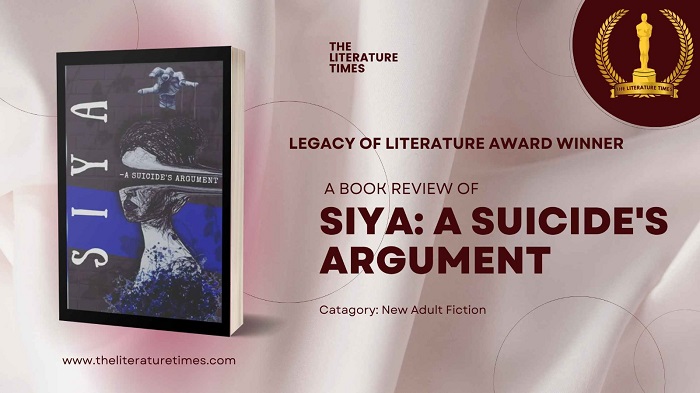
Siya: A Suicide’s Argument by Anjali Roongta is a raw, unflinching, and emotionally resonant novel that takes readers deep into the psyche of a young woman grappling with the aftermath of a suicide attempt. It is not a story about dying—it is a story about what survives. At once intimate and universal, the novel explores the aching gaps between appearances and inner reality, offering readers a profound meditation on mental health, trauma, and the silent battles that often go unseen.
The protagonist, Siya, seemingly has it all—an adoring partner, supernatural powers that set her apart, and a career marked by success. On the surface, her life gleams with perfection, but underneath lies a fractured self, weighed down by unresolved familial trauma and emotional exhaustion. When she wakes up in a hospital bed after attempting to take her own life, the illusion shatters. The story that unfolds from this moment is not one of spectacle but of quiet reckoning. Roongta invites the reader into Siya’s mind, unraveling layer by painful layer the experiences, thoughts, and inherited patterns that led her to that breaking point.
The novel’s structure is both linear and introspective. While the external timeline moves forward—from Siya’s hospitalization through her recovery—much of the narrative dwells in internal spaces: memories, reflections, mental spirals, and imagined dialogues. This dual movement allows Roongta to create a sense of claustrophobic immediacy while also slowly pulling back the curtain on Siya’s deeper wounds. There is no rush to resolution, no forced optimism. Instead, what emerges is a story rooted in emotional truth, where healing is non-linear, messy, and incomplete.
One of the most remarkable aspects of the book is its honesty. Roongta doesn’t sensationalize mental illness nor does she reduce it to cliché. Through Siya’s voice—sharp, vulnerable, often poetic—the reader is made to confront uncomfortable truths about how families can both nurture and destroy, how love can be present but still fail to save, and how survival can sometimes feel like a burden rather than a triumph. The narrative avoids the pitfalls of glorifying suicide or romanticizing suffering. Instead, it asks readers to sit with pain—to witness it without trying to fix it, erase it, or look away.
The writing itself is luminous in its precision. Roongta’s prose is often lyrical, with turns of phrase that feel both spontaneous and carefully crafted. Her background in poetry is evident in the rhythm and cadence of the text. Emotions are not merely described; they are felt, viscerally and intensely. At times, the language becomes jagged and broken, mirroring Siya’s fragmented mental state. At other times, it flows like a monologue delivered in the quiet stillness of a sleepless night. This stylistic range enhances the intimacy of the narrative and pulls the reader deeper into Siya’s inner world.
Another strength of the novel lies in its ability to handle heavy subject matter with a sense of nuance and restraint. It would be easy for a book like this to fall into melodrama or despair, but Roongta maintains a careful balance. There are moments of levity, glimpses of joy, and flashes of tenderness that punctuate the darkness. The presence of Siya’s partner is not rendered as a simple romantic trope but as a complex relationship that carries its own tensions, misunderstandings, and moments of profound connection. Love, in this story, is not a cure but a companion—one that walks beside pain rather than erasing it.
The supernatural elements—Siya’s powers—are a subtle yet significant layer of the narrative. They are not the central focus, but they serve as an allegorical extension of her inner world. These powers, extraordinary and awe-inspiring, come with their own burdens. They symbolize both the expectations placed upon her and the isolation she feels. In many ways, the magical realism enhances rather than detracts from the novel’s emotional grounding. It allows Roongta to explore questions of control, agency, and self-worth through a symbolic lens, making the internal struggles more vivid and relatable.
Family is another major theme in the book, and Roongta portrays it with painful clarity. Siya’s trauma is deeply intertwined with her familial relationships, particularly the unspoken wounds and generational patterns that she has inherited. These dynamics are portrayed not with judgment, but with complexity. There is no villain here—only people failing to understand each other, hurting and being hurt, loving imperfectly. This approach adds depth to the narrative, allowing it to speak to a broad spectrum of readers who may recognize their own familial entanglements mirrored in Siya’s story.
Despite the novel’s heavy themes, Siya: A Suicide’s Argument does not end in despair. Its resolution is quiet, reflective, and open-ended. There is no grand redemption arc or dramatic transformation. Instead, there is a slow, cautious return to self—a willingness to keep going, to keep asking questions, and to allow healing to take its own shape. The message is clear: survival is not about overcoming pain in a single moment, but about making the choice to live, again and again, even when it hurts.
The book is a powerful contribution to the growing canon of mental health literature in India. Too often, narratives of psychological struggle are either stigmatized or buried in silence. Roongta’s decision to center a protagonist who embodies both strength and vulnerability, brilliance and despair, is an act of radical honesty. It opens space for conversation, for empathy, and for recognition. Especially for young readers, this book may serve as a mirror and a lifeline, offering validation to those who have felt unseen or misunderstood.
In conclusion, Siya: A Suicide’s Argument is not just a novel—it is a courageous act of storytelling. Anjali Roongta has crafted a narrative that is both tender and unflinching, poetic and grounded, painful and, ultimately, quietly hopeful. It is a book that demands to be felt as much as read. For anyone who has ever wrestled with inner darkness, questioned the meaning of survival, or longed to be truly understood, Siya’s story offers not answers, but presence. And sometimes, that is the most powerful thing a book can give.