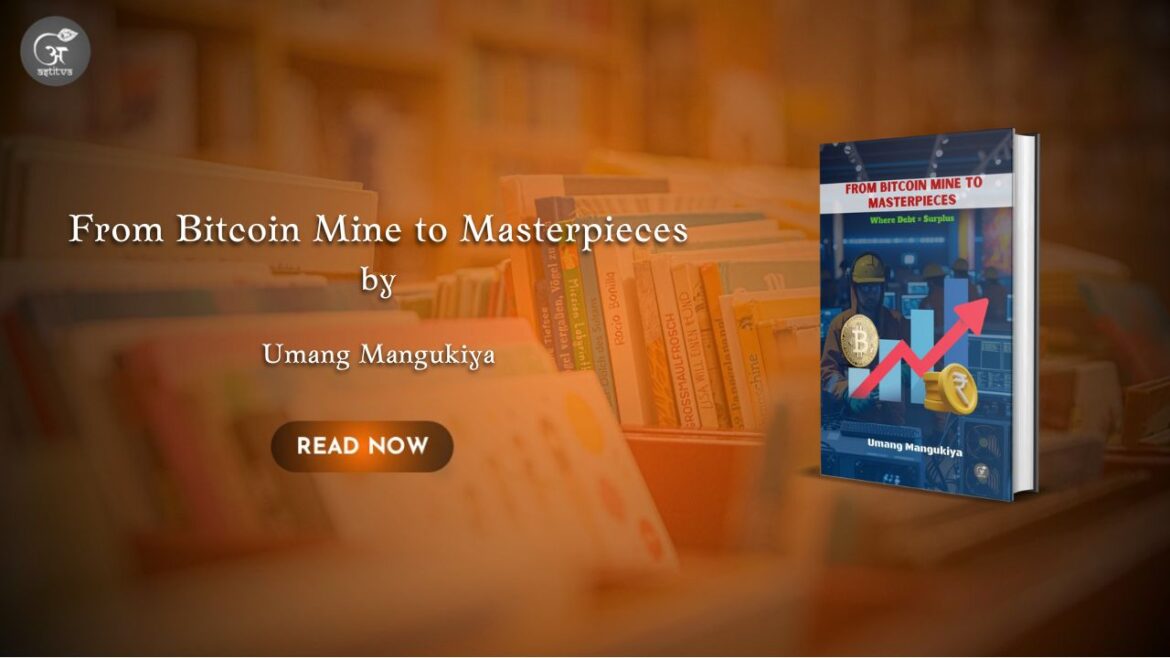
In the ever-evolving landscape of digital finance and value creation, Umang Mangukiya’s latest book, From Bitcoin Mine to Masterpieces, Where Debt = Surplus, emerges as a groundbreaking exploration of economic transformation in the 21st century. Far from being just another discourse on cryptocurrency or digital art, this work is a visionary redefinition of wealth, value, and surplus in the digital age. Mangukiya invites readers into a world where the traditional equations of economics are not just challenged, but reimagined. His central thesis—that “Debt” is not merely a liability but a form of latent energy waiting to be harnessed—offers a radical lens through which to view everything from blockchain to fine art.
The book opens with a deep dive into the mechanics of Bitcoin mining, illustrating how what many see as wasted energy or technical excess is, in fact, the raw material for modern economic alchemy. Through vivid metaphors and rigorous insights, Mangukiya demonstrates how Bitcoin mining acts as a societal engine—converting overlooked or stranded resources into economic surplus. Yet he doesn’t stop at the digital frontier. The narrative flows seamlessly from the hum of mining rigs to the quiet power of timeless masterpieces in art galleries, suggesting that the endpoint of this transformation isn’t merely financial, but cultural.
From Bitcoin Mine to Masterpieces proposes a new value chain, where volatility finds expression in beauty, and surplus—born of digital innovation—seeks its most enduring form in the artistic and the meaningful. It’s a book that connects technological ambition with aesthetic purpose, drawing a bridge between high-energy computation and high-human creativity. For Mangukiya, true wealth lies not just in what can be mined or traded, but in what endures and inspires.
What makes the book especially compelling is its blend of academic precision with philosophical depth. Mangukiya is not just offering a financial model; he is offering a worldview. He challenges readers to rethink the notion of debt—not as a burden, but as untapped potential. In this context, debt becomes the starting point of innovation, and surplus becomes more than a profit—it becomes a legacy.
As an author, Umang Mangukiya has already carved a niche for himself in contemporary Indian English literature, particularly among young readers and thinkers hungry for ideas that reflect the complexities of modern Bharat. His voice is both fresh and authoritative, balancing intellectual rigor with relatable narratives. With From Bitcoin Mine to Masterpieces, he continues this trajectory, bringing a uniquely Bhartiya perspective to global conversations on cryptocurrency, digital transformation, and the evolving meaning of value.
Mangukiya’s work resonates especially at a time when India is undergoing rapid digitization, positioning itself as a leader in the global digital economy. His insights draw attention to how Bharat’s own economic journey—from cash-heavy tradition to blockchain-backed future—might hold the key to redefining global economic models. The book serves as both a map and a mirror: a map of where we are headed in the digital value chain, and a mirror reflecting the untapped richness within systems we often dismiss as outdated or unproductive.
At its heart, From Bitcoin Mine to Masterpieces is a challenge—to economists, artists, entrepreneurs, and everyday readers. It asks us to see what others overlook. To recognize the value in what appears wasted. To turn instability into innovation. And to understand that the next frontier of wealth is not in accumulation, but in transformation.
In a single phrase, Mangukiya dares us to see the world anew: Where Debt = Surplus. This is not just a book—it’s a manifesto for the future.