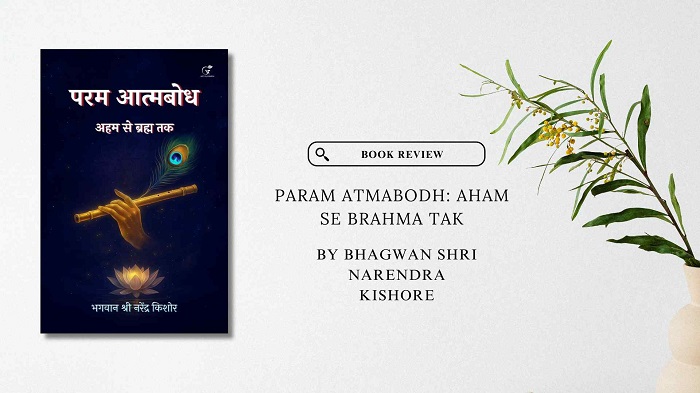
Param Atmabodh: Aham Se Brahma Tak by Bhagwan Shri Narendra Kishore is a profound offering for every spiritual seeker who wishes to experience the depth of Vedanta in its truest form, yet in a way that feels accessible and applicable to modern life. Unlike books that merely describe philosophy in abstract terms, this work is written from the living experience of self-realization. That makes all the difference, it is not intellectual speculation, but a reflection of direct awareness, a lived reality distilled into words with the intent of guiding others on their own journeys.
At its heart, this book is not just about spiritual concepts, but about a transformation of consciousness. From the very first page, it carries the gentle assurance that every question a seeker might have on the path from doubts, fears, and restlessness, to the yearning for peace and clarity can indeed find resolution. What stands out is the simplicity with which Shri Narendra Kishore communicates these lofty truths. The journey from “aham” (the sense of ego, the “I”) to “Brahma” (the infinite consciousness) is often described as the most difficult path one can undertake, yet here it feels approachable, as though a guiding hand is quietly but firmly leading the reader from confusion to clarity.
The beauty of Param Atmabodh lies in its balance between depth and simplicity. Vedantic texts are often revered but also feared for their complexity. Philosophical jargon, dense commentary, and abstraction sometimes leave seekers more perplexed than enlightened. However, this book does the opposite. It condenses the essence of the teachings into clear, relatable insights. The questions that naturally arise in every seeker’s heart “Who am I?”, “What is the purpose of my existence?”, “How do I transcend suffering?” are addressed without any intellectual heaviness, instead pointing the reader back to direct experience and inner stillness.
Reading this work feels less like studying a text and more like sitting in a satsang with a master who knows both the struggles of modern life and the timeless way out of them. Perhaps this stems from the author’s own unique journey. Shri Narendra Kishore does not come from the traditional mould of saints who were raised in ashrams or religious institutions. His early life was one of worldly success—an engineering degree from Mumbai University, an Executive International MBA from Russia, and professional roles in multinational companies. This makes his story particularly resonant for modern seekers, many of whom are navigating similar worlds of ambition, pressure, and discontent, yet feel a calling toward something deeper. His own shift from a life of external achievement to one of inner realization lends authenticity and relatability to his words.
In Param Atmabodh, the guidance offered is not limited to philosophical understanding. The book touches on the practical nature of spiritual evolution, devotion, meditation, and the cultivation of awareness. Instead of setting up spirituality as something distant and difficult, it reminds the reader that the highest truth is available in this very moment, waiting to be recognized. The writing is imbued with compassion; there is no sense of preaching or superiority, only the intention to share a treasure that has already been discovered within. For readers who often struggle with reconciling spiritual practice and daily life, this text can be a true companion.
What makes this book especially valuable is that it does not stop at presenting the “path.” It also illuminates the “goal.” Many seekers spend years engaged in practices without clarity on where they are headed or what realization truly means. Shri Narendra Kishore makes it clear that self-realization is not some vague mystical state but the recognition of one’s true nature as pure consciousness. This recognition dissolves restlessness, resolves existential doubts, and brings a sense of peace that is not dependent on circumstances. The book consistently points the reader back to this central truth, ensuring that spiritual seeking does not become a never-ending quest but a doorway to actual experience.
The language throughout is straightforward yet deeply evocative. The author does not rely on ornamental prose or excessive terminology. Instead, the words carry the weight of experience. This makes the book suitable for both beginners and advanced seekers. For those new to Vedanta, it provides a clear introduction without overwhelming them. For those already familiar with the teachings, it acts as a reminder to stop intellectualizing and turn inward toward direct realization.
Another strength of the book is its universality. Though rooted in Vedanta, its message transcends boundaries of religion or culture. The questions of identity, meaning, and truth are universal, and so are the answers presented here. Whether one comes from a Hindu, Christian, Buddhist, or secular background, the guidance resonates. In an era where spirituality is often fragmented into techniques, trends, and quick-fix solutions, Param Atmabodh serves as a grounding reminder of the eternal wisdom that has guided seekers for centuries, now expressed through the voice of a modern enlightened master.
The author’s mission is also worth highlighting. Beyond the pages of this book, Shri Narendra Kishore reaches seekers through his satsangs, his YouTube channel, and his social presence. His work is not about building a cult of personality but about ensuring that the light of self-knowledge is accessible to everyone who is sincerely ready. His reminder “When the seeker is ready, the Master appears” echoes the timeless truth that grace flows naturally to those who yearn for it.
Ultimately, Param Atmabodh: Aham Se Brahma Tak is not just a book to be read once and set aside. It is a companion to return to again and again, each time discovering new layers of meaning as one’s own inner journey unfolds. It offers not only intellectual clarity but also a taste of the peace and joy that comes from touching the essence of one’s own being. In a world where restlessness and confusion are so prevalent, this book shines as a beacon pointing to the inner stillness that lies within us all.
For any sincere seeker whether at the beginning of the path or nearing its culmination—this book is a priceless treasure. It bridges the ancient and the modern, the profound and the simple, the seeker and the realized. To read it is to be gently guided from “aham” to “Brahma,” from the noise of the ego to the silence of infinite truth.