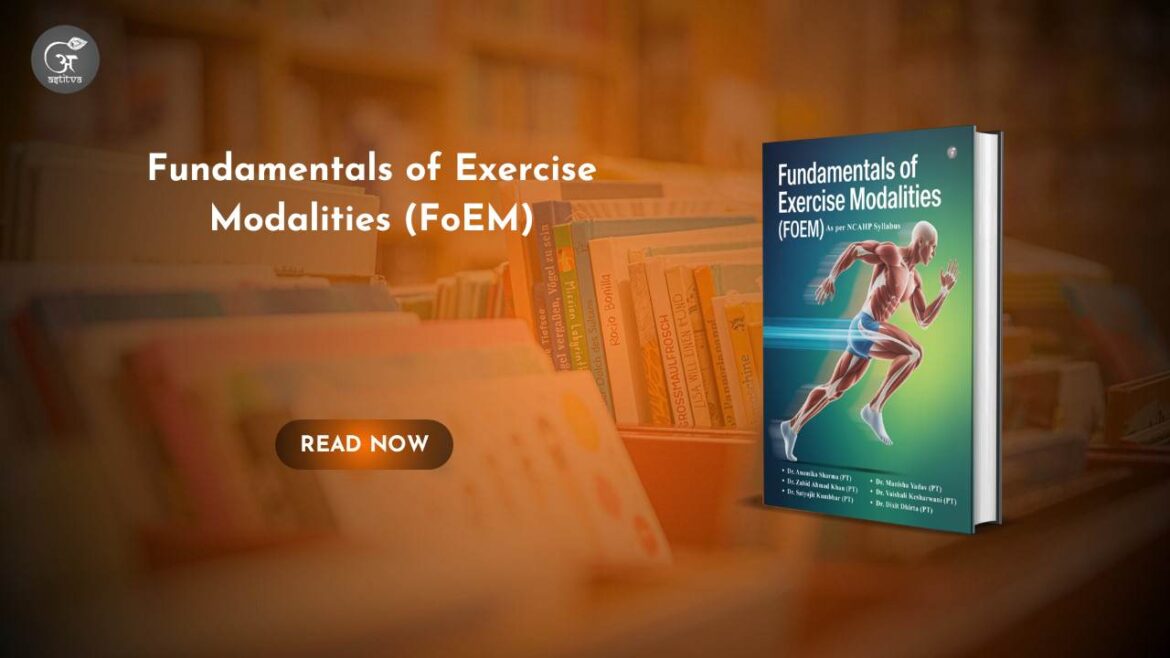
The discipline of exercise therapy stands as a foundational pillar of physiotherapy and rehabilitation—serving as both a science and an art in restoring, maintaining, and enhancing physical function across all age groups. Fundamentals of Exercise Modalities (FoEM) emerges as a comprehensive academic resource designed to align seamlessly with the syllabus for undergraduate physiotherapy students and allied health science learners, particularly those studying under the National Commission for Allied and Healthcare Professions (NCAHP) curriculum.
This meticulously structured textbook bridges the gap between theoretical understanding and practical application, empowering students with the essential knowledge required for effective therapeutic intervention. From the biomechanics of human motion to manual muscle testing and joint range measurement, the book takes readers through a progressive learning journey—each chapter building upon the previous to foster conceptual clarity and hands-on proficiency. With detailed explanations, stepwise techniques, and clinical correlations, the book ensures learners not only grasp the principles but also apply them with critical thinking and patient-centered focus.
What distinguishes Fundamentals of Exercise Modalities (FoEM) is its holistic approach—integrating classical methodologies with contemporary evidence-based practices. The content emphasizes the importance of demonstration, therapeutic rationale, physiological principles, and contraindications, helping students understand not just how to perform techniques, but why they are performed. The book also serves as a valuable guide for educators and clinical instructors, offering structured insights that promote consistent teaching and skill development in academic and clinical environments.
Behind this academic endeavor is a team of dedicated physiotherapy professionals and educators who bring diverse expertise and passion to the field.
Dr. Anamika Sharma (PT), Assistant Professor at Vedantaa Institute of Physiotherapy Sciences, Palghar, Maharashtra, specializes in Orthopedic Rehabilitation and is deeply committed to advancing clinical excellence through evidence-based interventions and mentorship. Her academic and clinical experience reflects a strong focus on musculoskeletal rehabilitation and patient-centered care.
Dr. Manisha Yadav (PT), Assistant Professor at People’s College of Paramedical Sciences and Research Centre, is a PhD scholar in Neurological Rehabilitation. Known for her innovative research, academic contributions, and evidence-based therapeutic techniques, she exemplifies leadership in neurological physiotherapy and education, striving to bridge research and clinical practice.
Dr. Zahid Ahmad Khan (PT), Assistant Professor at Mansarovar Global University, Bhopal, holds dual master’s degrees in Neuro- and Sports Rehabilitation, with a Fellowship in Osteopathy and Manipulative Therapy (FOMT) from IHC, Australia. His multidisciplinary background in zoology, neurophysiology, and sports rehabilitation strengthens his ability to integrate biological science with therapeutic techniques, shaping well-rounded healthcare professionals.
Dr. Vaishali Kesharwani (PT), Assistant Professor at People’s College of Paramedical Science and Research Centre, Bhopal, brings expertise in musculoskeletal rehabilitation, patient evaluation, and functional recovery. Her clinical experience, combined with a strong academic foundation, underscores her dedication to improving patient outcomes and advancing rehabilitation methodologies.
Dr. Satyajit Kumbhar (PT), Assistant Professor at BKL Walawalkar College of Physiotherapy, Sawarde, Chiplun, possesses nearly a decade of clinical experience and several years in academia. His focus on musculoskeletal physiotherapy and evidence-based management of both conservative and post-surgical conditions demonstrates his unwavering commitment to patient-centered healing and student mentorship.
Dr. Dixit Dhirta (PT), an accomplished Sports Physiotherapist and educator, contributes his expertise in sports medicine, biomechanics, exercise physiology, and manual therapy. His practical approach to teaching, rooted in real-world sports rehabilitation, equips students to meet the evolving demands of modern physiotherapy and athletic performance management.
Together, these authors have collaborated to create a resource that is both academically rigorous and practically relevant. Their combined expertise ensures that Fundamentals of Exercise Modalities (FoEM) will not only serve as a trusted academic companion but also as a professional guide for aspiring physiotherapists seeking to build confidence, competence, and compassion in their clinical practice.
The book stands as a testament to the evolving standards of physiotherapy education in India, aiming to inspire future practitioners to appreciate the profound connection between scientific precision and the empathetic art of healing through movement.