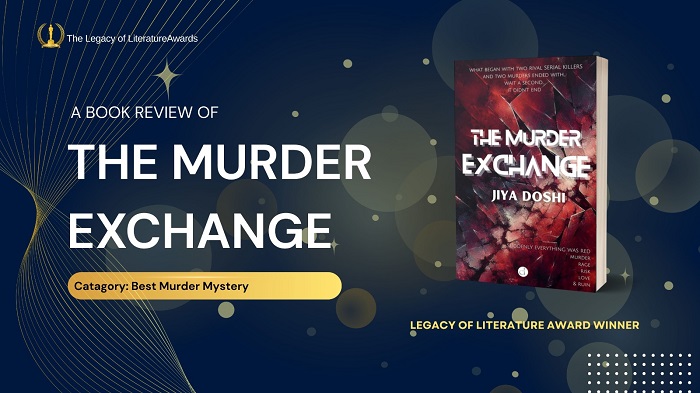
The Murder Exchange by Jiya Doshi, the novel built around Dalia and Bennett begins with an electrifying premise and wastes no time plunging the reader into a world of dark tension, fractured loyalties, and the unnerving proximity between guilt and innocence. From the opening declaration that the two protagonists had sworn never to cross paths again, the book immediately establishes the emotional weight of their reunion. The quoted passage—two knives hidden in their overcoats, their fingerprints already wiped clean—sets the tone for everything that follows. It is visceral, intimate, and unsettling, capturing the same blend of dread and fascination that defines the dynamic between the characters and shapes the world they move through. The author uses this moment as a narrative anchor, returning again and again to the question that haunts the story: How much trust can exist between two people bound by violence and suspicion?
The relationship between Dalia and Bennett is the beating heart of the book, and the author approaches it with impressive psychological nuance. Dalia’s perception of Bennett oscillates between fear, disgust, curiosity, and reluctant trust. His eyes, described with poetic specificity—“mocha brown” yet carrying the glint of murderous intent—embody the ambiguity that defines him. He is both familiar and frightening, a figure from her past who now stands as both her greatest threat and her only ally. This duality drives the tension forward, making every shared moment charged with emotional electricity. Bennett’s characterization is particularly effective because the narrative never fully commits to labeling him as villain or victim. This ambiguity not only sustains suspense but forces the reader to mirror Dalia’s own internal conflict, constantly evaluating whether he is manipulating her, protecting her, or guiding her deeper into danger.
The plot unfolds over a tightly compressed five-day period, a structural choice that infuses the narrative with a palpable sense of urgency. The ticking clock device is used not as a gimmick but as a natural extension of the stakes the characters face. They are fugitives who must solve a puzzle of murder, betrayal, and buried secrets before time runs out. Each day presents new layers of threat—old friends who can no longer be trusted, enemies who emerge with chilling familiarity, and mysteries tied to unsolved crimes that neither protagonist can fully escape. The pacing is brisk without feeling rushed; every chapter deepens the story’s complexity, pushing Dalia and Bennett into increasingly dangerous scenarios where survival depends on instinct as much as intellect.
One of the book’s standout strengths is its atmosphere. The world the characters inhabit feels like a labyrinth of shadows—alleyways that echo with unseen footsteps, abandoned buildings holding traces of past violence, and crowded city spaces that mask danger behind anonymity. The writing is cinematic yet controlled, never devolving into melodrama. Instead, the author uses sensory details with precision, painting scenes that are easy to imagine but difficult to escape. This atmospheric density mirrors the protagonists’ psychological state: suffocated by the past, hunted in the present, and uncertain of the future.
Thematically, the novel explores the fluid boundary between moral rightness and moral compromise. Dalia is thrust into an ethical quagmire, forced to question her instincts and reconsider her understanding of innocence. Her partnership with Bennett becomes a test of integrity as well as survival. The author deftly illustrates how trauma reshapes memory and decision-making, and how shared danger can forge a bond as powerful as it is unhealthy. Their alliance is not romanticized; even moments of connection are tainted with mistrust. That tension creates an emotional unpredictability that keeps the reader invested, wondering not only what will happen next but how these two damaged individuals will respond to each new threat.
The supporting cast of friends-turned-foes and newly introduced antagonists adds depth to the story, though at times their motivations feel purposely obscured to maintain mystery. While this technique sustains suspense, some readers may wish for more development of secondary characters whose involvement in the central plot could have been enriched. Nevertheless, the ambiguity surrounding these figures contributes to the book’s central theme: no one in this world can be trusted completely, not even the protagonists.
The prose itself is sharp and evocative, especially in moments of introspection or confrontation. Dialogue is crisp and often layered with subtext, revealing as much through silence as through spoken words. The author demonstrates a strong command of rhythm and tone, shifting seamlessly between violent action, tense exchanges, and reflective passages that explore the psychological wounds shaping the characters’ decisions. The narrative voice is confident and unflinching, refusing to shield the reader from the brutality of the world it depicts.
As the story barrels toward its climax, the sense of tightening danger becomes almost suffocating. The metaphorical noose referenced in the synopsis is not simply a device describing their legal peril—it reflects the tightening psychological pressure, the narrowed paths of choice, and the inescapable confrontation with truths they have both avoided. The final act delivers on the tension it has meticulously built, offering revelations that feel earned and leaving the reader with a lingering blend of satisfaction and unease.
Ultimately, this novel succeeds as a dark, fast-paced thriller that interrogates the nature of trust and the weight of shared history. It is a story that grips the reader from the first ominous reunion and refuses to let go, weaving danger, emotion, and ambiguity into a tale that is as haunting as it is compelling. Without relying on clichés or predictable turns, the author crafts an experience that feels intense, immersive, and driven by characters whose flaws are as compelling as their strengths. In the crowded field of crime thrillers, this book stands out for its psychological depth, atmospheric writing, and its willingness to explore the perilous territory where fear and dependency entwine.