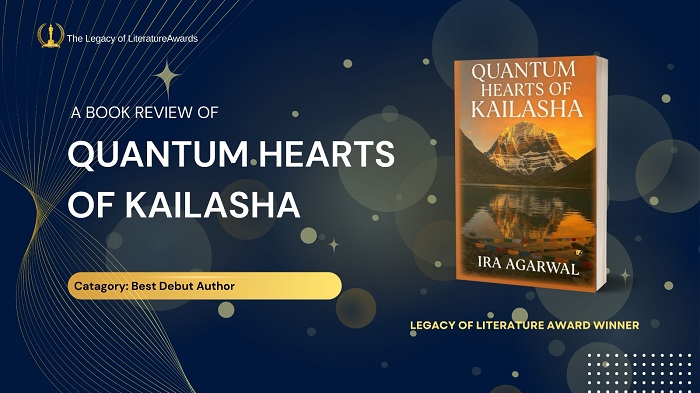
Quantum Hearts of Kailasha is an evocative and ambitious work that blends quantum philosophy, spiritual mythos, and human emotion into a narrative that feels at once intimate and cosmic. The novel positions itself within the growing genre that seeks to harmonize science with mysticism, but what distinguishes it is the tenderness and depth with which it approaches themes of reincarnation, destiny, and the timelessness of love. At its core is Alex, a young American whose arrival in India sets off a chain of events that defy rational explanation while pulling him—slowly and irrevocably—into a spiritual mystery spanning generations. The premise might seem abstract on the surface, but the storytelling remains grounded in the emotional journeys of its characters, who navigate a world where visions, memories, and energies intermingle in ways both wondrous and unsettling.
The novel’s structure, told through the reflective voice of a civil servant and father, is one of its most compelling choices. The narrator brings not only an observational clarity but a human vulnerability that makes the unfolding cosmic revelations feel personal rather than esoteric. This lens allows the reader to be guided gently through complex ideas—quantum entanglement, reincarnated bonds, the interplay of Shiva and Shakti—without feeling overwhelmed. The narrator’s own evolving understanding mirrors the themes of awakening that permeate the book, making the experience immersive for the reader.
The plot begins simply enough: Alex’s visit to India with a friend. But simplicity quickly unravels when an elderly man, Baju, recognizes Alex as spiritually connected to his missing daughter, the enigmatic “Alien Girl.” This moment is the hinge on which the entire narrative swings. From that point onward, the story transforms into a layered journey through some of India’s most spiritually charged landscapes—Delhi’s chaotic energy, the mystical enclave of Amarkund, the ancient sovereignty of Kashi, and the transcendent silence of Mount Kailasha. These settings are not mere backdrops; they act as energetic nodes that mirror the characters’ inner transformations. The author captures them with vivid detail, weaving together the physical and metaphysical textures of each place.
The spiritual revelations that unfold throughout the journey are handled with lyrical restraint. Rather than adopting a didactic tone, the book allows its mysticism to seep through journals, visions, rituals, and fragments of ancestral memory. The characters do not experience enlightenment as sudden bursts of knowledge but as gradual, layered realizations. This is especially true for Alex, whose identity becomes increasingly difficult for him to define. Is he merely a traveler swept into a stranger’s grief, or is he a reincarnated soul destined to complete an unfinished story? The novel does not give easy answers, and that ambiguity is part of its emotional power. Alex’s struggle between doubt and spiritual resonance becomes a mirror for any reader navigating questions of identity, purpose, and the unseen patterns that shape their lives.
One of the book’s great successes is its handling of the relationship between science and spirituality. Quantum theory is not forced awkwardly into the narrative; instead, it becomes a poetic metaphor for the invisible bonds that draw souls together. Ideas like entanglement, multidimensional consciousness, and parallel timelines are invoked not to showcase intellectual cleverness but to deepen the emotional stakes. When the novel suggests that love transcends logic or that consciousness travels beyond the limits of the body, these ideas feel earned because they are embedded in the characters’ lived experiences. The author’s ability to translate abstract theories into emotional truths is one of the book’s most impressive achievements.
The emotional core of the book resides in the relationships—between Alex and the missing girl he has never met but somehow feels, between Baju and the daughter he yearns for across spiritual planes, and between the narrator and his own children, whose futures he begins to perceive as threads woven into a much larger cosmic tapestry. The idea that families, lovers, and soul-groups find each other across lifetimes is presented with sincerity, avoiding sentimentality while still evoking a profound sense of connection. The novel’s portrayal of love is not limited to romance; it includes parental devotion, ancestral loyalty, and the mysterious pull of karmic ties.
The climax at Mount Kailasha is particularly powerful, bringing together the novel’s thematic threads with emotional clarity. Kailasha, revered as the axis mundi—the spiritual center of the universe—serves as the perfect setting for the characters’ ultimate confrontation with destiny. The scenes here blend natural grandeur with metaphysical revelation, offering insights that feel both ancient and freshly imagined. The moment when the characters realize they are not simply observers but active participants in the cosmic dance gives the novel its philosophical and emotional peak.
If there is a critique to be made, it is that the novel occasionally leans heavily into its mystical language, which may distance readers seeking a more grounded or linear plot. Yet for those willing to surrender to its poetic cadence, this quality becomes part of its allure. The narrative’s fluidity reflects the very themes it explores: the dissolution of boundaries between past and present, science and spirituality, self and cosmos.
Ultimately, Quantum Hearts of Kailasha is less a conventional novel than an invitation—a call to consider the possibility that love, consciousness, and destiny flow through life in ways that defy logic yet resonate deeply within the human heart. It is a beautifully imagined spiritual epic that lingers long after the final page, urging readers to look beyond the seen and into the shimmering potentials of the universe.