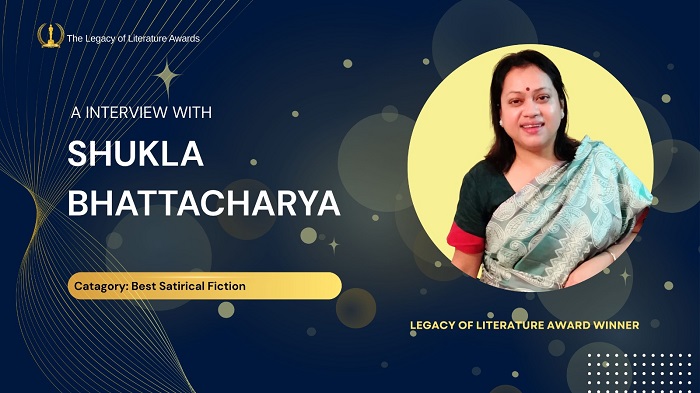
Shukla Bhattacharya is a reflective and deeply philosophical writer whose work blends personal memory, spiritual inquiry, psychological depth, and cultural observation. Her narrative voice moves effortlessly across continents, ideas, and emotions—bringing together lived experiences, introspection, and the subtle textures of human relationships. Through her distinctive style, she explores identity, belonging, love, loss, and the universal search for meaning.
The Literature Times: Your writing seamlessly weaves personal experiences with philosophical reflections. How did this narrative style evolve for you?
Shukla Bhattacharya: I’ve always been fascinated by the way a single moment can spark a whole line of thought—like a pebble creating ripples across a still pond. Early on, I kept a journal not just to record what happened, but to ask myself why it mattered. Those little “why” questions turned everyday events into tiny case studies, and over time I started to notice patterns: a missed bus that led to an unexpected conversation, a rainy day that reminded me of impermanence, and so on.
When I began writing more seriously, I deliberately paired those vivid snapshots with the broader questions they raised. I’d start with a concrete scene—say, the smell of rain on hot pavement—then linger on the feeling it evoked and ask what that says about longing, change, or presence. Practicing that back‑and‑forth in drafts helped the two threads feel less forced and more like a natural conversation between the self and the world.
Reading philosophers who write in a personal voice (think Camus’s essays or Søren Kierkegaard’s “Either/Or”) reinforced the idea that philosophy isn’t just abstract theory; it lives in lived experience. So, my style is really the result of habit (journaling), intention (pairing scene with reflection), and influence (authors who blend the two).
The Literature Times: Many sections in your book revisit childhood memories and cultural bonds. How important was nostalgia in shaping this work?
Shukla Bhattacharya: Nostalgia played a significant role in shaping this work. Revisiting childhood memories and cultural bonds allowed me to tap into a sense of authenticity and vulnerability. It’s like looking at an old photograph – you recall not just the event, but the emotions and people involved.
In writing, nostalgia became a tool to explore identity, community, and the passage of time. Childhood memories, in particular, offered a rich source of material, as they’re often tinged with a sense of wonder and curiosity. By revisiting these moments, I could examine how cultural traditions, family dynamics, and personal values were formed.
Nostalgia also helped me navigate complex emotions and experiences. It wasn’t about romanticizing the past, but rather understanding how those early influences continue to shape us. By embracing nostalgia, I could craft a narrative that’s both personal and relatable, allowing readers to reflect on their own experiences and connections. In a way, nostalgia became a bridge between the past and present, enabling me to explore themes that are universal, yet deeply personal.
The Literature Times: You explore themes of identity across religions, geographies, and human emotions. What inspired this cross-cultural introspection?
Shukla Bhattacharya: Exploring identity across different contexts is like trying to map the ocean – the deeper you go, the vaster and more interconnected it becomes. Growing up in a multicultural environment, I was exposed to various traditions, stories, and ways of seeing the world. This diversity sparked my curiosity about how people’s identities are shaped by their cultures, beliefs, and personal histories.
Travel, conversations with strangers, and even moments of feeling like an outsider in unfamiliar places added layers to this curiosity. I began to notice how identity isn’t static; it shifts with context, relationships, and time. Whether it was attending a Diwali celebration in India or a friend’s church service in another country, I saw how rituals, food, language, and shared experiences create belonging – and sometimes, friction.
Writing became my way to unpack these observations. I wanted to explore how identity is both inherited and chosen, how it’s rooted in geography yet floats across borders, and how it’s expressed differently in public and private spaces. The goal wasn’t to resolve contradictions but to embrace them – to ask, what does it mean to belong?
The Literature Times: The book moves through intense emotional landscapes—love, longing, loss, and rediscovery. Which emotion was the hardest to write about?
Shukla Bhattacharya: Writing about loss was the toughest for me. When I sit down to put grief on the page, the words feel fragile—like any wrong turn could shatter the scene entirely. I found myself lingering on the small, almost‑imperceptible moments—a forgotten scent, the echo of a laugh that’s no longer there—and I had to keep reminding myself that it’s okay to let the silence sit there.
The challenge was balancing raw honesty with a sense of narrative shape. I didn’t want the chapter to become a lament; I wanted it to carry the reader through the ache toward a quiet kind of acceptance. That required multiple drafts, a lot of reading aloud, and, honestly, a few late‑night walks where I let the emotion wash over me without trying to capture it immediately.
In the end, confronting loss on the page taught me that vulnerability isn’t a weakness—it’s the bridge that lets readers step into the same emotional landscape.
The Literature Times: Travel appears not just as a physical journey but as a spiritual one. How have your international experiences influenced your worldview?
Shukla Bhattacharya: Travel has been a quiet teacher for me—each border crossed, each language stumbled over, a reminder that “home” is more a feeling than a place.
– Seeing the common thread – In a bustling market in Toronto, a food court in Tripoli, or a quiet café in Copenhagen, I’ve watched people share the same hopes, fears, and laughter. Those moments dissolved the “us‑vs‑them” narrative and replaced it with a sense of shared humanity.
– Embracing uncertainty – Navigating a train that seldom seemed to arrive on time in India taught me to sit with discomfort. Instead of fighting the delay, I learned to let the minutes stretch, to notice the scenery, the conversations, the inner chatter. That patience has become a lens through which I view everyday challenges back home.
– Rituals as portals – Participating in a sunrise prayer at a temple in Singapore, an Iftar in the Kingdom of Saudi Arabia, or a simple sunset walk by the Mediterranean Sea showed me how rituals anchor us to something larger. They reminded me that spirituality isn’t confined to a building; it’s woven into the rhythm of daily life wherever we find ourselves.
– The inner map – Every new city added a layer to my internal map—not just geographic coordinates, but emotional coordinates: curiosity, humility, awe, and sometimes, a touch of loneliness. Those layers now guide how I approach relationships, work, and the stories I tell.
In short, traveling abroad has shifted my worldview from “I have the answers” to “I’m constantly learning to ask better questions.” It’s a spiritual compass that points me toward openness, wonder, and a deeper connection to both the world and myself.
The Literature Times: The characters you describe—real or symbolic—carry deep psychological layers. How do you approach writing such inner complexity?
Shukla Bhattacharya: I start by anchoring each character in a single, vivid desire—something they must have, whether it’s love, recognition, or redemption. From that core, I map out the internal obstacles that keep them from getting it: fears, past wounds, contradictory beliefs.
To give them depth, I blend two habits:
– Observation: I borrow quirks and reactions from real people (a nervous habit, a way of laughing) and try to interpret them so as to make the trait symbolic of a larger theme.
– Symbolic resonance: I ask, “What larger idea does this person represent?”—perhaps a character who never sits still embodies restless modernity, while a quiet caretaker reflects quiet resilience.
I then layer the narrative, letting the symbolic meaning surface gradually through actions, dialogue, and small internal monologues, so the reader discovers the psychology alongside the story.
The Literature Times: Silence, introspection, and inner conflict are recurring motifs. What role does solitude play in your creative process?
Shukla Bhattacharya: Solitude is the quiet stage where the noise of everyday life fades, letting the inner dialogue take centre‑stage. In those still moments I hear the faint echo of a memory, the half‑formed question that fuels a scene, and the subtle tension between what a character says and what they truly feel.
– Listening to the subconscious: Without distraction, stray thoughts surface and become the raw material for conflict and introspection.
– Shaping the silence: I often (not always though) write with a soft background hum—rain, a distant train—so the page feels as quiet as the room I’m in.
– Balancing tension: Solitude lets me sit with more comfort than discomfort, turning inner conflict into something that can breathe on the page rather than be rushed away.
In short, solitude isn’t just “being alone”; it’s the fertile pause that lets the motifs of silence, introspection, and conflict grow into something tangible.
The Literature Times: You frequently reference music, art, literature, and spiritual traditions. Which influences shaped your creative identity the most?
Shukla Bhattacharya: Music, art, literature and spirituality have all been my compass points, but three stand out most sharply:
– Music – The melody, rhythm, lyrics of Bollywood songs; the emotional resonance of Christmas carols; the timeless themes, the blend of poetic and captivating expressions of Ghazals; and the meditative cadence of Indian ragas taught me how to let a story breathe, often dictating the rhythm of a scene before the words even appear.
– Literature – Poets like Rabindranath Tagore, William Wordsworth, T. S. Eliott Emily Dickinson and the existential musings of F. Scott Fitzgerald showed me that philosophy can live inside a character’s heartbeat, turning abstract ideas into lived experience.
– Spiritual traditions – Practices from Buddhist Mindfulness, Sikh Naam Japo, Christian Thanksgiving, to Hindu Bhakti gave me a framework for silence and inner conflict, helping me map the quiet spaces between dialogue.
Together they shape the way I hear, see and feel the world, and they inevitably find their way onto the page.
The Literature Times: Some parts of the book feel like a dialogue with the self or an unseen listener. Who were you writing to—or writing for?
Shukla Bhattacharya: Writing felt like a conversation with a few different “listeners” at once.
First, I was talking to myself—trying to untangle the memories and emotions that kept looping in my head. Putting them on the page gave those inner voices a shape I could see and, eventually, understand.
At the same time, I imagined a quiet, unseen listener: someone who’s ever sat alone with a cup of tea, watching the rain, and wondered about the gaps between what we say and what we feel. I wanted that person to feel less alone, to know that the silence can be a place of discovery.
Finally, I wrote for the reader who might find a fragment of their own story in the pages—a fellow traveller in the messy, beautiful journey of identity, loss, and rediscovery. The dialogue on the page is really a bridge between my inner world and anyone willing to sit with it for a while.
The Literature Times: What core message or emotion do you hope readers carry with them after finishing this book?
Shukla Bhattacharya: I’d love readers to finish “Survival of the Stupidest and other Anecdotes” feeling a mix of wonderful absurdity and quiet resilience—the sense that even the most ridiculous moments can teach us something about ourselves; that love and unity aren’t just feel‑good slogans—they’re the only real antidote to hatred and division. The stories aim to stir a “thinking mind” that’s brave enough to pursue a higher, more peaceful order of things. So, the core emotion I hope lingers is hopeful optimism, a quiet confidence that even in a world riddled with prejudice we can choose compassion, keep questioning, and work toward that “hard‑earned paradise” of benevolence and concord.