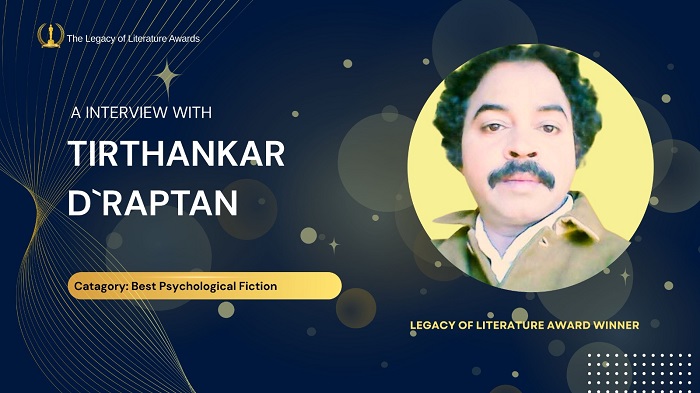
Tirthankar D`Raptan is a contemporary fiction writer whose work explores the fragile landscapes of guilt, memory, and redemption. Known for delving into the emotional undercurrents that shape ordinary lives, the author brings a quiet intensity to storytelling. In PENANCE, they craft the haunting psychological journey of Abhirup Mallick—an unemployed aspiring actor tormented by remorse for neglecting his ailing mother. Through Abhirup’s unexpected encounters, acts of compassion, and confrontation with his own past, the author examines the human capacity for self-forgiveness and transformation. Their writing is deeply introspective, empathetic, and rooted in the complexities of real life.
The Literature Times: PENANCE revolves around remorse and emotional paralysis. What first inspired you to explore guilt as the central theme of the novel?
Tirthankar D`Raptan: Time has spread its colourfl wings in such a way that now very few people want to refrain from flying themselves and remain confined to a traditional life, especially for those who have met people in the world of fame. As a result, family disharmony has emerged. As a result, the families that are financially and socially poor are affected miserably, in such families those who are dependent on other family members due to age or physical reasons, suffer the most. Seeing this suffering with their own eyes and the constant effort to get out of the traditional life, and as a result the increasing disharmony in the family, many poor creative people become guilt-inflicted. I have made this subject the central theme of the novel to explore this guilt. As a child, I saw this kind of guilt among poor artists and singers. This sense of guilt can be observed even among the most ardent spiritual people who, in the desire to meet God and to ensure heaven, have detached themselves from all family responsibilities and devoted themselves entirely to the thought of God. Later, I saw the presence of this type of guilt among failed, unemployed, poor actors and other people in the creative world as well.
The Literature Times: How did you shape the character of Abhirup Mallick, a man torn between ambition, poverty, and moral responsibility?
Tirthankar D`Raptan: Abhirup Mallick is a symbol of countless poor, creatively unsuccessful people. If you go to the homes of unknown actors, writers, poets, painters, singers, or many sportspersons, you will see many such Abhirup Mallicks. They are running forward with all their mental strength, pushing aside moral responsibility in the face of extreme poverty. When they are losing their performance and physical strength due to misfortune, they are struggling with their memories and guilt inflicted and are struggling with extreme mental pain. Some are trying their best to get rid of this guilt through various charitable works. When Abhirup Mallick sees the talent and success of others and tries to define himself, he feels that he is a very talented and hardworking person, but he is troubled by his misfortune, which is almost always seen in the case of financially and socially poor talented people. His work has a spirit of creativity. He believes it is possible to find true spirituality in creativity—true salvation through creativity. He is a frustrated person, very disappointed about his life because even at such an age, he could not get married and start a family, due to poverty. He is not a person of the mindset of casual love and casual company of women. It is a kind of his family philosophy. Overall, it can be said that creativity is more important to Abhirup Mallick than sex and that is why he does not spend money on sex but on creativity. Another characteristic of his is that he cannot trust any girl because he has seen that girls either want financial security or a man who is their equal or more established than them to give them as their real-life love interest. Since he is a very poor unemployed man, he cannot be a candidate for the love of girls. He feels that the intense desire to love a creative person that he had seen in girls as a boy is no longer seen today. That’s why he keeps himself away from women, lest they find out about his financial situation and lose the respect he gets from them.
The Literature Times: The tension between siblings and parental favoritism plays an important role. Why was family dynamics essential to this story?
Tirthankar D`Raptan: The reason for Abhirup Mallick’s separation from his family is the selfishness of his siblings and his father’s greater trust in his siblings than him. As a result, they tried to do various businesses and incurred extreme losses and imposed all the debts on their parents. His father sold all his property and paid off their debts and got rid of the public humiliation and as a result, there is no such thing as family property, which would have made Abhirup’s path much easier. Therefore, it can be said that Abhirup’s frustration due to financial hardship is due to his parental favouritism; the relatively neglected members of the family are often in extreme financial hardship due to its efforts. It is very natural for Abhirup to be intolerant towards his siblings because when all the siblings for whom his parents have lost everything, they do not do their duty to their parents despite having financial means and as a result, when the responsibility of taking care of the parents falls on the unfavourite child like Abhirup, then an unemployed person like Abhirup is expected to react negatively. It is not uncommon for person like Abhirup to lose their temper while chasing after their dreams the financial responsibilities of the family fall on them, so parental favouritism and filial duty are closely related, and since this is one of the points of the novel, I have tried to explain it with great importance. Since Abhirup’s siblings caused a terrible financial disaster to the family and it can be assumed that as a result of this, his father died prematurely and his mother became paralyzed and had lost the ability to speak while she was thinking about the future of her children and died tragically without treatment due to financial hardship, therefore sibling rivalry and parental favouritism are important themes in this story.
The Literature Times: Abhirup’s injuries trigger his introspection. What symbolism did you intend behind his physical suffering?
Tirthankar D`Raptan: To me, the crucified Jesus is not a symbol of any theistic religion but suffering urging humanity. It is the embodiment of the most terrible physical pain inflicted by fate. And the only way to truly feel this terrible pain is to feel the physical pain of others, and as a result, the urge to relieve the inhuman physical pain of other people and animals comes naturally. Therefore, symbolism had to be brought in to convey the extent of Abhirup’s terrible physical pain and his intention to try to relieve others from such pain. Apart from this, I have used some other symbolism, including some symbols from natural world, to illustrate how intense Abhirup’s physical pain is.
The Literature Times: The hospital becomes a turning point in the narrative. Did you draw on personal observations or research to portray these scenes so vividly?
Tirthankar D`Raptan: I had to go to a hospital for several days for personal reasons, but writing PENANCE didn’t even occur to me at that time, but I observed hospital life very closely, which drove me to write the novel within a few days.
The Literature Times: The abandoned elderly man deeply affects Abhirup’s conscience. What does this character represent in the broader moral landscape of the book?
Tirthankar D`Raptan: The abandoned elderly man is a symbol of unemployed poor parents who are neglected and abandoned by all their children due to old age and physical disability. Therefore, he is a living symbol of Abhirup’s dead mom in front of him, he repeatedly reminds him of the helplessness and pain in which his mother died. The old man and his agony, his helplessness, are also a prognostication of Abhirup’s impending future.
The Literature Times: Guilt often leads people into self-destruction, but Abhirup’s journey suggests the possibility of redemption. What message do you hope readers take away?
Tirthankar D`Raptan: Choosing the path of self-destruction is a sign of extreme mental weakness and these people have very low self-reliance and the struggle that a class of people go through every day just to survive is not seen in these self-destructive people. Abhirup is almost a middle-aged man, he has been struggling with poverty almost his entire life, despite extreme financial hardship, he has awakened his innate artistic qualities and aspirations through his proper practice. He is seen controlling another age-related emotion, despite the sexual advances around him, he tries to keep himself away from them because for him, sexuality is an economic responsibility and he is not yet willing to take it because of giving priority to his other qualities. Such restrained people do not choose the path of self-destruction even if they feel guilt for some reason. They try to make this personal guilt a matter of creation, whether it is through some creation or by relieving someone’s pain. This kind of people seek redemption creatively. I would like to tell my readers that the failure of individual life, the attempt to dissolve it through self-destruction is completely a wrong way, the chaos of a great creation, so socially reprehensive; they must come out of the trap of such thoughts and find solace in some creation. The true direction is to benefit someone, and it is also a creation, rather it can be said that the best creation is to come out of the trap of these thoughts and find solace in some creation.
The Literature Times: How do you view the relationship between ambition and neglect, especially in Abhirup’s choice to chase acting instead of supporting his mother?
Tirthankar D`Raptan: Ambition and neglect play very closely here, complementing each other. Poor and socially underprivileged people do not run after their ambitions. When they run after their ambitions from such socio-economic conditions, they have nothing to do but neglect their family duties, which almost always leads to tragic consequences in both cases. Because neglecting family duties and running after ambitions does not fulfill ambition. For this, it is necessary to have the ability to manipulate others, the ability to understand the situation and enter into it to achieve one’s own interests. The mentality and prudence of Abhirup are none of these.
The Literature Times: The novel blurs the lines between psychological reality and emotional memory. How did you approach writing these introspective moments?
Tirthankar D`Raptan: What I saw and how I reacted to people of all ages, from different walks of life, from different professions, all these are my personal experiences, my psychological reality, my emotional memories, which always seem to float before my eyes, some make me feel terrible.. So when I sat down to write PENANCE, they appeared in front of me one by one, they penetrated my entire body and made their presence known, which made it much easier to finish the novel in an acceptable way.
The Literature Times: If PENANCE were adapted into a film, what aspects of Abhirup’s inner life would you most want preserved on screen?
Tirthankar D`Raptan: If PENANCE were adapted into a film, I would most want to preserve the mental anguish of Abhirup’s failure to fulfill his filial duty to his paralyzed mother, the mental exhaustion of his failure to succeed in life due to his poverty, the mental exhaustion of his failure to be known as an actor despite giving his best performance and his hard work and valuable time. The shooting of one film after another not being completed and the extreme disappointment of being forever ignored as a casual amateur actor due to the non-release of the films, the prolonged monotony of his life without a life partner due to poverty and above all the terrible suffering of his extreme physical pain and the experience of seeing this pain in his hospital roommates and the mental anguish of not being able to fulfil his filial duty to his helpless mother and the voluntary efforts to free a helpless old man from the extreme pain to atone for ever haunting guilt. These are the main focal points to be preserved on screen. And finally, one more thing to mention here, Abhirul Mallick is not a saintly monk, has a strong desire to have any girl as his life partner. I have shown this by liking to see a young girl named Neha Shukla and getting lost in the world of thoughts with her. I would want to flash this side of him a little bit.