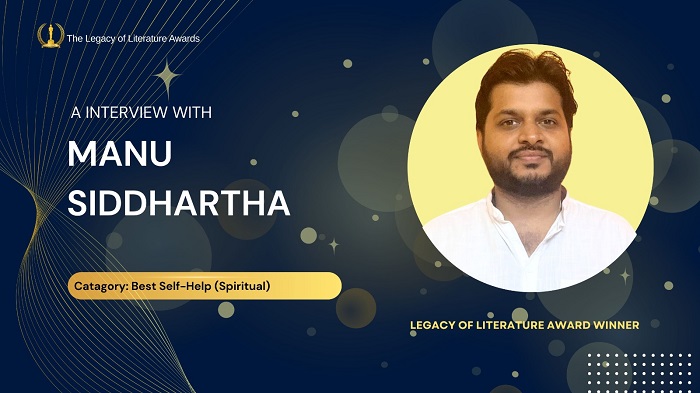
Manu Siddhartha is a dedicated storyteller and spiritual researcher with a passion for making ancient Indian wisdom accessible to the modern reader. With a deep reverence for Hindu scriptures and a gift for simplifying complex philosophical ideas, the author brings clarity, insight, and warmth to traditional narratives. In Shiv Puran Unlocked, they reimagine one of Hinduism’s most profound texts, distilling its timeless teachings into an engaging and approachable exploration of Lord Shiva’s divine stories, symbolism, and spiritual philosophy. Their mission is to bridge the gap between tradition and modern understanding—inviting readers of all backgrounds to experience the transformative power of Shiva’s cosmic wisdom.
The Literature Times: What inspired you to reinterpret the ancient Shiv Puran for modern readers?
Manu Siddhartha: The inspiration came purely from Lord Shiva’s grace. My personal transformation while reading the original Shiv Puran was deeply moving. I felt immense peace, clarity, and spiritual grounding. I realized that many people, especially the youth, are curious about Sanatan Dharma but struggle with complex texts. That’s when I decided to simplify the Shiv Puran with guidance from my Guru Maharaj Swami Purushottamanand Ji. It became my way of serving Shiva and making His divine stories more accessible.
The Literature Times: How did you approach balancing accuracy to the original text with accessibility for newcomers?
Manu Siddhartha: I approached the balance by treating accuracy and accessibility as complementary, not competing goals. My first step was to stay completely faithful to the essence of the original scriptures—every story, teaching, and philosophical insight was cross-checked with multiple traditional sources. I made sure the spiritual depth and authenticity remained untouched. Once the foundation of accuracy was secured, I focused on accessibility: simplifying complex Sanskrit concepts, removing unnecessary jargon, and presenting ideas through relatable examples and clear narrative flow. Instead of diluting the meaning, I translated the wisdom into language that modern readers—especially newcomers—could understand without losing the soul of the text. In short, I preserved the truth of the scriptures while reshaping the presentation, so that anyone—whether a devoted reader or a first-time explorer—could experience the same spiritual clarity and inspiration.
The Literature Times: What aspects of Lord Shiva’s stories do you feel resonate most deeply with contemporary audiences?
Manu Siddhartha: For contemporary audiences, the aspect of Lord Shiva that resonates most deeply is His unparalleled compassion—His boundless dayā toward anyone who approaches Him with sincerity. In a world filled with pressure, uncertainty, and emotional fatigue, people are naturally drawn to a deity who does not demand perfection, purity, or privilege—only honesty of heart.
Shiva’s stories repeatedly show Him embracing the flawed, the fallen, and the forgotten. Whether it’s granting refuge to ghosts and ganas, uplifting the most unlikely devotees, or rushing to protect those who call Him in fear or pain, His compassion feels profoundly relevant today.
Modern readers see in Shiva a divine presence who understands human struggle, responds instantly to genuine devotion, and treats every seeker—saint or sinner—with the same overflowing grace.
In essence, Shiva’s dayā makes Him timeless. His love is not distant; it is intimate, immediate, and deeply reassuring—something every generation longs for.
The Literature Times: Many people find scriptural language difficult to navigate. How did you ensure simplicity without losing spiritual depth?
Manu Siddhartha: Many people struggle with scriptural language because it can feel dense, symbolic, or layered with philosophical nuance. To ensure simplicity without losing spiritual depth, I followed a very grounded approach: I first made sure I understood the text deeply. For this, I spent time learning from saints, Aghoris, and traditional practitioners who live these teachings, not just study them. Their insights helped me grasp the subtle meanings, hidden symbolism, and experiential truths behind the scriptures.
Once I had internal clarity, I re-expressed those teachings in straightforward, modern language—removing jargon, simplifying metaphors, and using relatable examples—while still preserving the original intent and spiritual essence.
My goal was not just to translate the text, but to translate the experience the scriptures are trying to give. By understanding deeply first and simplifying later, I ensured that readers of all backgrounds—whether new seekers or seasoned devotees—could access the wisdom without losing its spiritual power.
The Literature Times: What research process did you undertake while preparing this modern retelling?Manu Siddhartha: My research process for this modern retelling was both traditional and experiential. I began by studying multiple critical editions of the original text, cross-checking commentaries, and comparing interpretations to ensure accuracy and consistency. But I knew that scriptures are not understood through reading alone—so I went deeper.
I spent time learning from saints, scholars, and practitioners, including Aghoris who live the inner dimensions of these teachings. Their wisdom helped me uncover nuances, symbolism, and experiential truths that are often missed in textual study.
Alongside this, I researched historical context, regional variations, and the philosophical layers embedded in the stories. I then distilled all of this information into simplified, contemporary language—ensuring that the emotional, spiritual, and cultural depth of the original remained untouched.
In essence, my research process blended scripture, scholarship, and lived wisdom to create a retelling that is faithful to the source yet accessible to modern readers.
The Literature Times: Shiv Puran Unlocked explores symbolism, devotion, and cosmic philosophy. Which of these themes do you personally connect with the most?
Manu Siddhartha: Among the themes of symbolism, devotion, and cosmic philosophy in Shiv Puran Unlocked, the one I connect with most deeply is devotion—pure, unconditional devotion to Lord Shiva. While reading and researching the Shiv Puran, one truth kept revealing itself to me again and again: there is nothing in this entire universe greater than true devotion to Mahadev.
It is devotion that transforms the weakest devotee into the strongest seeker. It is devotion that melts Shiva’s heart faster than any ritual or knowledge. And it is devotion that allows even the most ordinary person to experience the extraordinary grace of the Divine.
For me, this theme isn’t just philosophical—it is deeply personal. Every story, every teaching, every moment in the Purana highlights how Shiva responds instantly to sincerity, to love, to surrender. That is the aspect of the text that touches me the most, and it is the emotion I tried to keep alive throughout the retelling.
In the end, true devotion is the greatest path—and the greatest power.
The Literature Times: Can you share a particular story or insight from the Shiv Puran that moved or surprised you during your writing?
Manu Siddhartha: One story from the Shiv Puran that truly moved me during my writing was the extraordinary showdown between Sage Dadhichi and Lord Vishnu—a narrative that reveals the unimaginable power of pure devotion to Lord Shiva.
In this tale, Sage Dadhichi receives the Mahamrityunjaya mantra from his ancestor Sukra and performs intense penance to please Lord Shiva. Shiva grants him boons that make him fearless, invincible, and filled with divine radiance. When King Ksuva later insults him, Dadhichi—protected entirely by Shiva’s grace—emerges unharmed and victorious.
Feeling humiliated, Ksuva seeks Vishnu’s help. Even though Vishnu knows the invincibility of Shiva’s devotees, he arrives due to duty and an old curse. What follows is a remarkable confrontation: Vishnu hurls his divine weapons, but they become powerless before Dadhichi. Even the Sudarshana Chakra refuses to harm him. When the gods attack together, a simple handful of kushā grass in Dadhichi’s hand transforms—through Shiva’s power—into blazing tridents that send them fleeing. Vishnu creates countless forms to overpower him, but Dadhichi remains unshaken, burning with Shiva’s brilliance.
The moment that touched me most is when Dadhichi calmly shows Vishnu the entire universe—Brahma, Vishnu, Rudra—within himself. It is a breathtaking reminder that a true devotee, blessed by Mahadev, holds limitless strength.
This story surprised me not because of its drama, but because of its message: even the greatest gods bow before the sincere devotion of a Shiva-bhakta. It reinforced the core truth that guided my entire writing journey—nothing in the universe is greater than true devotion to Lord Shiva.
The Literature Times: How do you see this book helping readers who are new to Hindu spirituality?
Manu Siddhartha: I see this book as a gentle doorway into Hindu spirituality for anyone who is just beginning their journey. Scriptures like the Shiv Puran can feel overwhelming at first—filled with symbolism, layered philosophy, and ancient language. My goal with Shiv Puran Unlocked was to remove that hesitation and make the wisdom accessible without losing its depth.
By simplifying the stories, explaining their meaning in clear language, and highlighting the emotional core—devotion, surrender, compassion—readers can experience the heart of Hindu spirituality without needing prior knowledge.
The book gives newcomers:
• A clear understanding of who Lord Shiva is, beyond mythology
• Relatable explanations of spiritual concepts like karma, devotion, and cosmic order
• Practical insights that they can apply in daily life
• A sense of connection to India’s spiritual heritage without feeling intimidated
Ultimately, I want readers to feel what I felt while writing it—that spiritual wisdom is not distant or complex; it is alive, loving, and meant for everyone. If the book inspires even one person to take their first step toward Shiva with an open heart, I believe it has achieved its purpose.
The Literature Times: What were the biggest challenges in translating ancient teachings into relatable modern language?
Manu Siddhartha: One of the biggest challenges in translating ancient teachings into modern, relatable language was preserving their depth while making them feel alive and understandable for today’s readers. The Shiv Puran is filled with symbolism, layered meanings, and philosophical concepts that can easily become overwhelming or feel distant if presented in their original complexity.
My challenges included:
- Decoding symbolic language Many verses use metaphors that made sense in ancient times but can confuse modern readers. I had to interpret the symbolism clearly without oversimplifying it.
- Maintaining spiritual authenticity Modernizing the language must never dilute the essence. Ensuring that every simplified explanation still carried the original spiritual truth required tremendous care and cross-checking.
- Making divine concepts emotionally relatable Gods, cosmic events, and spiritual states needed to be explained in ways that speak to the heart of a contemporary reader—someone living with stress, ambition, and everyday struggles.
- Balancing narrative flow with philosophical insight The challenge was to make the stories smooth and engaging without losing the deeper teachings hidden within them.
- Understanding the teachings deeply myself first Before simplifying anything, I had to fully grasp it. That meant learning from saints, Aghoris, and traditional practitioners who helped me uncover meanings that are not obvious from the text alone.
In short, the biggest challenge was transforming ancient wisdom into a language that today’s readers can feel, understand, and connect with—without losing even a drop of its spiritual power.