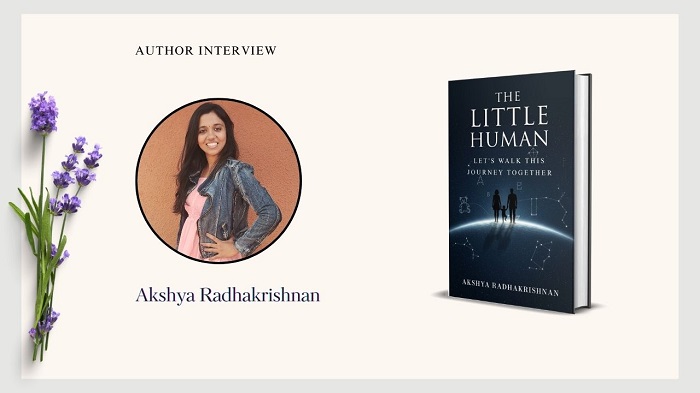
The Literature Times: What inspired you to write The Little Human: Let’s Walk This Journey Together?Akshya Radhakrishnan: I wrote The Little Human because I needed it first. I needed a reminder that my child isn’t a problem to solve but a person to understand. Every chapter comes from a moment that shifted something inside me—moments when I failed, learned, healed, and grew. The book became a way of offering parents what I wish someone had offered me: clarity, compassion and companionship on days that feel heavy.
The Literature Times: How did your experience of raising twins shape the themes and reflections in your book?
Akshya Radhakrakrishnan: Being a twin mom meant living in contrast every single day. One child needed closeness while the other needed space. One processed emotions loudly, the other silently. And I was constantly learning, unlearning, failing, and trying again.
Those lessons became the reflections in my book—especially the idea that a child’s behaviour is never a test for the parent; it’s a window into their inner world. The twins taught me that beautifully
The Literature Times: You describe parenting as a journey of presence rather than perfection. How do you personally practice this in your daily life?
Akshya Radhakrishnan: For me, presence over perfection is about staying real with my children — not performing calmness, not pretending to be the ideal parent, but meeting them with honesty.
There are days when tantrums happen and I’m not in the best mind space. I may snap. I may raise my voice. And in that moment, it’s not perfection — it’s me being human.
But the real presence begins after that moment. When things settle, I take time to sit with myself and reflect: Why did I react that way? What was happening inside me? How did my response land on my child? And then I go to them, acknowledge it, and repair. I tell them, ‘I wasn’t in the right space. My reaction wasn’t about you.’
That, to me, is presence. It’s choosing awareness over performance. It’s choosing truth over perfection. It’s letting my children see me as a human being who feels, learns and tries again — and that honesty becomes the bridge between us.
The Literature Times: What do you think parents often misunderstand about children’s emotions, and how does your book address that?
Akshya Radhakrishnan: Often, parents (caretakers, grandparents, neighbours and everyone around) see emotional outbursts as disrespect or stubbornness. But children aren’t giving us a hard time — they’re having a hard time.
The Little Human brings this perspective forward through gentle reminders, reflections, and real moments from my own journey. It shifts the focus from ‘Why are they doing this?’ to ‘What are they feeling right now?’ That simple shift changes the entire relationship.
The Literature Times: Your book blends stories, reflections, and practical activities. How did you find the balance between these elements while writing?
Akshya Radhakrishnan: As a parent myself, I know that some days you want a story, some days you want guidance, and some days you just want something to try right away. So I wrote the way I would like to read.
So I used reflections to bring depth, stories to make that depth relatable, and activities to make it usable.
Every time a chapter felt too emotional, I added a practical piece to help parents take action. And whenever something felt too instructional, I added a story to soften it. The balance came from constantly asking myself, ‘Will this touch the heart and also help the hands?’
The Literature Times: Leaving the corporate world to become a full-time mother is a significant transition. How did that shift influence your writing journey?
Akshya Radhakrishnan: Leaving the corporate world was like stepping out of structure and into surrender. In the corporate space, everything was measurable — outcomes, targets, timelines. Motherhood was the opposite. Nothing was linear, nothing was predictable, and yet everything felt profoundly meaningful.
That contrast softened something in me. It made me observe, feel, and reflect more deeply. And those reflections slowly became the pages of my book. The shift allowed me to write not from achievement, but from awareness.
The Literature Times: What message do you hope parents take away after reading The Little Human?Akshya Radhakrishnan: By the time they finish the book, I sincerely hope parents feel a deep sense of reassurance — that they are not alone in this journey. And more than anything, I hope they walk away with renewed empathy, not just for their child, but for themselves too.
The Literature Times: Can you share a memorable moment with your children that deeply impacted the philosophy of this book?
Akshya Radhakrishnan: There are many moments, but one moment to share. L1 nudged L2, and L2 reacted physically, biting L1 on the hand. It all happened within a minute. When I heard L1 crying, my heart ached — but I also noticed L2’s helplessness. She hadn’t realised it would hurt him, and he ended up getting hurt badly.
This repeated incident made me realise we needed a practical way to manage these strong emotions. So, we created a simple rule: whenever someone feels like hitting, they should move to a corner, to their room, or come to me and acknowledge that things are heading in the wrong direction. It didn’t work overnight — it took many reminders — but eventually it clicked. L1 even started warning me: ‘Amma, something wrong is going to happen very soon, please come.’ That way, I could intervene before the conflict escalated.
This experience taught me a key philosophy I share in The Little Human: empathy, presence, and co-creating solutions are far more powerful than punishment. Giving children the tools to recognise and manage their emotions, and guiding them without shaming, builds understanding and connection
The Literature Times: In a world of fast-paced parenting and societal pressures, how does your book encourage parents to slow down and reconnect?
Akshya Radhakrishnan: In today’s fast-paced world, it’s easy for parents to rush from one task to another, checking off milestones rather than truly connecting with their children. The Little Human encourages slowing down by inviting parents to pause, observe, and reflect — to see the child behind the behaviour, and also to check in with themselves. Through stories, reflections, and small practical activities, the book creates space for parents to reconnect emotionally, respond with empathy, and be fully present, even in small everyday moments. It’s less about perfect parenting and more about being a present, conscious guide in their child’s life.
The Literature Times: Do you plan to write more books on parenting or related themes in the future?Akshya Radhakrishnan: The Little Human came together so naturally, without any strict planning or schedule. It was more about noticing moments, reflecting on my parenting journey, and putting those insights into words. If something like that happens again in the future — a project that flows organically and feels meaningful — I would definitely be open to exploring it. I like the idea of following the process, staying curious, and seeing where it leads rather than forcing anything.