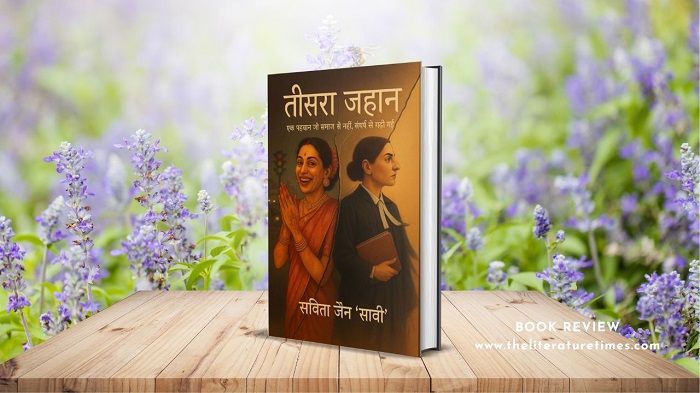
Teesra Jahan is not merely a poetry collection; it is a quiet yet powerful act of social witnessing. In this deeply moving work, Savita Jain ‘Savy’ turns her poetic gaze toward the transgender community, a group often pushed to the margins of society and reduced to stereotypes or silence. What makes this book remarkable is not just its subject, but the sensitivity, restraint, and moral clarity with which it approaches that subject. Savy does not attempt to dramatize suffering for effect, nor does she position herself as a saviour. Instead, she chooses the more difficult and honest path—inviting readers to listen, reflect, and confront their own biases.
The title Teesra Jahan (The Third World/Realm) itself is symbolic. It gestures toward an invisible space that exists alongside the familiar binaries of gender and social structure, a world that society acknowledges only in fragments, if at all. Through her poems, Savy gives form and voice to this neglected realm, presenting the transgender experience not as an abstract social issue, but as lived reality—rich with emotion, longing, pain, resilience, and hope. Her poems insist on one fundamental truth: that the transgender community is not asking for special treatment, only for dignity, acceptance, and the right to exist without fear or shame.
One of the strongest aspects of Teesra Jahan is its emotional honesty. Savy writes with empathy rather than appropriation. She does not claim to speak on behalf of the transgender community; instead, her poems act as windows through which readers can glimpse their struggles and humanity. The verses explore themes of identity, rejection, love, and survival, often highlighting how societal prejudice wounds not only the body but the soul. There is a persistent ache in these poems—a sense of lives lived in constant negotiation with judgment—but there is also quiet strength. Savy acknowledges suffering without allowing it to define her subjects entirely.
Stylistically, the poetry in Teesra Jahan is accessible and unpretentious, which works to the book’s advantage. The language is simple yet evocative, allowing emotions to take center stage rather than ornate literary devices. This simplicity makes the poems more intimate, almost conversational, as though the poet is gently holding the reader’s hand while guiding them through uncomfortable but necessary truths. The restraint in her writing reflects maturity and confidence; Savy trusts the power of emotion and thought over embellishment.
What also stands out is the ethical responsibility embedded in the book. Teesra Jahan does not aim to shock or provoke outrage; instead, it seeks to awaken conscience. The poems ask difficult questions—about exclusion, hypocrisy, and moral failure—without offering easy answers. Savy challenges the reader to consider how social norms are constructed and who they exclude in the process. Her work exposes the contradiction of a society that claims cultural richness and spiritual depth while denying basic humanity to those who do not fit prescribed roles.
Savy’s background as a technocrat and a long-serving professional in government lends an interesting dimension to her writing. There is a quiet awareness of systems—legal, social, and cultural—that shape human lives. Yet, her poetry never feels clinical or detached. On the contrary, it is deeply emotional, suggesting that her analytical understanding of society is balanced by a profound compassion for individuals within it. This dual perspective allows Teesra Jahan to function both as art and as social commentary.
Another strength of the book lies in its universality. While the focus is on the transgender community, the underlying emotions—desire for acceptance, fear of rejection, yearning for love—are universal. Readers may enter the book out of social curiosity, but they leave with personal introspection. Savy’s poems subtly remind us that marginalization is not limited to any one group; it is a human condition that changes form depending on context. In this sense, Teesra Jahan becomes a mirror, reflecting not just society’s treatment of transgender individuals, but society’s broader failures of empathy.
Importantly, the book avoids moral grandstanding. Savy does not lecture or accuse; she observes and feels. This approach makes the work more persuasive and enduring. The poems linger in the mind, urging readers to reconsider everyday attitudes, language, and behaviors that often go unquestioned. The impact of Teesra Jahan lies in this quiet persistence—it stays with you, unsettling comfort and inspiring thought.
In conclusion, Teesra Jahan is a courageous and compassionate work that expands the scope of contemporary Indian poetry. Savita Jain ‘Savy’ proves that literature can be both gentle and revolutionary, personal and political. Her poetry does not demand change with raised fists; it invites change through understanding. In a time when voices are often drowned by noise and outrage, Teesra Jahan stands out as a work of calm conviction. It is a book that deserves to be read slowly, reflected upon deeply, and remembered long after the final page—because it speaks not only about a community, but about our collective humanity.