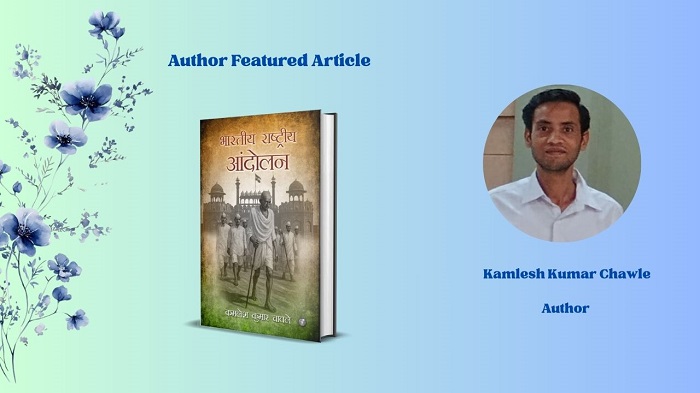
Kamlesh Kumar Chawle stands out as a writer who bridges the worlds of academic scholarship and real-world administrative experience, bringing remarkable clarity and depth to his latest work, Bhartiya Rashtriya Andolan. At a time when students often feel intimidated by the vastness of Indian history, his writing offers a refreshing approach that simplifies complexity without compromising intellectual integrity. His book reflects not only his command over political science and public administration but also his deep commitment to making knowledge accessible, especially for Hindi-medium students who frequently struggle to find well-structured and analytical academic material in their language. The way he deconstructs the Indian National Movement shows a teacher’s sensitivity and a researcher’s precision, making his work relevant across academic levels, competitive exam preparation, and general readership.
Chawle’s journey into academia is rooted in years of rigorous study and professional exposure. With postgraduate degrees in Public Administration and Sociology from Barkatullah University, Bhopal, and qualifications in UGC-NET in both Political Science and Public Administration, he has built a strong foundation in understanding governance systems, socio-political interactions, and public policy. His ongoing Ph.D. research on the role of e-governance in establishing good governance demonstrates his forward-looking academic orientation, reflecting an effort to connect traditional political studies with the evolving demands of modern administrative frameworks. His academic career is enriched by years of teaching at both undergraduate and postgraduate levels, where he has shaped the understanding of countless students, inspiring many to pursue excellence in public administration and political science.
Before entering academia, Chawle spent seven years serving as a Commercial Tax Inspector in the Government of Madhya Pradesh, an experience that offered him a close look at the functioning of the administrative machinery from within. This practical exposure has had a visible influence on his intellectual approach, enabling him to view historical and political processes not just as theories, but as systems grounded in everyday governance realities. It is this blend of scholarly insight and administrative understanding that makes his analysis particularly strong, balanced, and relatable for readers who wish to connect past events with contemporary policy structures.
His academic contributions go beyond teaching. With several research papers published at national and international platforms, and active participation in seminars, he has continuously engaged in scholarly discourse, refining his perspectives and exploring new dimensions of political and administrative thought. His interests in good governance, constitutional values, and administrative reforms align closely with the themes of nation-building, making him especially equipped to write about the Indian National Movement—a subject that requires sensitivity toward both historical nuance and institutional evolution.
In Bhartiya Rashtriya Andolan, his expertise shines through every chapter. Instead of viewing India’s freedom struggle as a series of isolated events, he presents it as an evolving, multi-dimensional movement shaped by political ideologies, economic pressures, social transformations, and the aspirations of ordinary people. His writing echoes his belief that history must be understood, not memorized; analyzed, not merely repeated. By presenting complex events in simple and fluent Hindi, he ensures that students preparing for university examinations or competitive exams like UPSC and MPPSC can deepen their understanding without being overwhelmed by academic jargon.
Through this book and his broader body of work, Kamlesh Kumar Chawle positions himself as a scholar dedicated to democratizing knowledge and strengthening the intellectual foundation of students. His contribution goes beyond authorship—he is shaping a generation of learners who can think critically, understand deeply, and appreciate the rich legacy of India’s national movement.