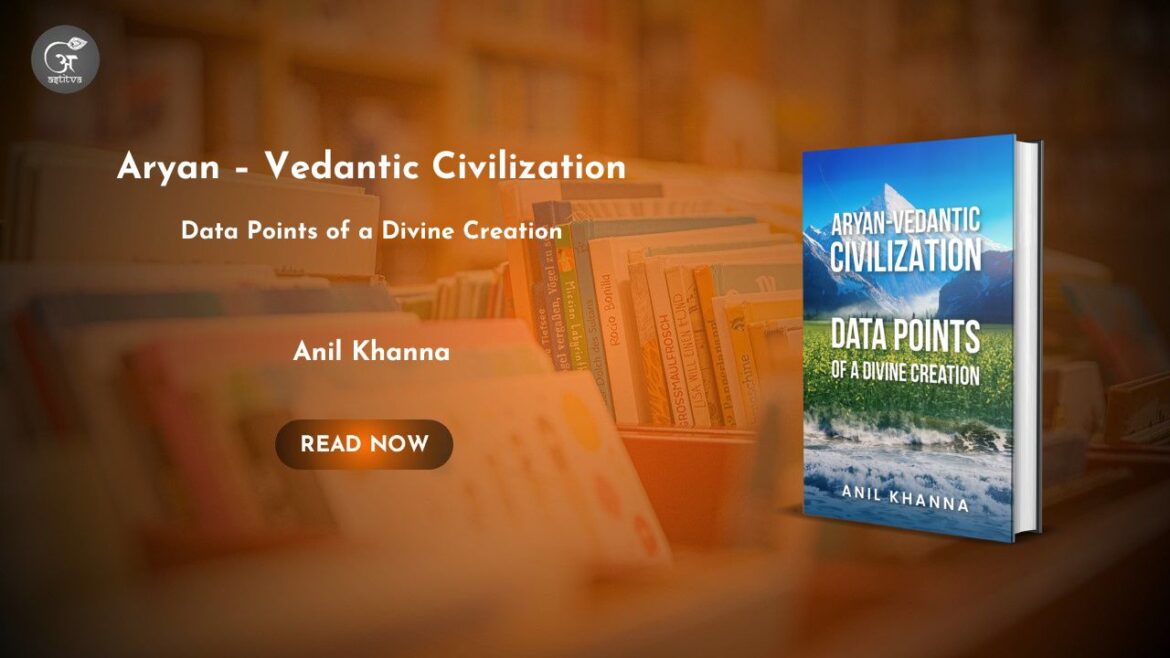
Aryan – Vedantic Civilization: Data Points of a Divine Creation by Anil Khanna arrives as a bold, contemplative, and deeply researched exploration of India’s most ancient civilizational roots. The book seeks to address a long-standing void in the collective understanding of India’s distant past—a past that stretches back tens of thousands of years and remains obscured by fragmented narratives, external distortions, and the limitations of purely material interpretations of history.
The author begins by confronting a fundamental challenge: the modern world’s dependence on Western frameworks of evidence, which prioritize material science while often overlooking other valid modes of knowing. In contrast, this work is anchored in the Indian epistemological tradition of Pramana, where evidence is not restricted to the physical alone but also includes logic, inference, testimony, and experiential truth. By adopting this approach, the book presents an indigenous lens through which the evolution of what was once known as Aryan civilization can be more authentically understood.
Rather than attempting a linear chronological history, the narrative unfolds through broad civilizational milestones. The central benchmark of progress, as proposed in the book, is not technological dominance or territorial expansion, but the attainment of the highest spiritual realization available to humanity. This culmination, the author argues, was achieved through Vedanta—specifically Advaita philosophy—around 2,300 years ago, marking the peak of intellectual and spiritual evolution of the civilization.
The book delves into some of the most iconic and often debated pillars of Indian thought and culture, including the Dashavtar, the decimal number system, the Devanagari script, the Sanskrit language, and the Vedas. Each is examined not as a matter of belief or mythology, but through context, logic, and interlinked evidence that points to deliberate scientific and philosophical intent. The author proposes that these constructs were not accidental or symbolic alone, but deeply systematic responses to the nature of existence itself. Presented in this manner, even readers with an atheist or purely rational outlook are invited to engage with the arguments without the need for faith, as the case is built on reasoning rather than devotion.
Anil Khanna’s own journey lends credibility and depth to the work. An engineer by training, with a professional career spanning electronics, information technology, and business advisory roles, his analytical background is evident throughout the narrative. His early years as a lecturer and founder of a state’s first electronics department reflect a lifelong commitment to structured thinking and education. Over time, his passion for reading and travel evolved into a deeper inquiry into existence, truth, and consciousness—an inquiry that ultimately found its destination in Vedantic thought.
Writing with the sensibility of both a technologist and a seeker, the author balances clarity with intellectual rigor, ensuring that complex ideas remain accessible without compromising their essence. His intuitive teaching style and ability to communicate nuanced perspectives transform dense philosophical material into an engaging and thought-provoking reading experience.
Aryan – Vedantic Civilization: Data Points of a Divine Creation stands as an invitation to rethink history, evidence, and the very definition of progress. It challenges readers to move beyond inherited assumptions and to consider the possibility that India’s ancient civilization was not merely old, but profoundly advanced in its understanding of life, consciousness, and existence itself.