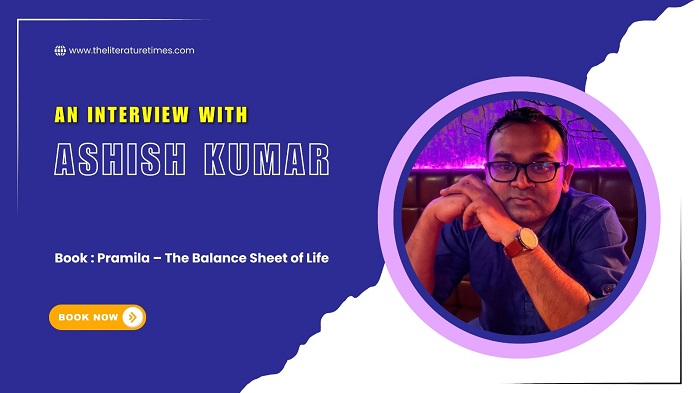
The Literature Times: Ashish Kumar, The Balance Sheet of Life uses a financial metaphor to explain personal growth. What inspired you to connect life and self-reflection with the concept of a balance sheet?
Ashish Kumar: The idea first came to me 3–4 years ago while I was travelling. It was a sudden thought: to write something on the assets and liabilities of life. From that moment, I began working on a roadmap. Initially, I imagined writing an article and publishing it in a leading newspaper. However, once I completed the roadmap—outlining what would constitute the balance sheet of life—it became clear that an article would not suffice. A book was needed.
This book identifies the minimum assets and liabilities of life, illustrated with real-life examples. Each incident is chosen to be relatable to the theme, rather than presented as mere theory. Thus, The Balance Sheet of Life was born, and today it is available for every individual to reflect upon and judge for themselves.
The Literature Times: How did your own personal or professional experiences influence the ideas and examples presented in this book?
Ashish Kumar: The examples presented in the book are relatable. They serve to substantiate the core message the book seeks to convey. Not all of them stem directly from my personal or professional life; rather, they are drawn from a blend of experiences and observations. Each example offers the reader a sense of lived reality—whether through direct experience or through careful observation. At some point in life, most individuals will have either encountered or witnessed situations similar to those described in the book. That’s why the book asks the reader to pause and reflect.
The Literature Times: You emphasize managing liabilities rather than eliminating them. Why do you believe this perspective is more realistic for peaceful living?
Ashish Kumar: In today’s fast-paced world, people own a watch but often lack time. As human beings, none of us is perfect—it is practically impossible to find someone who is flawless. A pragmatic approach to life is to identify your liabilities and gradually work to minimize them as much as possible. Every individual is unique and carries a different perspective towards life. The greatest challenge lies in recognizing these liabilities; the second challenge is in reducing them.
From another perspective, only once you are capable of identifying your liabilities can you begin the process of minimizing them. Suppose a person recognizes their liabilities at the age of 40 and then starts working to reduce them. That individual has already carried those liabilities for 40 years. Even if, hypothetically, they succeed in eradicating all liabilities in the years that follow, the fact remains that they bore them for four decades. In totality, therefore, liabilities cannot be completely eliminated from life.
The pragmatic approach is to identify liabilities early and then minimize—or better yet, avoid—those that weigh us down. When one succeeds in reducing liabilities, peaceful living begins to emerge gradually. It should become a conscious practice: identify, then minimize, the liabilities of life.
The Literature Times: Many readers may struggle to identify their own intangible assets and liabilities. What is the first step you suggest for honest self-evaluation?
Ashish Kumar: This book is intended as a first step toward the self-evaluation of intangible assets. As mentioned earlier, it outlines the bare minimum assets and liabilities of life. Understanding this foundation is the first step toward identification and self-reflection. The next step requires each individual to introspect—drawing from personal experiences, observations, circumstances, and incidents—to determine what is lacking and what must be minimized. When you succeed in achieving what is lacking, it becomes an asset. When you identify what must be minimized, you have recognized your liabilities.
The process of identification should not feel like a struggle. Instead, it should be approached with positivity and openness. It demands patience, calmness, and, most importantly, the intent to truly know your assets and liabilities. That intent requires pausing, reflecting, and engaging in honest introspection. Gradually, this practice leads to meaningful self-evaluation.
The Literature Times: The book includes real-life scenarios from workplaces and leadership roles. What message do you hope professionals and leaders take away from these examples?
Ashish Kumar: In India, toxic work culture is not new. What employers project may not always reflect reality. The problem often lies in orthodox working environments and a “control everything” attitude, including excessive micromanagement. Today’s generation, particularly Gen Z, is unwilling to accept such bureaucratic structures and rigid work cultures, including “school-level management”. Employees cannot be treated as “school students”.
Many leaders and senior employees misuse their power and position to satisfy personal egos, and this often influences appraisals. It is a well-known truth, yet little has changed to address these issues. Professionals and leaders must evaluate their actions before using authority as a tool for vengeance. Empathy should be embraced, and a realistic approach must be promoted. Unrealistic commitments should be avoided.
Leaders and professionals should not arrive at conclusions based merely on hearsay or rumours. Instead, they must identify the root cause before passing judgment or making decisions. Only then can workplaces move toward healthier, more sustainable cultures.
The Literature Times: Peace is a central theme in your book. How do you personally define peace in today’s fast-paced and competitive world?
Ashish Kumar: Peace is eternal and can be discovered within us—if we are willing to explore. The ultimate goal of life is to live peacefully. In today’s fast-paced and competitive world, people often feel they have no time. Yet even a few minutes—five or ten—set aside for introspection can be the first step toward peace.
Gradually, this practice allows us to dive deeper into the “inner world,” where true peace resides. Chasing peace externally will never succeed; it must be found within. In my view, peace is not something to be pursued outside—it is something to be realized inside.
The Literature Times: Did you face any challenges while translating abstract life concepts into a structured, almost analytical framework?
Ashish Kumar: Frankly speaking, it was indeed a challenge. After outlining the roadmap of essential topics—assets and liabilities—the real difficulty lay in deciding how to present them: through concepts alone, examples alone, or a blend of both. I ultimately chose an approach where the topic is substantiated with examples, wherever possible. Importantly, these examples are relatable rather than hypothetical, so readers can connect them to real-life situations.
Beyond concepts and examples, I also included open-ended questions to encourage self-evaluation and reflection. I intended to ensure the book is not just a passive read, but an interactive experience that invites readers to pause, think, and view ideas from their own perspective. This balance—between explanation, illustration, and introspection—was the greatest challenge in shaping the book. It is up to the respected readers to read and judge how much the book succeeded in its intent.
The Literature Times: How do you think The Balance Sheet of Life differs from conventional self-help or motivational books?
Ashish Kumar: The book takes a distinctive approach in presenting what constitutes assets and liabilities. Rather than aiming to eliminate liabilities, it emphasizes minimizing them—a practical and realistic perspective.
Each topic is enriched with real-life examples drawn from both personal and professional contexts. These relatable illustrations make the book engaging and accessible, ensuring that readers connect with the ideas on a deeper level. True to its claim, “A Mirror, not a Manual”, the book reflects who we are in terms of our intangible assets and liabilities, inviting readers to see themselves within its pages. This isn’t a rulebook. It’s a mirror. Sometimes the mirror will comfort you, sometimes it will confront you.
Every chapter is designed to actively engage readers with the subject matter. Beyond explanations and examples, the book explores thought-provoking questions that are rarely discussed or debated. For instance: Is a happy person necessarily satisfied—or is it the other way around? Does happiness guarantee satisfaction, or does satisfaction lead to happiness? What is the true correlation between the two?
Some of these questions are answered, while others are intentionally left open, encouraging readers to pause, reflect, and form their own perspectives. In this way, the book sets itself apart—not just as a source of knowledge, but as a companion for introspection.
At the end, the book also asks the readers to prepare their own balance sheet of life.
The Literature Times: What kind of reader did you have in mind while writing this book, and who do you think will benefit from it the most?
Ashish Kumar: This book is not written for a specific class of readers—it is meant for everyone. Whether professionals or non-professionals, students or employees, leaders, men or women, it speaks to all age groups. It is a book for mankind to reflect on life through the lens of assets and liabilities, and to strive for balance.
The central idea is simple yet profound: minimize liabilities and increase assets. By doing so, readers are encouraged to cultivate strengths while reducing the burdens that hold them back.
The Literature Times: After completing this book, has your own “balance sheet of life” changed in any way, and if so, how?
Ashish Kumar: Writing this book truly changed my perspective on life. As I worked through the ideas, I began identifying my own assets and liabilities and consciously started working on them. As I mentioned earlier, this is not just a one-time exercise—it should become a practice, a habit to be adopted as far as possible.
The intent behind this practice matters greatly. I have already worked on my personal balance sheet and continue to refine it, striving to minimize liabilities and strengthen assets. In that sense, the book is not only a message to readers but also a journey I am living myself.