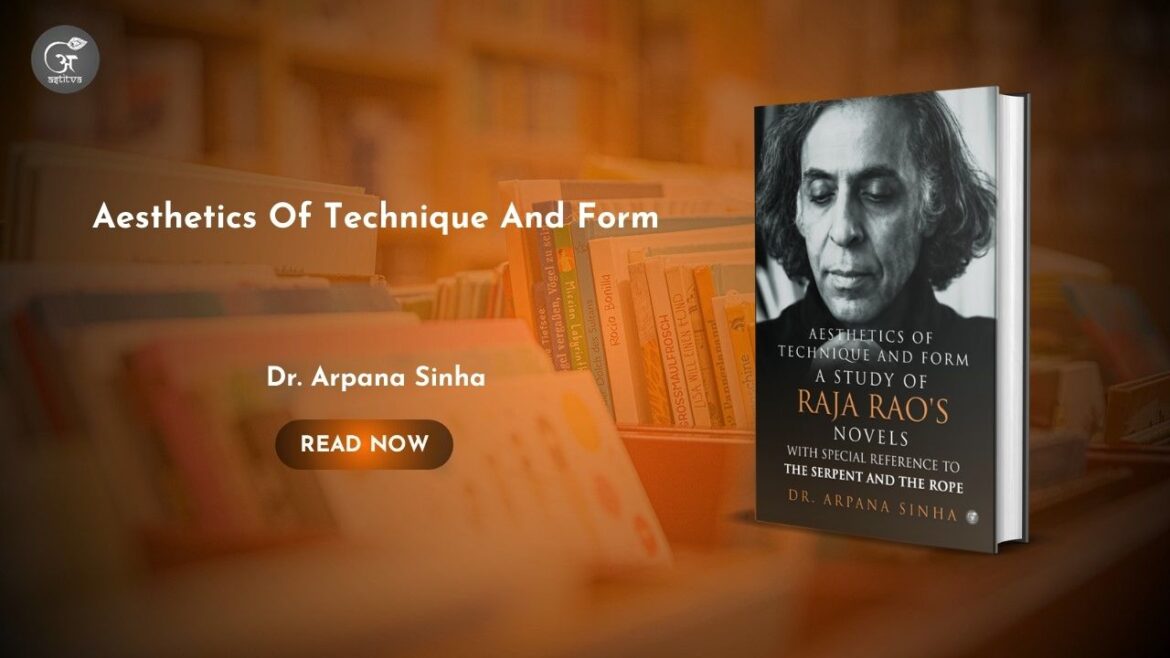
Aesthetics of Technique and Form: A Study of Raja Rao’s Novels with Special Reference to The Serpent and the Rope by Dr. Arpana Sinha stands as an important scholarly contribution to the field of Indian English literature. The book offers a deep exploration of Raja Rao’s artistic vision, technical sophistication, and philosophical depth, making it a valuable resource for students, researchers, and admirers of Indian English novels. Through five well-structured chapters, the study reveals how Rao’s writing transcends conventional narrative boundaries to create a literary experience that is both introspective and metaphysically rich.
The book begins by establishing the philosophical and autobiographical base on which The Serpent and the Rope is built. Raja Rao’s novel, often regarded as a complex blend of intellectual exploration and spiritual yearning, is examined through its roots in Indian philosophy—particularly Vedanta—and the author’s own life experiences. The study shows how the novel becomes an inward journey of identity and dissolution, an interplay between the real and the metaphysical, and a quest for ultimate truth. By grounding Rao’s narrative in these philosophical frameworks, the book allows readers to enter the deeper layers of meaning embedded in his work.
A major strength of Dr. Arpana’s study is its detailed examination of narrative structure. Rao’s style is known for its non-linear technique, fluid shifts in voice, and meditative pace. The book analyzes these aspects with clarity, demonstrating how the narrative technique mirrors the protagonist’s spiritual search. Through its layered narrative, The Serpent and the Rope becomes more than a story; it becomes a method of inquiry. Dr. Arpana explains how Rao uses structure itself as a philosophical tool, revealing his mastery in transforming narrative form into a medium of inner exploration.
The book also delves into the aesthetics of characterization, highlighting how Rao’s characters are not merely fictional constructs but embodiments of philosophical questions. Their dialogues, actions, and emotional struggles represent deeper inquiries into identity, belonging, and self-realization. By linking character and form, the study reveals how Rao’s literary universe is shaped by his metaphysical concerns, and how the very structure of the novel reflects Vedantic concepts such as duality, illusion, and the unity of being.
Another significant contribution of the book is its examination of Raja Rao’s quest for a linguistic style capable of expressing Indian thought in English. Dr. Arpana discusses how Rao developed a unique idiom—one that bridges Indian rhythms with English syntax, enabling a cultural and philosophical synthesis that remains unmatched in Indian English literature. The study highlights how his language is not merely a communicative tool but an aesthetic choice that enriches the spiritual and cultural texture of his novels.
In its concluding pages, the book synthesizes the analysis to reaffirm the central theme that runs through Raja Rao’s body of work: the unending spiritual search for identity. Dr. Arpana presents this journey with scholarly precision, offering readers insights into why Raja Rao remains one of India’s most significant literary figures. Her work reflects intellectual rigor, sensitivity, and a deep engagement with the humanities, making this book a meaningful addition to contemporary literary studies.