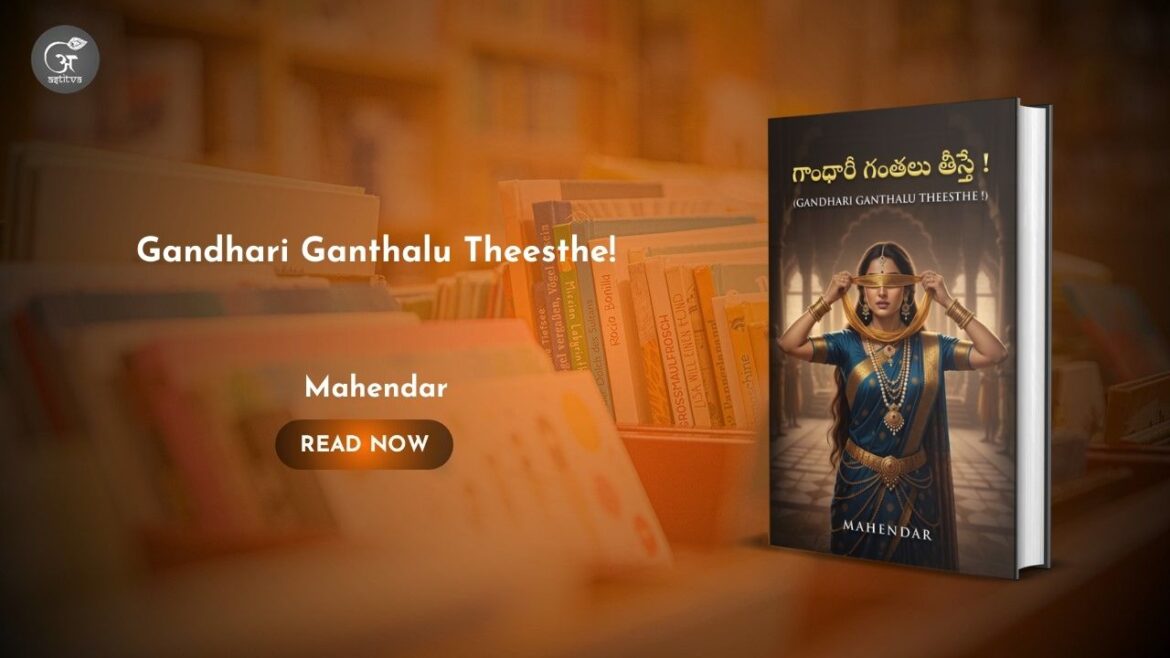
The release of Gandhari Ganthalu Theesthe! by Mahendar presents a compelling re-imagining of one of the most powerful and emotionally complex characters from the great Indian epic, the Mahabharata. This thought-provoking work explores an intriguing question: What would have happened if Gandhari had never worn the blindfold? Through this central idea, the book offers an imaginative journey into an alternate version of the epic—one shaped by her vision, her choices, and the consequences that may have unfolded in Hastinapura and beyond.
Gandhari, the queen of Hastinapura and mother of the 101 Kauravas, remains one of the most enigmatic figures in Indian mythology. Her decision to blindfold herself, symbolically sharing her husband Dhritarashtra’s darkness, has long been seen as an act of loyalty, sacrifice, and strength. Yet, it has also raised questions—did this choice limit her ability to guide her sons? Was it a silent punishment she imposed on herself? Could she have changed the course of history had she chosen differently? These unanswered questions form the foundation of Mahendar’s narrative.
Gandhari Ganthalu Theesthe! delves into these possibilities with curiosity and emotional depth. The book examines Gandhari’s inner conflicts, the weight of her responsibilities, and the unspoken regrets that may have shaped her life. By imagining her without the blindfold, the story opens the doorway to a different Mahabharata—one where she sees not only the world around her but also the unfolding destinies of her sons. This imaginative exploration allows readers to reflect on themes of motherhood, fate, choice, and the power of awareness.
Mahendar approaches this reinterpretation not as a scholar but as a passionate reader who has lived with books for over 15 to 20 years. His love for literature, including his habit of reading at least 100 pages every day, forms the backbone of his creative expression. Although this is his first book and he openly acknowledges his lack of formal writing experience, the sincerity and originality of his thought shine through every page. Rather than relying on technicalities, he uses imagination as his primary tool—letting the idea itself guide the narrative. His openness to feedback and willingness to grow as a writer reflect a commendable humility rarely seen in debut authors.
This book offers readers a fresh perspective on a well-known epic, encouraging them to rethink Gandhari’s role and the immense emotional landscape hidden behind her silence. By lifting the symbolic blindfold, Mahendar not only gives Gandhari a new voice but also invites readers to consider how a single choice can shape destinies. Gandhari Ganthalu Theesthe! stands as a creative and heartfelt contribution to mythological fiction, opening a conversation that blends imagination with timeless epic tradition.