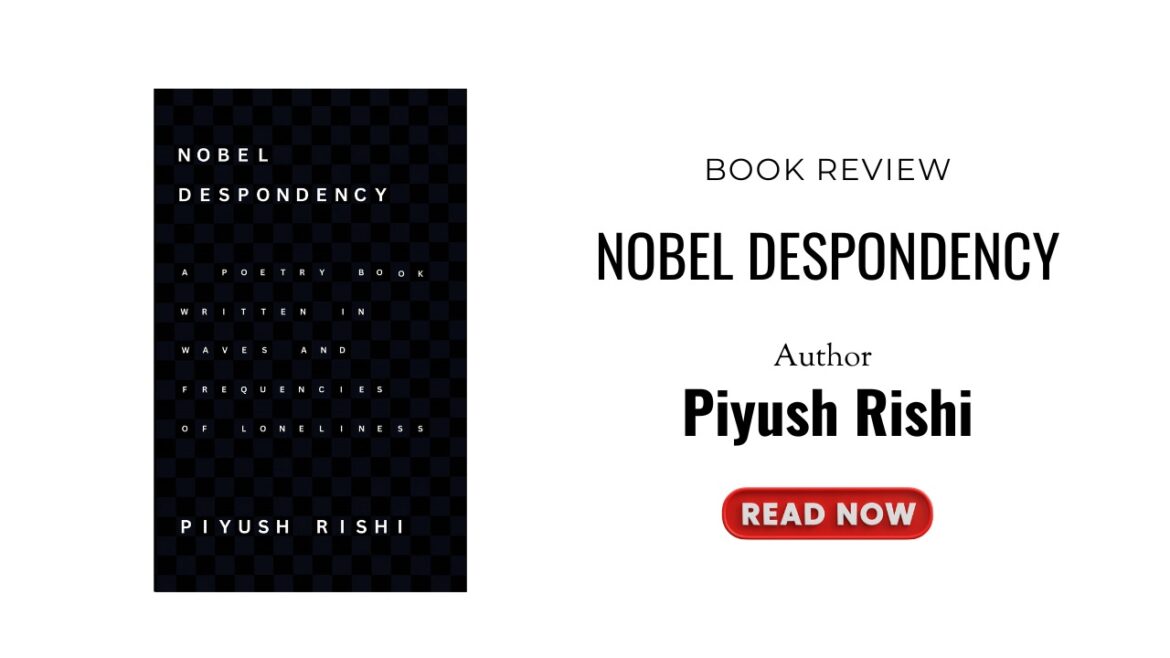
Nobel Despondency by Piyush Rishi is not a book you casually pick up for light reading—it is an experience that demands emotional surrender. Written as a collection of poetic reflections intertwined with prose-like narratives, the book dives deep into the unsettling terrains of loneliness, grief, abandonment, and psychological unrest.
What stands out immediately is the raw honesty of the author. There is no attempt to romanticize pain or dilute suffering with decorative language. Instead, Rishi embraces discomfort and forces the reader to confront it head-on. The “phases” structure of the book works effectively, allowing readers to witness a gradual emotional descent and evolution. Each phase feels like peeling back another layer of the human psyche—revealing not just sadness, but the anatomy of despair itself.
The themes of abandonment and emotional homelessness are particularly powerful. The author repeatedly questions the reliability of human connections, presenting relationships as fragile constructs that can collapse without warning. This perspective may feel intense, even unsettling, but it is also deeply relatable in a world where emotional disconnection is increasingly common.
Stylistically, the book blends poetry and prose seamlessly. Short verses capture fleeting emotions, while longer passages build immersive psychological landscapes. The imagery is vivid and often haunting—smoke-filled rooms, empty ceilings, rain washing away internal chaos. These visuals are not just descriptive; they function as emotional metaphors, amplifying the reader’s connection to the narrator’s inner state.
Another notable aspect is the book’s philosophical undertone. It questions societal norms, particularly the way people handle emotions, relationships, and mental health. Rishi critiques the superficiality of modern interactions, suggesting that people are more inclined to perform emotions rather than truly experience them. This critique adds depth to the narrative, elevating it beyond personal storytelling into social commentary.
However, the intensity of the book can be overwhelming. It is not structured for comfort or easy resolution. There are no neatly packaged lessons or uplifting conclusions. Instead, the reader is left in a space of reflection—sometimes heavy, sometimes unsettling. This is both the book’s strength and its limitation. While it offers authenticity, it may not appeal to readers seeking hope-driven narratives.
Ultimately, Nobel Despondency is a powerful literary work that captures the complexity of human emotions in their most unfiltered form. It is a book for those who are willing to sit with discomfort, explore the darker corners of the mind, and acknowledge the realities often hidden beneath societal expectations.
Title: Nobel Despondency
Author: Piyush Rishi
Publisher: Evincepub Publishing
Link: https://www.amazon.in/Nobel-Despondency-honesty-emotional-clarity/dp/937335907X