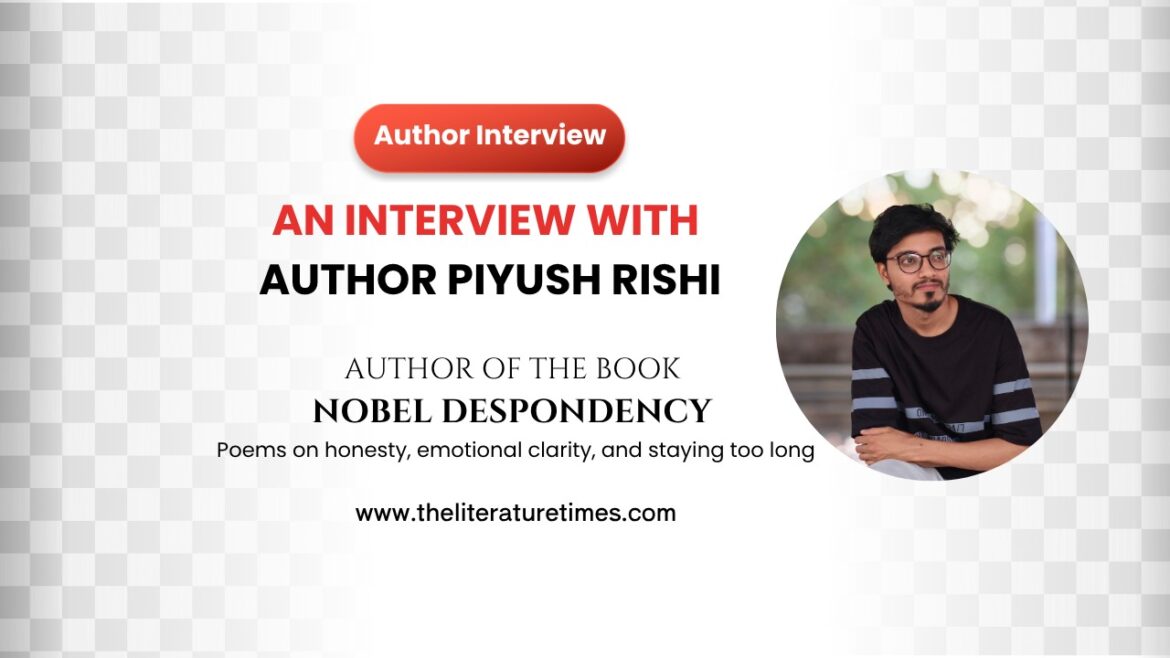
Piyush Rishi is an emerging Indian writer whose work blends poetic intensity with psychological depth. His voice is defined by brutal honesty, cinematic imagery, and a fearless exploration of pain, identity, and emotional collapse. Nobel Despondency is his debut novel, drawn from lived experiences and years-long reflections on loss, betrayal, death, and the violent anatomy of loneliness. His writing reflects a worldview shaped by grief, introspection, and an artist’s sensitivity to the hidden patterns of human behavior. Influenced by Kafka’s surrealism, Plath’s emotional clarity, and contemporary trauma literature, he delivers a narrative that is at once lyrical and devastating. He resides in Pune, India and continues to explore themes of hurt, emotional depth, human fragility, and artistic truth in his work.
Discussion on the Book & Writing Process
What inspired you to write Nobel Despondency, and why did you choose poetry as the medium?
I feel suffering is underrated. I have been observing that people are chasing happiness like anything. I feel them; they are sprinting towards it, and that’s where expectations chip in. People are not expected to feel happy with themselves; they expect happiness from the people around them.
So I re-routed. When I was in a tough phase, I stayed and observed what this suffering and depression thing was. I stayed with my thoughts and emotions and spent all my days beneath them. Not forcefully ofcourse. Believe me, there’s a lot to explore. If you see negative things in a welcoming way, you come out differently for the rest of your life. You may permanently enroll with many necessary emotions or way of living which are actually needed in your life such as patience, fewer expectations, and selflessness. You gain clarity on how you should face the world, with kindness and only kindness.
As I said, I stayed and simply observed what my mind was running with. And what do artists end up doing? Whether it’s a good phase or a bad phase, it comes out as a poem, a sketch, a composition, etc.
The book is described as “written in waves and frequencies of loneliness.” What does that phrase mean to you personally?
Author: The idea for this phrase came after I compiled all my poetry and prose. When the manuscript was complete and I read the entire copy from a reader’s point of view, I realized that I had tried to capture every thread of loneliness in this manuscript.
The character in this book is completely involved in or surrendered to loneliness and simply observes rather than escaping from his emotions. I hope readers find justice in it and experience every emotion if they relate to even a single poem.
Your writing feels deeply raw and unfiltered. Was it difficult to expose such intense emotions?
Author: Yes, it was a six-year-long wait. Every time I felt something, I wrote. Six long years of feelings, detachment, observations, and zero confidence. Five months ago, I decided to bring this book into the world.
I don’t expect anyone to feel inspired by this book, but I do hope they read it at least once, as it doesn’t speak like a close friend but more like a vibe. It may raise a few questions, especially for people in their twenties, and the book will simply sit with them.
How much of this book is autobiographical, and how much is creatively interpreted?
Like every artist, I’ll lie… it is a work of fiction. Yet, the feelings are quite direct, the words are direct, and the book is less metaphorical but quite hard-hitting and straightforward.
The book explores themes like loneliness, abandonment, and mental struggle. Why were these themes important for you to highlight?
As I mentioned, everyone is suffering; it’s just that no one dares to accept it. People go to the gym to build muscles, yet no one thinks of building brain muscles or embrace emotional intelligence.
The world is getting more violent. People say what they want and behave how they want, yet forget how hurtful it can be. These societal topics need to be discussed. Even if 1% of people are encouraged to share or talk to someone who listens deeply, we may build a better society.
Your writing often blends storytelling with poetry. How do you define your writing style?
Author: Honestly, sometimes I am a huge fan of my own writing and storytelling. Before publishing the book, I wrote a piece on Instagram called Fumbles at Goodbyes, and I became a fan of it. It was hard to believe I wrote it or whether I could ever write something this better again.
I always feel like trying something different on a blank page. Whatever the theme or section of the book, I want to spread myself fully and start playing, dancing, falling, flying and everything once at all.
I bet no author has taken the opportunity to write a creative disclaimer. The standard format is “This is a work of fiction…” and so on. But this book has two lengthy pages of disclaimer.
My style is less metaphorical and more direct. You always don’t need the sea, the sun, or winter every time to write a poem. That’s the modern poetry I want to practice for life.
Did you follow a structured writing routine, or was the book created during emotional phases?
Author: As I said, it is a six-year compilation of poetry. I felt things and kept writing. Then, with one random decision, I chose to make this my debut book.
I wrote exactly what I felt at that moment. I didn’t write a single poem for this book in 2026 or in the last quarter of 2025, so there was no routine.
A good thing about this book is that if anyone feels the pain, weight, or emotions in these poems, it’s because the poems were written in those exact moments. If I tried to recreate those feelings now and write, it wouldn’t make sense, and the authenticity would be missing.
Many sections feel like conversations with the self. Do you see this book as a form of self-dialogue?
Author: Maybe. I don’t know much about the reader’s point of view. I can’t analyze that since I’ve written it. But if it feels like a conversation with the self to readers, then it’s a win for me.
Was there any particular “phase” in the book that was the hardest for you to write?
Author: Every phase. When I read the book after publication, everything felt like a flashback. The hardest part was not writing, but releasing it.
Having zero confidence in whether I could ever become an author of this book was the hardest part. The hesitation, the doubt, everything. But it just happened.
What do you hope readers feel or take away after finishing this book?
Author: Honestly, do anything in life, but stay kind. It is a necessity. I’ve been writing the same note about kindness on signed copies of the book.
Explore every phase of your life. Take your time if things don’t go right. You never know, the wrong phase might lead you to the right one. And I think this book is the greatest example to it. It made me start my Author’s journey. Hold onto hope and start living.
Title: Nobel Despondency – Poems on honesty, emotional clarity, and staying too long
Publisher: Evincepub publishing