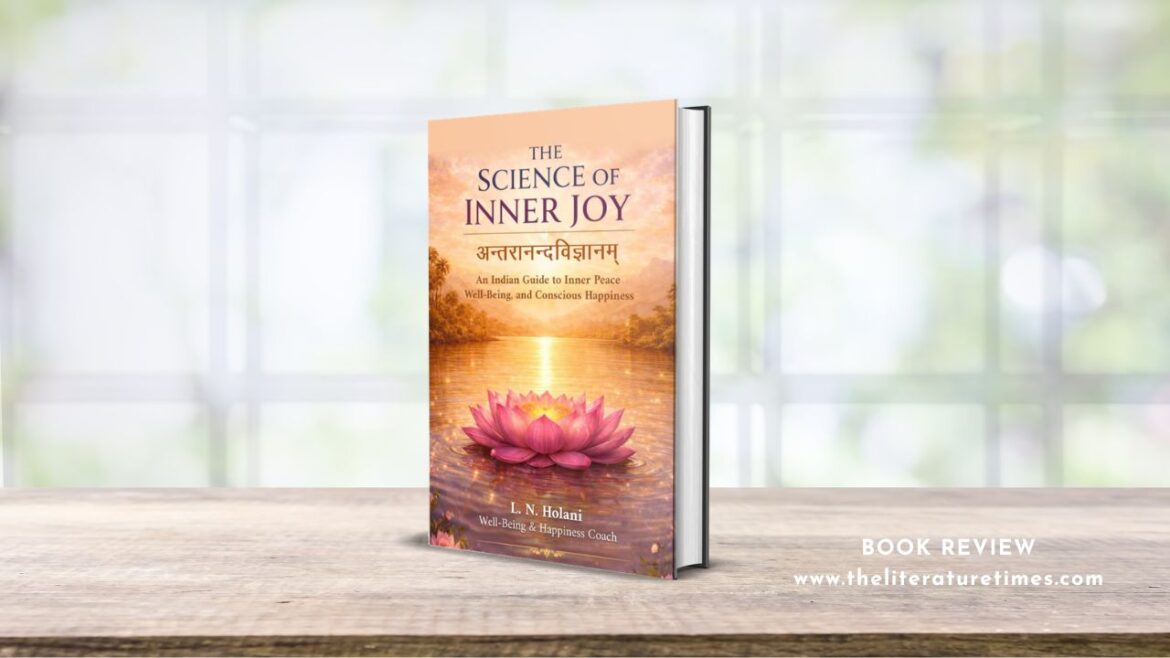
A book that speaks to the reader’s inner world must carry sincerity, clarity, and a lived understanding that cannot be manufactured. The Science of Inner Joy: A Practical Guide to Conscious Happiness by Laxminiwas Holani stands out as one such meaningful work. Rather than presenting happiness as a grand achievement or a distant spiritual ideal, the author approaches it as an accessible, learnable, and deeply personal experience. The book feels like a companion for anyone navigating emotional fatigue, life transitions, or the quiet longing for a more grounded sense of peace.
From the very beginning, the writing reflects a rare blend of humility and depth. Holani does not attempt to preach, instruct, or impose ideas; instead, he shares his journey with disarming honesty. He opens up about the pressures of responsibility, the weight of expectations, and the emotional restlessness that often lies hidden behind appearances of stability. This vulnerability forms the emotional foundation of the book and invites the reader into a space of introspection rather than judgment.
One of the most compelling aspects of the book is how it weaves Indian wisdom with scientific understanding. Concepts like ānanda, balance, and awareness—deeply rooted in Indian philosophical traditions—are explained in relation to modern neuroscience and psychology. Instead of placing the two knowledge systems in opposition, Holani demonstrates how ancient wisdom and contemporary research complement each other beautifully. This integrative approach enriches the narrative and makes the book appealing to readers from diverse backgrounds.
The prose is gentle, reflective, and unhurried. Holani’s writing style is simple yet evocative, relying on clear expression rather than complex language. Each chapter has an inviting quality that encourages the reader to pause, breathe, and absorb the message. It feels less like reading a guidebook and more like engaging in a meaningful conversation—one that nurtures self-awareness and emotional clarity.
What makes the book particularly impactful is its practicalit. Holani emphasizes that inner joy is not a mystical experience reserved for the gifted or spiritually advanced. Instead, he presents it as a learnable capacity arising from everyday actions: the way we think, breathe, respond, and observe ourselves in ordinary moments. This perspective removes the pressure of achieving happiness and replaces it with a gentle invitation to cultivate it gradually.
The real-life experiences shared throughout the book add authenticity to the insights. They are not exaggerated or dramatized; rather, they are presented with honesty and humility. Through stories of responsibility, loss, transition, healing, and renewal, Holani demonstrates how inner peace often emerges not from external success but from internal stability. These anecdotes help readers relate their own life experiences to the author’s and recognize similar patterns within themselves.
The pacing of the narrative is balanced and thoughtful. No chapter feels rushed or incomplete. The book does not overwhelm the reader with information, nor does it dilute its message with excessive repetition. Instead, it offers gentle reminders, subtle shifts in perspective, and simple practices that gradually accumulate to create a wholesome reading experience.
A standout quality of the book is the author’s focus on self-regulation. By highlighting how the mind and body respond to emotional triggers, Holani brings awareness to the role of breath, consciousness, and internal dialogue. This scientific grounding strengthens the book’s credibility and empowers readers to take practical steps toward emotional well-being.
Another admirable strength is its universal relevance. While the book emerges from the author’s personal journey, it speaks to experiences shared by countless individuals—stress, uncertainty, emotional weariness, and the desire for inner equilibrium. Readers from all walks of life—professionals, parents, students, or retirees—can find value in its pages.
Holani’s background as a conscious living mentor and happiness coach is evident, but he never positions himself as a flawless expert. Instead, he conveys wisdom through humility, presenting himself as a fellow traveler on the path of self-discovery. This approach adds warmth to the book and deepens its impact.
In essence, The Science of Inner Joy is both a mirror and a guide. It encourages readers to look inward with curiosity rather than fear, to cultivate calmness without force, and to recognize joy not as a rare blessing but as a natural state waiting beneath layers of worry and conditioning. The book offers clarity, comfort, and courage to anyone seeking emotional balance or a deeper connection to themselves.
Overall, this is a beautifully written, profound, and practical work that feels like a gentle hand on the shoulder—supportive, reassuring, and quietly transformative. Its insights linger long after the last page, offering a renewed understanding of what happiness truly means. This book is not simply meant to be read; it is meant to be lived, reflected upon, and returned to whenever life feels overwhelming. A deeply inspiring and enriching contribution to the literature of inner well-being.