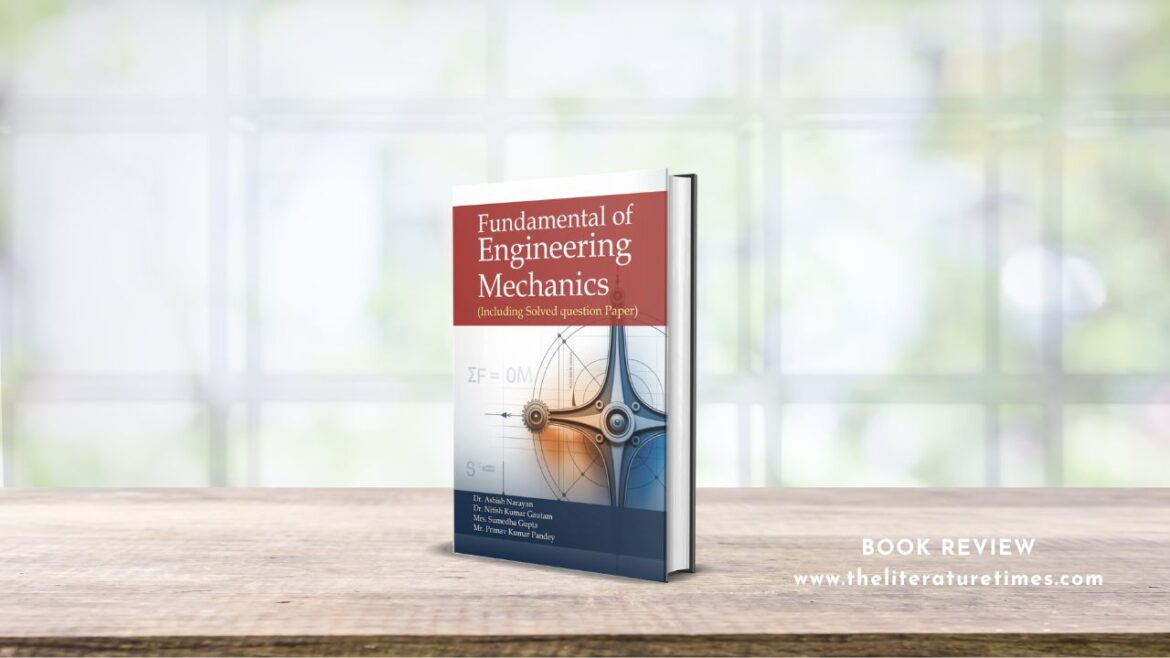
Fundamental of Engineering Mechanics (Including Solved Question Paper) is a comprehensive and thoughtfully curated textbook designed for Degree, Diploma, and A.M.I.E. aspirants who seek clarity, precision, and strong conceptual foundations in engineering mechanics. Authored by a team of experienced academicians—Dr. Ashish Narayan, Dr. Nitish Kumar Gautam, Mrs. Sumedha Gupta, and Mr. Pranav Kumar Pandey—the book fulfills its promise of presenting complex mechanical principles in a concise, compact, and lucid manner. It stays true to the needs of students, offering both conceptual depth and examination-oriented clarity.
From the first few chapters, the reader notices the authors’ commitment to simplifying difficult theories without compromising their technical accuracy. Engineering mechanics can often feel intimidating, especially for beginners. However, this book makes an immediate effort to remove that barrier. The language is straightforward, the explanations are well-structured, and the progression from fundamental to advanced topics is steady and well-planned. It is evident that the authors understand the kinds of difficulties commonly faced by engineering students and have crafted the content to address those challenges.
One of the major strengths of the book is its disciplined structure. Every concept is presented step by step, beginning with definitions, followed by theoretical explanations, practical illustrations, and, finally, numerical examples. This layered approach ensures that students not only memorize formulas but also understand their real-world applications. The inclusion of solved questions gives learners a strong advantage; they can see problem-solving methods clearly and learn the stepwise logic behind each solution. For students preparing for university exams or competitive assessments, this feature alone makes the book particularly valuable.
Another noteworthy aspect is the authors’ ability to maintain simplicity while dealing with diverse topics like force systems, equilibrium, friction, centroid and moment of inertia, kinematics, and kinetics. These subjects often require good visual understanding, and the book supports this through diagrams, illustrations, and clean layout. The clarity of the illustrations enhances comprehension and helps students retain concepts more effectively.
The presence of multiple authors with varied academic backgrounds enriches the book’s content. Dr. Ashish Narayan, with fifteen years of combined industrial and teaching experience, brings practical exposure and real-world relevance to the theoretical sections. His experience with both the academic world and industry makes the explanations more grounded, helping students understand not just what a concept means, but why it matters in actual engineering practice.
Similarly, Dr. Nitish Kumar Gautam’s strong academic foundation adds depth to the theoretical components. His involvement ensures that the subject matter aligns with the expectations of engineering syllabi across institutions. Mrs. Sumedha Gupta’s academic training contributes to the accessible language and well-organized content, making the book student-friendly. Meanwhile, Mr. Pranav Kumar Pandey’s contribution reflects the perspective of a young educator who understands the learning patterns and struggles of today’s students. This blend of experience and modern academic sensibility results in a balanced and effective textbook.
One of the book’s standout advantages is its exam-oriented approach. Engineering students often seek clarity on problem types and expected solutions, especially when approaching semester examinations. The solved question papers included in the book are immensely helpful in this regard. They give readers a sense of exam patterns, marking schemes, and the level of detail expected in answers. Many textbooks provide theoretical knowledge but fail to offer such practical guidance, making this book a preferred companion for students aiming for high performance.
The writing style remains consistently engaging. Even though engineering mechanics is a technical subject, the book avoids unnecessary jargon. The authors focus on the core ideas, replacing complex language with clarity and simplicity. This makes it suitable not only for strong students but also for learners who may be encountering the subject for the first time or struggling with its abstract nature.
In terms of relevance, the book caters perfectly to the evolving educational needs of engineering students. As curriculums shift towards competency-based learning and application-driven understanding, textbooks must adapt by offering conceptual clarity and illustrative examples. This book does exactly that. It supports both traditional examination preparation and conceptual mastery, making it usable throughout a student’s academic journey.
Overall, Fundamental of Engineering Mechanics is an excellent resource that bridges the gap between theoretical understanding and practical problem-solving. It stands out because of its focused content, accessible language, useful solved questions, and the authors’ collective expertise. The textbook serves as a reliable companion for engineering students who want to build a strong foundation, score well in exams, and develop confidence in mechanical principles. It is a book written with clarity, purpose, and genuine consideration for learners—qualities that make it a standout addition to any engineering student’s library.