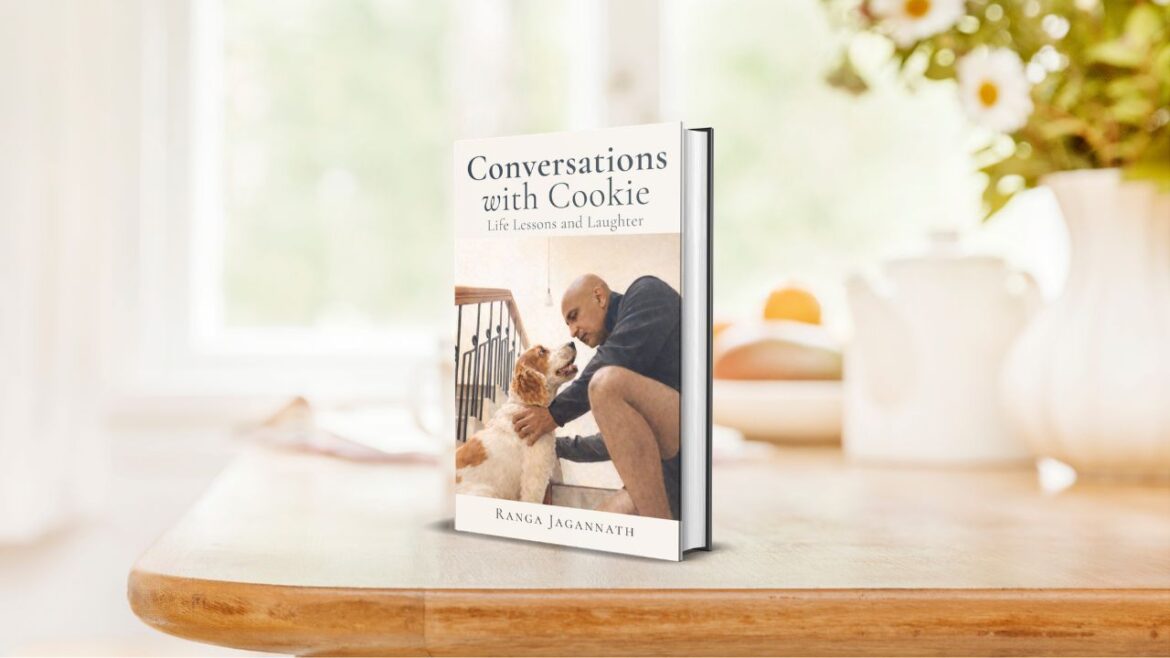
Ranga Jagannath’s Conversations with Cookie enters contemporary nonfiction as an inventive blend of humour, introspection, and philosophical inquiry. At first glance, the premise—dialogue-driven essays between the author and his late Cocker Spaniel—seems whimsical, even eccentric. But beneath this playfulness lies a carefully constructed exploration of modern anxieties and the cultivated art of stepping away from them. Through 52 illustrated essays, the book offers not just reflection but a structural and thematic study of how fiction, humour, and memoir can converge into a cohesive narrative on conscious living.
From a critical standpoint, the book’s most notable strength is its narrative architecture. The decision to use Cookie as a questioning, sarcastic, and unexpectedly wise conversational partner allows the author to interrogate his own assumptions without resorting to didactic exposition. This framing device transforms what might have been a traditional essay collection into a dynamic, dialogic text. Cookie’s voice is a deliberate literary construct—sharp, humorous, and perceptive—serving as both foil and conscience. The dialogues enable emotional distance, making self-analysis more palatable and theatrically engaging.
Stylistically, the prose is crisp, contemporary, and rhythmically calibrated. Jagannath writes with a clarity that belies the complexity of his themes. Humour is deployed not as decoration but as structural scaffolding. It punctures self-seriousness and enables the reader to approach heavy topics—burnout, imposter syndrome, digital addiction, the paralysis of ambition—without emotional fatigue. The comedic timing, particularly Cookie’s deadpan delivery and wry one-liners, is one of the book’s artistic triumphs.
Yet the book’s humour does not dilute its reflective intensity. Instead, it heightens it. By embedding insight within banter, the text embraces a narrative strategy reminiscent of philosophical fables, comics with moral undertones, and introspective dialogue traditions. It is no coincidence that comparisons to Calvin & Hobbes are invited in the description; the structural influence is evident in the way humour intersects with human truth.
Thematically, the book excels at capturing contemporary restlessness. Jagannath explores the pressures of productivity culture with nuance, recognizing both its seduction and its cost. His reflections on digital distraction feel acutely relevant, embodying the fractured attention spans that define today’s mental landscape. Cookie’s critiques serve as prompts for deeper questions: Who are we without external validation? Why do we fear slowing down? What identities collapse when we stop measuring ourselves by output?
The essays addressing ambition, aging dreams, and the subtle erosion of curiosity demonstrate some of the book’s strongest writing. Here, the author balances sharp self-awareness with emotional vulnerability, crafting passages that resonate beyond personal narrative. However, the reliance on autobiographical framing does occasionally narrow the thematic scope; certain insights, while evocative, remain centered on individual experience rather than expansive social critique.
Structurally, the book’s episodic format is both strength and constraint. The short essays make the book accessible and engaging, but some ideas could benefit from deeper exploration. The brevity sometimes leaves readers wanting more elaboration, particularly when the text raises profound questions but resolves them with light humour or gentle ambiguity. Yet this stylistic choice also reinforces the book’s central philosophy: that self-inquiry is continuous, not neatly concluded.
The integration of illustration is noteworthy. Visually, the book echoes graphic essay traditions, where images reinforce thematic tone. The art lightens the emotional load, underscores comedic beats, and creates a visual rhythm that complements the text.
From a literary standpoint, the construction of Cookie as a posthumous conversational partner is particularly compelling. Cookie functions as memory, conscience, anchor, and muse. This creative choice introduces layers of poignancy—grief, nostalgia, companionship—without explicit sentimentalism. The emotional restraint is admirable; the book avoids romanticizing loss while honouring the quiet psychological space a pet occupies in human life.
Critically, the book’s accessibility is both an advantage and potential limitation. Readers searching for rigorous philosophical analysis or deeply argued sociological critique may find the reflections more impressionistic than analytical. The book chooses intimacy over academic depth, wit over formal theory, and experiential truth over structured argumentation. This is not a flaw but a stylistic decision that defines its genre identity.
What elevates the work is its sincerity. Despite its playfulness, the book never feels trivial. There is a disciplined intentionality in the writing: each essay nudges the reader toward awareness, not through instruction but through recognition. Jagannath’s strength lies in presenting modern chaos with empathy, humour, and a willingness to critique himself as much as the systems he inhabits.
In conclusion, Conversations with Cookie is a skillfully crafted, thoughtful, and stylistically inventive contribution to reflective nonfiction. Its blend of humour, dialogue, and philosophical undercurrents offers a refreshing and emotionally resonant reading experience. While not academic in structure, it succeeds brilliantly in what it sets out to do: invite readers to laugh, reflect, and reconsider the patterns shaping their lives. It is a book of lightness with depth, simplicity with intelligence, and wit with heart—a testament to the unexpected wisdom of a dog and the human willing to listen.