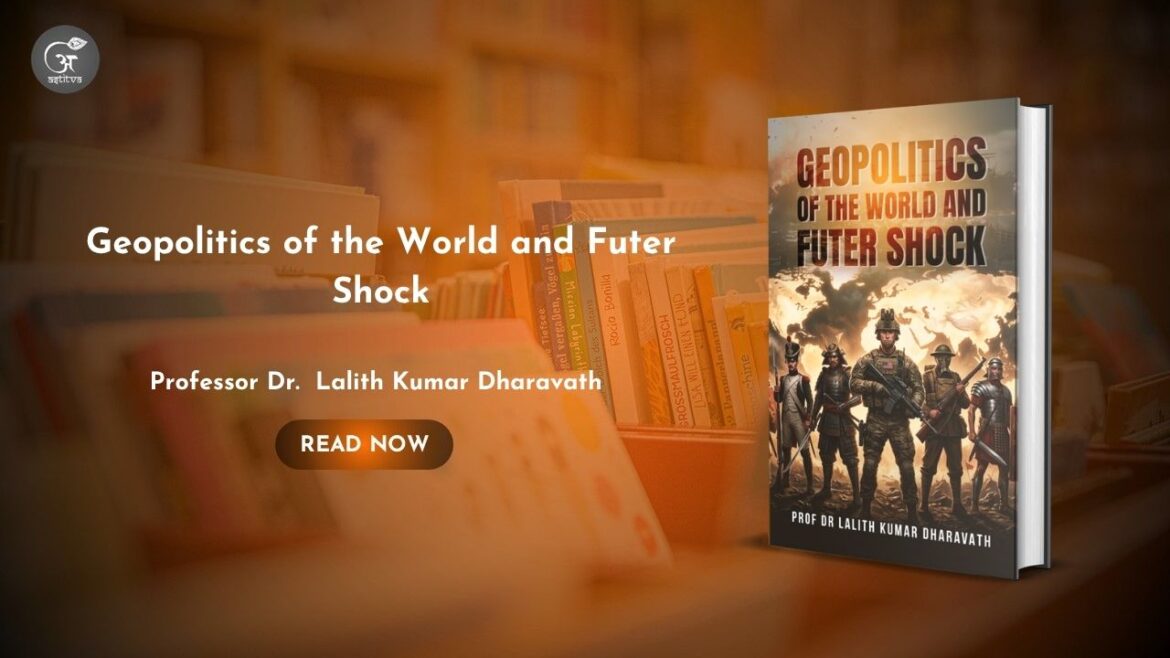
Geopolitics of the World and Future Shock arrives at a moment when the global order is shifting faster than our ability to interpret it. The book explores one of the most debated assumptions in modern strategic thought—the belief that a Third World War is improbable. Rooted in what historian John Lewis Gaddis termed “The Long Peace,” and later expanded by cognitive psychologist Steven Pinker, this thesis suggests that nuclear deterrence, economic interdependence, and the unimaginable costs of modern conflict have made great-power wars irrational.
But the author does not stop at established interpretations. By introducing the lens of Future Shock, a concept warned by futurist Alvin Toffler, the book argues that the 2020s represent an era of “poly-crisis”—a moment when multiple destabilizing forces collide. Toffler predicted that societies would experience disorientation and paralysis when faced with “too much change in too short a time.” Today, this prediction feels alarmingly prophetic. Technological velocity, demographic shifts, ideological extremism, and environmental volatility have combined to produce a world that often feels ungovernable.
The book highlights how even institutions that once promoted global cooperation have begun sounding warnings. The World Economic Forum now lists “Geoeconomic Confrontation” as a top global risk, indicating a shift where trade—once the backbone of peace—is rapidly becoming an arena of competition. Concepts like “strategic autonomy,” once peripheral, have become central to national policy, redefining alliances and creating new fractures in the global system.
Through its analysis, the book raises a critical question: Has the world moved beyond the stability that made “The Long Peace” possible? Or is humanity simply transitioning into a new phase of geopolitical negotiation where power, technology, and identity collide in unpredictable ways? Geopolitics of the World and Future Shock does not claim to offer easy conclusions; instead, it provides the intellectual tools to understand the turbulence shaping the twenty-first century.
Behind this powerful work stands Professor (Dr) Lalith Kumar Dharavath, a scholar whose contributions to academia and contemporary thought are both vast and transformative. A prolific author with over 120 books and more than 40 research articles, Dr. Dharavath has established himself as one of the most compelling modern voices in socio-administrative theory. His groundbreaking Resilience Theory Tanda Gor Banjar and his Reciprocity Theory and Practice illuminate how traditional communities adapt, sustain themselves, and evolve within modern political landscapes.
His scholarship is multidimensional—bridging anthropology, governance, sociology, and geopolitical analysis. As an academic leader, editor, and advisor to numerous scholarly institutions, Dr. Dharavath has shaped intellectual discourse on both national and global stages. His work is driven by a commitment to understanding the complexities of contemporary society, especially the “poly-crises” that define this era.
As an educator, he continues to inspire and mentor the next generation, ensuring that theories of resilience, reciprocity, and adaptive governance are not just studied but implemented. Geopolitics of the World and Future Shock is yet another landmark in his extraordinary journey—an essential contribution for anyone seeking clarity in a rapidly changing world.