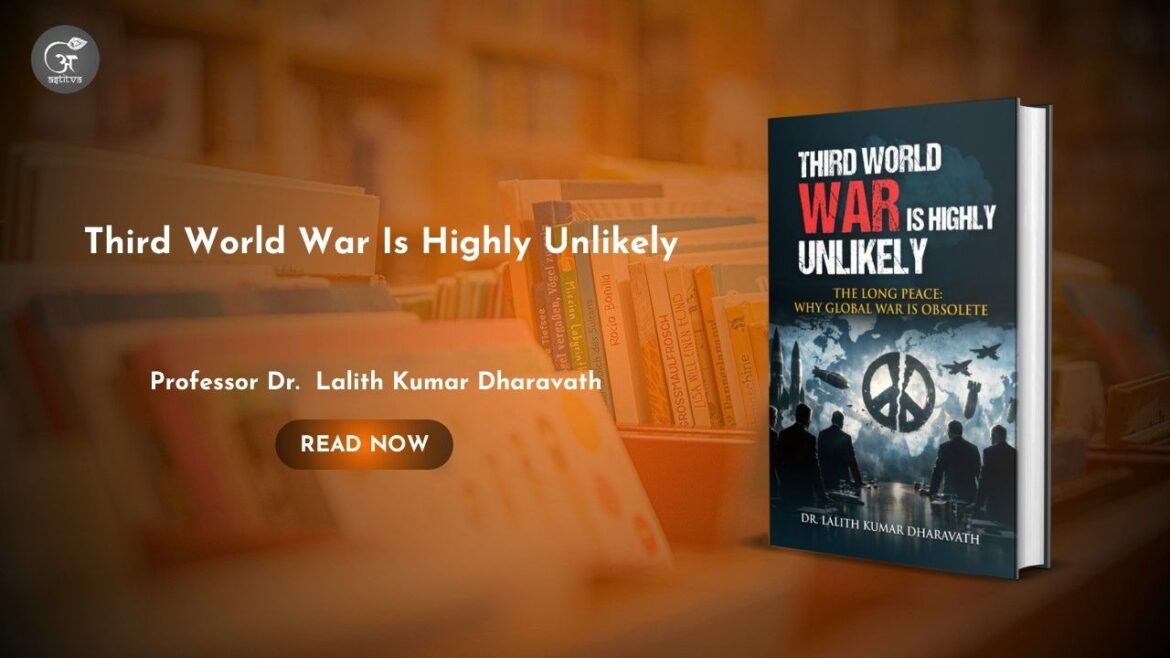
The much-anticipated book Third World War is Highly Unlikely (The Long Peace: Why Global War is Obsolete) by Prof. Dr. Lalith Kumar Dharavath has been officially released, offering a timely and deeply researched perspective on one of the most pressing questions of global security: Is a Third World War still possible in today’s world? At a time when geopolitical tensions, technological disruptions, and economic rivalries dominate global discourse, this work presents a refreshing counter-narrative grounded in historical analysis, contemporary data, and forward-looking geopolitical interpretation.
The book presents the argument that a Third World War is no longer a looming inevitability but an obsolete concept shaped by an evolved “Architecture of Stability.” This architecture—comprising automated nuclear deterrence, deep global economic interdependence, and the rise of non-aligned, multi-vector diplomacy—has fundamentally altered the way nations perceive and engage in conflict. The author explains that the nature of warfare has shifted from territorial invasions to a more complex, subtle, and pervasive “Grey Zone” where cyber operations, digital surveillance, financial warfare, and technological competition have replaced traditional battlefield confrontations. In such an interconnected global ecosystem, the very idea of a large-scale physical conflict becomes economically suicidal and strategically irrational.
Prof. Dharavath revisits the fear that gripped humanity for nearly a century, beginning with the atomic age and continuing through the long shadows of the Cold War. Despite repeated predictions of an apocalyptic global conflict, the post-1945 period, known widely as the “Long Peace,” has endured. The book analyses how this remarkable stability has survived ideological shifts, the rise and fall of empires, regional conflicts, nuclear proliferation, and rapid technological change. It argues persuasively that peace is not accidental—it is engineered. It is the result of a “Triple Lock” system that physically deters aggression, materially binds nations together, and psychologically discourages leaders from triggering catastrophic escalation.
A compelling dimension of this work is its examination of India’s emerging global role. Prof. Dharavath positions India and the wider Global South as the world’s new “Diplomatic Circuit Breakers,” capable of absorbing shocks, mediating tensions, and steering global politics away from rigid, bipolar escalation. India’s growing influence as a Vishwa Mitra, or global friend, reflects its ability to maintain strategic autonomy while fostering cooperation across competing blocs. In a world where diplomacy increasingly outweighs military force, India’s ascent offers a stabilizing counterbalance in the international arena.
The release of this book marks another milestone in the distinguished career of Prof. Dr. Lalith Kumar Dharavath, a renowned academic, researcher, and modern thinker. A retired Professor of Public Administration at Osmania University, he has authored more than 120 books, guided over 25 Ph.D. scholars, and contributed significantly to intellectual discourse through his pioneering theories, including Resilience Theory Tanda Gor Banjar and Reciprocity Theory and Practice. His scholarly legacy, enriched by decades of research and global academic engagement, lends exceptional depth to this new work.
Third World War is Highly Unlikely stands as a profound reminder that humanity has built a world too interconnected to destroy and too valuable to risk. It invites readers, policymakers, and scholars alike to reconsider global security through the lens of stability rather than fear, offering a powerful vision of a future shaped not by war but by managed peace.