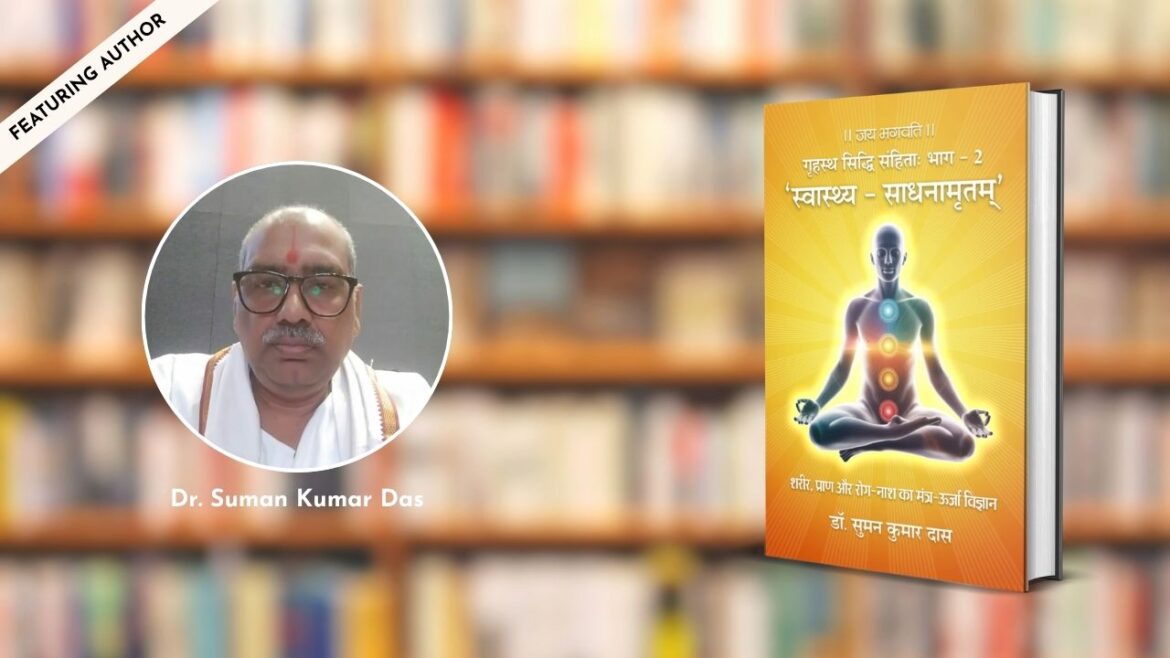
In a world increasingly driven by external cures and quick-fix solutions, Dr. Suman Kumar Das stands as a rare voice reminding humanity that true healing begins from within—from the subtle currents of energy that animate the human body, the vibrations that shape consciousness, and the intentions that govern health. His work, Gṛhastha Siddhi Samhita – Bhag II: “Swasthya Sadhanamṛtam”, emerges from decades of lived experience, scientific exploration, and deep spiritual practice. It is a work born not just of scholarship but of sadhana; not just of knowledge but of realization. In its pages, Dr. Das invites the reader to see health as something more than the absence of disease—he invites them to see it as harmony between sharir, prana, and consciousness.
What makes Dr. Suman’s journey remarkable is its breadth. From an international career across Central Asia and Russia to his return to India with a renewed sense of purpose, his life traces a path of continuous evolution. Rather than separating his scientific curiosity from his spiritual inclinations, he allowed the two to inform each other. His background in research, fieldwork, and ecological innovation blended seamlessly with his dedication to mantra sadhana and consciousness studies. This rare integration shaped the foundation of his later work—Mantra Urja Vigyan, the science of vibrational healing.
The Gṛhastha Siddhi Samhita series reflects a lifetime of inquiry into how human beings can lead balanced, awakened, and energetically aligned lives while fulfilling worldly responsibilities. The second volume, Swasthya Sadhanamṛtam, carries the essence of Dr. Das’s vision: that health is a multi-dimensional phenomenon where the body, mind, prana, and deeper awareness flow as a single continuum. He explains that disease does not originate only in bodily imbalances; it begins in subtle disturbances—fractured breath rhythms, fractured emotional states, and fractured energetic patterns. Healing, therefore, must move beyond physical symptoms and address the vibrational architecture of human existence.
Dr. Das’s ability to articulate ancient wisdom in a structured, scientific manner makes his work especially relevant today. In his writing, mantras are not portrayed merely as devotional chants; they are energetic codes carrying measurable impact on the nervous system, endocrine balance, cellular communication, and pranic flow. He brings forward the understanding that a mantra is a technology—precise, repeatable, transformative. Through his research and practice, he demonstrates how mantra japa can recalibrate brain-wave patterns, influence neurochemical responses, and dissolve energetic blocks that manifest as chronic ailments. This perspective elevates the conversation on wellness to an entirely new domain—one where consciousness is not an abstract concept but a dynamic force shaping health.
His commitment to integrating spirituality with practical living is reflected in his role as Founder-Peethacharya of Lalita Divyashram, a unique Mahavidya Siddha Peeth in Khajuraho. The Ashram stands as a crucible where mantra research, yogic practices, ecological sustainability, and regenerative agriculture coexist. Dr. Das’s work in Gau Krishi Vanijyam—cow-centric regenerative farming—reflects his belief that health must be viewed not only at an individual level but at the level of environment, soil, food, and community. For him, healing is not a solitary pursuit; it is a symbiotic process tied to nature, consciousness, and collective wellbeing.
His role as a spiritual teacher and guide further enriches his writing. Thousands of seekers have found clarity, balance, and transformation through his teachings on Mantra Yoga, Vibrational Healing, and holistic living. He possesses the rare ability to simplify profound concepts without diluting their depth. Whether speaking about pranic alignment, the neurobiology of mantras, or the karmic underpinnings of disease, he brings together scientific precision and experiential wisdom with effortless naturalness.
Dr. Das is not just a teacher or researcher; he is a storyteller of energy, consciousness, and the inner sciences of life. His narrative style carries warmth and sincerity, making complex ideas accessible to the modern reader without losing their spiritual essence. His books reflect the same quality—practical yet profound, rooted in tradition yet relevant to contemporary life. They do not promise instant miracles; instead, they offer a pathway of discipline, awareness, and inner responsibility.
What truly defines him as an author is his dedication to bridging worlds that are often seen as separate: science and spirituality, ancient knowledge and modern research, household life and inner realization. He writes for the seeker who wants to heal, the researcher who wants to understand, the householder who wants to balance responsibilities with spiritual growth, and the practitioner who wants to deepen their sadhana. His work speaks to anyone who believes that health is not merely physical maintenance but the art of living in energetic harmony.
Through Swasthya Sadhanamṛtam, Dr. Das extends an invitation—to reclaim the power of prana, rediscover the science of mantras, and realign life with the vibrational intelligence that governs the universe. He reminds readers that healing begins with awareness, grows through discipline, and culminates in transformation. The book stands as a testament to his life’s mission: to empower individuals with the knowledge and tools to awaken health, energy, and consciousness.
In a rapidly changing world where people seek meaning and wellbeing beyond material success, Dr. Suman Kumar Das offers a vision rooted in timeless wisdom yet grounded in everyday life. His work is a guide for those who wish not only to treat the body but to understand it; not only to manage illness but to dissolve it from its source; not only to live, but to live consciously, vibrantly, and purposefully. Through his writing and his teachings, he continues to illuminate the path of inner awakening—one mantra, one breath, one insight at a time.