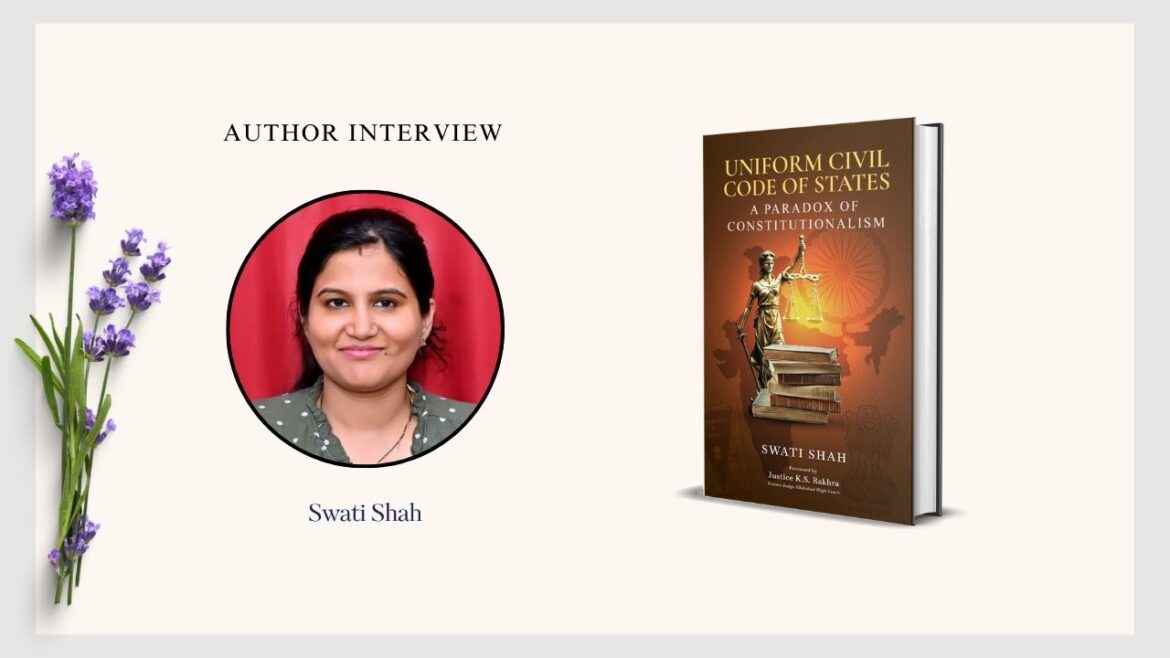
The Literature Times: What inspired you to write Uniform Civil Code of States: A Paradox of Constitutionalism, and why did you choose this topic at this particular time?
Swati Shah: It was inspired by my deep engagement with constitutional law from the time I was pursuing my LL.M. The debate surrounding the Uniform Civil Code has always been one of the most significant constitutional and socio-legal issues which deals with principles of equality, secularism, federalism, and religious freedom. I chose to write Uniform Civil Code of States: A Paradox of Constitutionalism at a time when discussions around the UCC had gained renewed momentum across the country. Several States Like Uttarakhand ,Gujarat, Assam have already enacted different uniform civil code applicable within their States which in my opinion is contrary to the conscience of the Constitution which is not only a law but a living document as per the opinion of Dr. B.R Ambedkar, Y.V. Chandrachud (Chief Justice of India), not only a Union of States but Unitary Nation which abides by one Constitution, one civil code, uniform criminal code applicable to all citizens and separate uniform civil code for separate States are not only contrary to the beliefs of the founding fathers, but also against the Directive Principles of State Policy enshrined under Article 44 Part IV of the Constitution.
The Literature Times: The Uniform Civil Code remains one of the most debated constitutional issues in India. What unique perspective does your book bring to this discussion?
Swati Shah: Yes, the topic has been one of the most debatable constitutional issues; but India is progressing towards reforming its old laws with new ones with sine qua non reforms beginning from modernisation of criminal laws in our country namely Bhartiye Nyaya Sanhita, Bhartiya Nagrik Surasha Sanhita, 2023 Bhartiye Sakhsh Adhiniyam, 2023. These laws are not only uniform for all citizens within India but also modern as they cover stringent punishments and speedy trial for repeat offenders of sexual crimes. Non-uniform civil laws within India is actually working against New India as they fail to prohibit polygamy, gender biasedness within the domestic frontiers. States of India are making separate uniform civil laws which are of course, uniform for the citizens of that State but are largely leaving the marginalised tribal communities as an exception to the law, making live-in relationship registration compulsory violating the Right to privacy under Article 21, departure from the spirit of Article 44 of Constitution which calls for one uniform civil code for India and not multiple uniform civil code within India. Legally, legislating different uniform civil codes is possible but it can only form part of a colourable legislation which needs to be checked by the apex Court in India.
The Literature Times: While researching this book, what were some of the most surprising insights you discovered about personal laws and constitutional reforms?
Swati Shah: Constitutional law and personal laws were always considered as separate and could not overlap in the opinion of the Courts when Independence was new to India contrary to the New India which beliefs that personal laws govern the person like any other law and are subject to rule of law under Article 14 of Constitution of India; Bombay High Court in State of Bombay v Narasu Appa Mali held that personal laws are not “law in force” within the meaning of Article 13 and therefore, they are not directly subject to challenge for violating Fundamental Rights under Article 13. It took almost 6 decades to come to the conclusion that personal laws are subject to State scrutiny if they violate personal freedom of citizens. In 2017 when the landmark case Shayara Bano came up for final verdict not only the judicial opinion, opinion of the legal fraternity, opinion of victim changed but it put the whole immoral practices within the religious tenets of a person in the lens of every citizen of India. Constitutional reforms and personal law lie on the same principles of rule of law and Equality and reforms within personal law are checked by Supreme Court of India as the Guardian of the Constitution.
In India Hindu personal law was made uniform in 1955 and 1956 with enactment of Hindu Marriage Act, 1955, Hindu Minority and Guardianship Act, 1956, Hindu Adoption and Maintenance Act, 1956 and Hindu Succession Act, 1956 for all Hindus, (Sikhs, Jains and Buddhist) who are also deemed Hindus for the purpose of applicability of law. Its applicability was not only wider but also the law made bigamy as a punishable offence under section 17 of Hindu Marriage, Act 1955. Second marriage between two Hindus during the life-time of first spouse will make him/her liable to punishment under section 82 of Bhartiye Nyaya Sanhita formely known as I.P.C. It criminalizes marrying again while a spouse is living. The offence carries up to 7 years in prison, extending to 10 years if the first marriage is concealed from the new partner. Personal law of Muslims on the other hand, does not prohibit polygamy for men and thus, any second marriage solemnized between two Muslims do not attract penalty under Bhartiye Nyaya Sanhita or any other Act. In 2017 Shayara Bano case changed the Constitutional history of Indian Muslims contracting Triple Talaq by penalizing it (also termed as the most evil talaq). We can say that journey of constitutional reforms in personal laws of Muslims started from Shayara Bano case and will end with pan-India application of uniform civil code which can ban polygamy among Indian Muslims. It is also very surprising that our Neighbouring countries like Turkey, Pakistan, Afghanistan have already banned Triple Talaq prior to 2017. In India practice of triple Talaq was termed as legal in the name of Sharia despite the fact that it contravened Quranic Principles which lay the foundation of Muslim Law. If we examine polygamy through the lens of constitution, it is illegal, immoral and against the principles of Rule of Law; personal law is based on sound principles, rationality and common understanding of equal principles between men and women. Under Quranic principles also second marriage between Muslims while the first spouse is alive is not a general rule but an exception and unforeseen circumstances. The application of uniform civil code instead of separate personal laws can completely reform those lacunas where Sharia law is misinterpreted and misunderstood.
The Literature Times: How do you address the balance between religious freedom and the constitutional principles of equality and justice in your book?
Swati Shah: Freedom of religion is guaranteed as Fundamental Right under Article 25 of Constitution to every Individual. The principles of Justice and Equality is soul of Constitution embodied in Preamble which is again key to the Constitution including of course, Fundamental Rights. Right to Equality and Justice is also protected as Fundamental Right under Article 14 and 32 Right to Constitutional Remedies. Now, the balance among religious Freedom, Justice and Equality requires understanding of competing interests and exception to the religious Freedom provided under Article 25 itself by the inclusion of three broad terms “public order, morality and health”.
The Literature Times: You have discussed significant judicial observations, including the Minerva Mills case. Why do you believe these judgments are crucial to understanding the Uniform Civil Code debate?
Swati Shah: Judicial decisions are the cornerstone of constitutional interpretation, and they provide the legal framework within which debates on the Uniform Civil Code must be understood. In my book, I discuss landmark judgments, including Minerva Mills v. Union of India, because they reaffirm fundamental constitutional principles such as the supremacy of the Constitution, the harmony between Fundamental Rights and Directive Principles of State Policy, and the doctrine of the Constitution’s basic structure.
The Uniform Civil Code debate cannot be viewed in isolation. It must be examined in the broader context of constitutional values, including equality, religious freedom, dignity, secularism, and the rule of law. Judgments like Minerva Mills remind us that the Constitution does not place Fundamental Rights and Directive Principles in conflict; rather, it envisions a harmonious balance between them. This principle is particularly relevant when discussing Article 44, which encourages the State to strive for a Uniform Civil Code while remaining mindful of the guarantees contained in Part III of the Constitution.
The judiciary has also consistently emphasized that constitutional interpretation must preserve the delicate balance between individual liberties and the State’s pursuit of social reform. These judicial observations provide valuable guidance on how constitutional goals should be pursued within the limits of constitutionalism and democratic governance.
By examining these landmark decisions, I encourage readers to appreciate that the debate on the Uniform Civil Code is not merely a political or social issue but a constitutional conversation shaped by decades of judicial reasoning. Understanding these judgments enables readers to engage with the subject in a more informed, balanced, and legally grounded manner.
The Literature Times: How does your book help law students, judicial service aspirants, and researchers better understand Constitutional Law?
Swati Shah: The book is definitely going to aid law students, judicial aspirants and researchers as to constitutional debate of uniform civil code one requires to understand how the Preamble of the Constitution deals reflects the minds of the founding fathers and a guide to the Constitution, how Indian Constitution adheres to Constitutionalism meaning thereby it prohibits any arbitrariness in the hands of the Government; understand the relationship among the Centre and States, better understanding of Fundamental Rights such as Article 12 which is State, Article 13- definition of law, Article 14 embodying rule of law, Article 25 giving Religious Freedom and Article 32 giving Right to constitutional Remedies. Directive Principles of State Policy are most important part of the syllabus of judicial competitive examinations; Article 44 which makes provision for Uniform civil code being the most important directive principles reflecting the intent of the constitutional makers.
The Literature Times: What challenges did you face while simplifying such a complex and sensitive constitutional subject for a broader audience?
Swati Shah: I faced numerous challenges as the subject is not only sensitive dealing with Gender Justice in a federal diverse India but also there is so much confusion regarding implementation of state-based uniform civil codes. The book caters to the need of new law students, researchers pursuing doctorate in law so obviously, the complex situation of diverse India and its personal laws needed holistic approach which I have tried to do through my book. Presenting these issues in a manner that is understandable to students, researchers, legal practitioners, and general readers without oversimplifying the law required careful thought. Another challenge was preserving neutrality. The Uniform Civil Code is one of the most debated constitutional issues in India, with strong and often conflicting viewpoints. I aimed to present the constitutional provisions, judicial precedents, Law Commission reports, and state developments objectively, allowing readers to understand the legal framework and competing arguments before forming their own opinions. Simplifying legal terminology also required considerable effort. Constitutional doctrines, statutory provisions, and judicial reasoning often involve technical language. I translated these concepts into clear, accessible explanations while ensuring that their legal meaning and constitutional significance remained intact.A further challenge was dealing with a rapidly evolving legal landscape. With states such as Uttarakhand implementing a Uniform Civil Code and other states considering similar measures, it was important to incorporate the latest legislative developments and judicial interpretations while acknowledging that constitutional law continues to evolve.
Finally, I wanted the book to encourage informed constitutional dialogue rather than merely advocate a particular viewpoint. My objective was to make constitutional law accessible to a wider audience and to promote thoughtful engagement with one of India’s most significant legal and social debates, while remaining faithful to constitutional principles and the rule of law.
The Literature Times: Your book also examines legal reforms in other countries. How can India’s lawmakers and legal scholars learn from these international experiences?
Swati Shah: When Shayara Bano case was heard by Supreme Court of India, the Court cited the example of Afghanistan, Turkey and Pakistan which have already banned Triple Talaq before India. In countries like Turkey, Nepal, Egypt uniform civil code is applicable giving equal rights to women in marriage, divorce, adoption and inheritance. Why should India lag behind other Nations? Indian Parliament needs to examine the fact that these Nations have implemented uniform legislation for civil rights of citizens in their stage of development, state-based legislation for civil rights in India would do more harm than good.
For India’s lawmakers, the most important lesson is to ensure that any legal reform remains firmly rooted in the Constitution of India. Constitutional values such as justice, equality, dignity, secularism, and the rule of law should guide every stage of the reform process. Comparative experiences can help identify best practices in legislative drafting, stakeholder engagement, and implementation while avoiding mistakes made elsewhere.
For legal scholars, studying international reforms encourages critical thinking and evidence-based research. It enables them to evaluate different legal models, judicial approaches, and policy outcomes, thereby contributing to a more informed constitutional discourse. Rather than advocating the adoption of any single foreign model, I believe comparative constitutional law should inspire thoughtful, context-specific solutions that are compatible with India’s pluralistic society and constitutional vision.
The Literature Times: As someone who has qualified competitive examinations such as CLAT, UP PCS (J) Mains, and UGC-NET, what advice would you give to aspiring law students and judicial service candidates?
Swati Shah: Understanding constitutional principles is the foremost requirement for any legal competitive exams in India. My recommendation to students and judiciary aspirants would be to understand all the legal developments and reforms pertaining to Constitution. Uniform civil code is not just one provision of Constitutional law but it covers detailed study of personal codified law applicable in India. My advice is to build a strong foundation in the basics of law. Whether you are preparing for CLAT, judicial services, UGC-NET, or any other competitive examination, conceptual clarity is far more valuable than rote memorization. A thorough understanding of the Constitution, major statutes, and landmark judicial decisions forms the backbone of legal education and competitive success.
Equally important is consistency. Success in legal examinations is not determined by the number of hours one studies in a single day but by disciplined, sustained preparation over time. Regular revision, solving previous years’ question papers, and staying updated with recent judgments and legislative developments are indispensable.
The Literature Times: What do you hope readers will take away from Uniform Civil Code of States: A Paradox of Constitutionalism, and are there any future writing projects you are currently working on?
Swati Shah: Above all, I hope readers come away with a deeper appreciation of the constitutional complexities surrounding the Uniform Civil Code. My objective was not to persuade readers toward a particular viewpoint but to encourage them to engage critically with the constitutional, legal, and social dimensions of this important subject. I want the book to serve as a resource that promotes informed dialogue, constitutional literacy, and evidence-based discussion among students, legal professionals, policymakers, and the general public.
I also hope readers recognize that constitutionalism is not simply about the enactment of laws but about ensuring that every legal reform is guided by the values enshrined in the Constitution—justice, equality, liberty, dignity, secularism, and the rule of law. A meaningful constitutional discourse must respect India’s diversity while remaining committed to these enduring constitutional principles.
As for my future writing, I intend to continue researching and writing on contemporary issues in constitutional law and public policy. I am particularly interested in exploring subjects such as constitutional governance, judicial reforms, the intersection of technology and law, gender justice, and emerging challenges in legal regulation. My aim is to produce scholarship that is academically rigorous, practically relevant, and accessible to a wider audience.
Writing this book has reinforced my belief that legal scholarship should not remain confined to academic circles. It should contribute to public understanding, inspire meaningful debate, and support the continued evolution of constitutional thought in India. I look forward to undertaking future projects that further this mission and contribute to India’s growing body of legal scholarship.