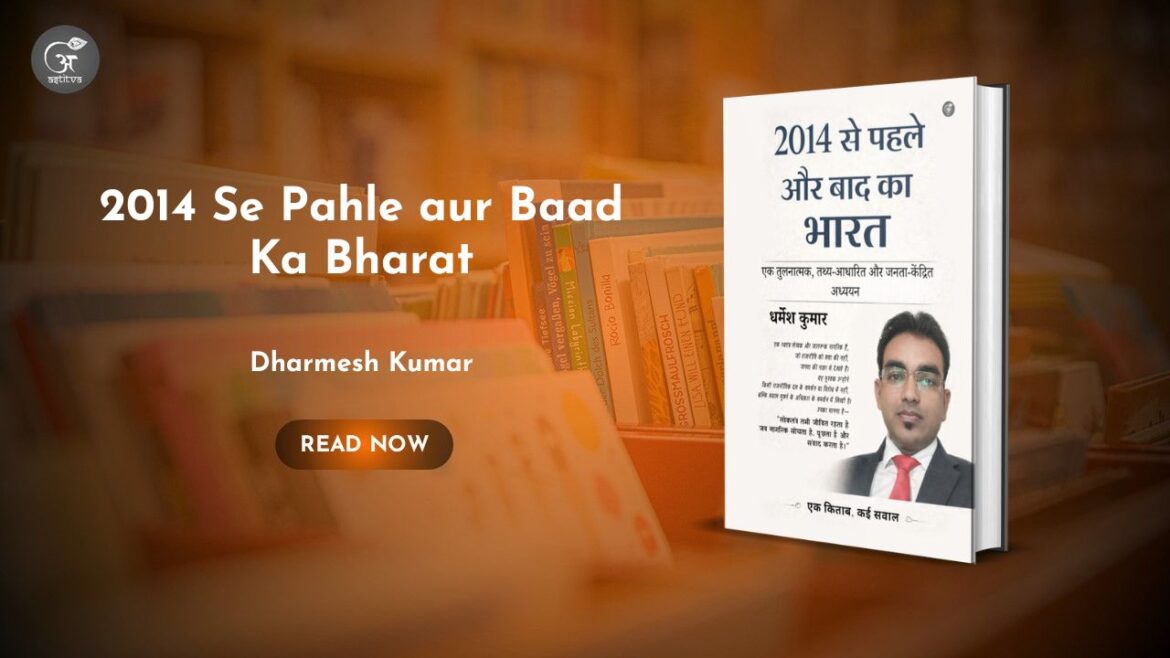
In today’s times—when discussions on politics and social issues are often confined merely to the binary of the ruling side versus the opposition—*2014 Se Pahle aur Baad Ka Bharat* (India Before and After 2014) by Dharmesh Kumar emerges as a distinct and thought-provoking book. This volume does not take a stance either in favor of or against any specific government or individual; rather, it brings to the forefront the voice of the common citizen—the citizen who participates in every election, harbors expectations from every budget, yet often finds themselves feeling crushed under the weight of burdens.
This book is, in essence, a mirror reflecting the realities of various segments of society. It captures the anxieties of the middle class, whose savings are dwindling despite their rising incomes. It voices the plight of the youth, who, even after attaining higher education, continue to struggle in their quest for employment. It tells the stories of farmers who toil to cultivate their crops but fail to receive a fair price for their produce. Furthermore, the book also gives space to the narratives of women—those whose hard work and contributions are all too often overlooked.
Dharmesh Kumar’s work does not seek to impose a definitive conclusion; instead, it serves to raise questions. This book compels us to ponder: Are we truly grasping the realities of our society and our nation? Are we exercising our rights effectively? And, most importantly—is it wrong to ask questions? This book makes it clear that asking questions is not a sign of insensitivity or a lack of patriotism, but rather the hallmark of an engaged citizen. It reflects a blend of factual perspective and empathetic thought—qualities that set it apart from other political or social books.
*India: Before and After 2014* is a book that not only informs readers but also inspires them to think critically, seek understanding, and form their own opinions. It is meant for anyone who wishes to gain a deeper understanding of the world around them.
This book serves as a voice—the voice of the silent, of their questions, and of their experiences. And perhaps, therein lies its greatest strength.