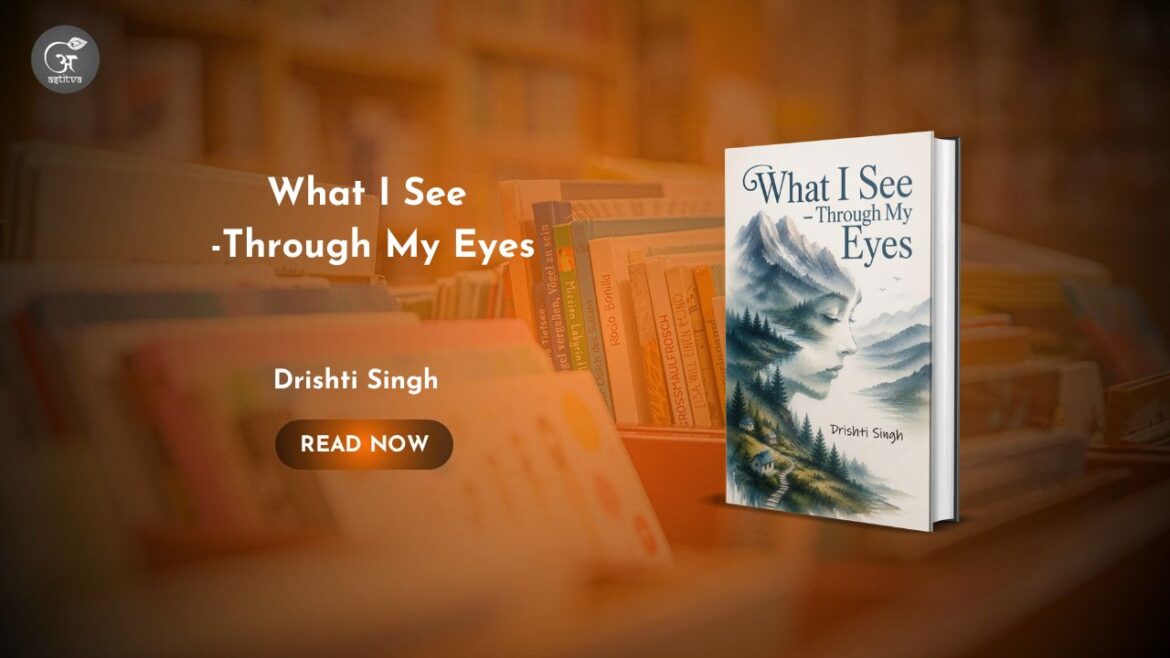
What I See (Through My Eyes) by Drishti Singh is a deeply personal collection of poetry, reflections, and observations that offers readers an intimate glimpse into the mind of a young writer finding her voice.
Written at the age of sixteen, the book explores identity, belonging, friendship, growing up, loneliness, comparison, love, nature, and the complicated emotions that often remain unspoken. Through simple yet striking words, Drishti invites readers to pause and look at familiar experiences from a different perspective—through her eyes.
The book begins with the question, “Who am I?” From there, Drishti takes readers through different aspects of her inner world, exploring the contradictions that make us human—being confident yet unsure, social yet introverted, deeply caring yet distant, and alive while sometimes feeling as though one is barely living.
Her experiences of growing up as an Army child form an important part of the book. Poems such as Delhi, Olive Green, and Growing Up reflect on changing schools, moving between cities, forming friendships, and learning to say goodbye. Her connection with Delhi and the colour olive green becomes a reflection of memories, identity, discipline, courage, and belonging.
The book also explores the complexities of relationships. A Stranger I Knew Too Well, To My Best Friend, My Anchor, and Trying to Be Wanted capture the vulnerability of friendship, the fear of losing people, the desire to be understood, and the struggle of supporting others while carrying one’s own emotional weight.
Nature becomes another language through which Drishti expresses emotion. In Colours, Rain, Moon, Sunset, and Sunflowers, ordinary elements of the world become reflections of memory, longing, beauty, and change.
The later chapters turn inward, exploring self-comparison, expectations, identity, social behaviour, and the search for peace. Pieces such as The Crowd and The Kid with the Broken Toy examine human contradictions and the ways people can both heal and hurt one another. The final chapter, Insights, leaves readers with reflections on hope, peace, overthinking, normalcy, and personal responsibility.
At its heart, What I See (Through My Eyes) is a coming-of-age work—honest, vulnerable, thoughtful, and deeply personal. It captures the emotional landscape of a young person trying to understand herself and the world around her.
The author describes the book as “the face of my rationality, my fear, my intelligence, my best skill, and the one thing that I cared enough to finish.” This honesty defines the spirit of the work. Rather than presenting a perfect version of growing up, Drishti allows readers to experience the uncertainty, contradictions, memories, questions, and emotions behind the surface.
What I See (Through My Eyes) is ultimately an invitation to slow down, look closer, and perhaps discover a version of yourself hidden somewhere between the words.