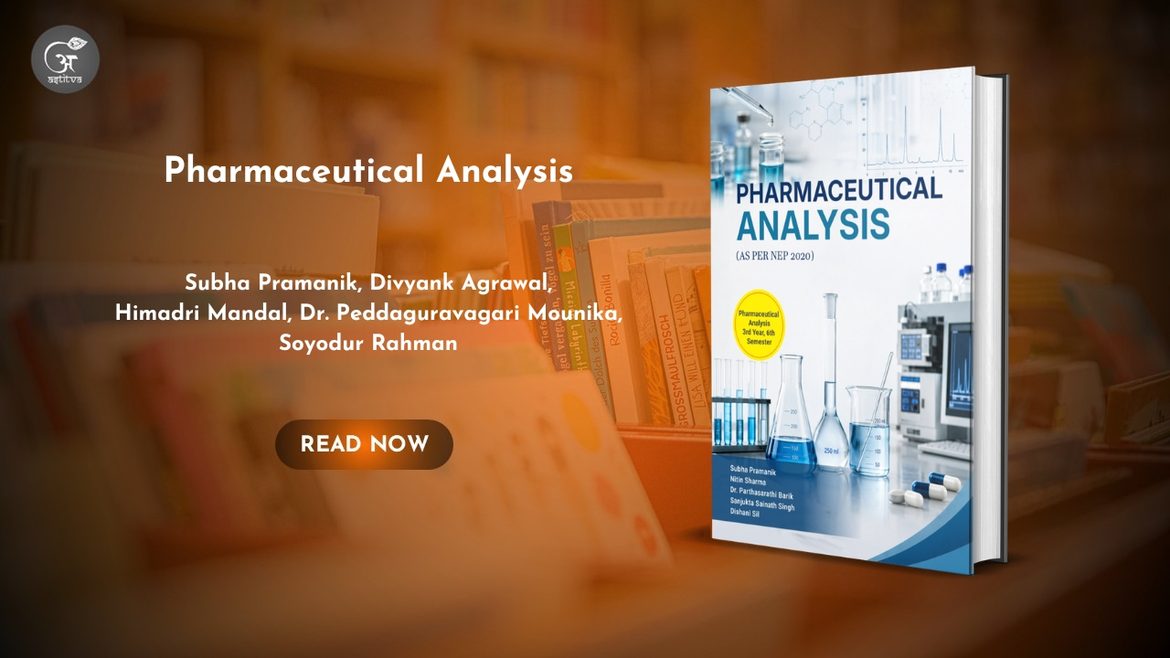
The much-awaited book Pharmaceutical Analysis, authored by Subha Pramanik, Divyank Agrawal, Himadri Mandal, Dr. Peddaguravagari Mounika, and Soyodur Rahman, with editorial contributions from Akash Shaw, Ramit Rahaman, and Pritam Kayal, has been released as a comprehensive academic resource for B.Pharm 3rd Year, Semester VI students. Designed in complete alignment with the latest 2026 Pharmacy syllabus, the book brings together fundamental concepts, advanced analytical techniques, practical pharmaceutical applications, and examination-oriented learning in a clear and systematic format.
Pharmaceutical analysis plays a fundamental role in pharmaceutical research, quality control, drug development, manufacturing, and regulatory evaluation. With modern medicines becoming increasingly complex, a strong understanding of analytical science is essential for pharmacy students and professionals. Recognizing this need, Pharmaceutical Analysis has been developed as both a theoretical textbook and a practical academic guide, helping students understand the principles, instrumentation, interpretation, and applications of important analytical techniques used in the pharmaceutical sciences.
The book is structured across all five core units of the prescribed curriculum and presents complex analytical concepts in an accessible and student-friendly manner. The first unit focuses on important electroanalytical techniques, including potentiometry, conductometry, polarography, and Karl Fischer titration. These topics introduce students to the principles and practical applications of electrochemical methods used in pharmaceutical analysis and quality assessment.
The second unit explores molecular spectroscopy, covering UV-Visible spectroscopy, deviations from the Beer-Lambert law, and Fourier Transform Infrared Spectroscopy (FTIR). The book explains the underlying principles, instrumentation, applications, and analytical significance of these techniques, enabling students to connect theoretical spectroscopy with real-world pharmaceutical analysis.
The third unit introduces important atomic and emission-based analytical methods, including fluorometry, flame photometry, atomic absorption spectrometry (AAS), and nepheloturbidometry. These techniques are explained with an emphasis on their principles, instrumentation, applications, and relevance to pharmaceutical quality control.
Units IV and V provide extensive coverage of chromatography and separation science. Students are introduced to column chromatography, thin-layer chromatography (TLC), paper chromatography, ion-exchange chromatography, electrophoresis, gas chromatography (GC), high-performance liquid chromatography (HPLC), and high-performance thin-layer chromatography (HPTLC). These methods are among the most important analytical tools used for the identification, separation, purification, characterization, and quantitative estimation of pharmaceutical substances.
One of the major strengths of the book is its syllabus-focused approach. The content has been carefully organized according to the latest 2026 curriculum, allowing students to systematically prepare for university examinations while developing a strong conceptual foundation. Alongside detailed theoretical explanations, the book incorporates mathematical derivations, instrumentation schematics, block diagrams, chemical equations, comparison tables, and step-by-step explanations to support visual and conceptual learning.
The textbook also adopts an exam-oriented approach to help students prepare effectively for assessments. It includes university-style Multiple Choice Questions, Short Answer Questions carrying 5 marks, and Long Answer Questions carrying 10 marks, supported by detailed model answers. This combination of conceptual learning and structured assessment makes the book particularly useful for classroom study, examination revision, and self-learning.
The authors bring together diverse academic and research expertise from pharmaceutical chemistry, pharmaceutics, analytical science, drug discovery, drug delivery, regulatory affairs, and quality assurance. Mr. Subha Pramanik, Assistant Professor at the School of Pharmacy, Arka Jain University, Jharkhand, has academic and research expertise in pharmaceutical chemistry, medicinal chemistry, rational drug design, in-silico drug discovery, synthesis, characterization, SAR studies, and biological evaluation of bioactive compounds, particularly in neuroprotective and anticancer research.
Mr. Divyank Agrawal is a pharmacy professional with an M.Pharm in Pharmaceutics whose academic interests encompass novel drug delivery systems, transdermal delivery, pharmaceutical technology, nanomedicine, artificial intelligence in healthcare, and digital health. His research and scientific interests include AI-driven drug discovery, transdermal drug delivery, and phytochemical and anthelmintic evaluation.
Himadri Mandal is an M.Pharm scholar in Pharmaceutics at Adamas University, Kolkata, with interests spanning pharmaceutics, drug delivery systems, regulatory affairs, and instrumental analysis. His academic and practical exposure includes industrial and hospital pharmacy training as well as participation in professional programmes related to drug discovery, intellectual property, HPTLC, and computational biology.
Dr. Peddaguravagari Mounika, Assistant Professor at JSS College of Pharmacy, JSSAHER, Mysuru, received her doctorate in Pharmaceutical Chemistry in 2025. Her research focuses on drug development, analytical and bioanalytical methodologies, Quality by Design, impurity profiling, and comparative evaluation of generic and branded pharmaceuticals. Her expertise includes advanced analytical instruments and techniques such as HPLC, GC, LC-MS, and NMR.
Soyodur Rahman, Assistant Professor in Pharmaceutical Chemistry and Quality Assurance at Saraswati Institute of Pharmaceutical Science, Gandhinagar, brings expertise in medicinal chemistry, drug discovery, molecular docking, in-silico research, and biological evaluation. His academic and research contributions reflect a strong commitment to pharmaceutical education, scientific research, mentorship, and innovation.
The editorial team further strengthens the academic quality of the publication. Akash Shaw is a pharmaceutical specialist with expertise in formulation development, pharmacovigilance, and regulatory affairs. With qualifications including B.Pharm, M.Pharm in Pharmaceutics, and an MBA in Operations Management from NMIMS, Mumbai, he has professional experience with organizations including Wipro, Tata Consultancy Services, and Freyr Solutions. His research interests include targeted drug delivery, nanotechnology, and antimicrobial evaluation.
Ramit Rahaman, an M.Pharm specialist in Pharmaceutics and Assistant Professor at Jakir Hossain Institute of Pharmacy, has research interests in phytosomal formulations, artificial intelligence in healthcare, and pharmaceutical technology. He has contributed to scientific literature, holds a patent under the Indian Patent Act, 1970, and actively participates in academic and professional initiatives.
Mr. Pritam Kayal, a full-time PhD Scholar in Pharmaceutics at Assam Central University, Silchar, specializes in dermatological nanotechnology, advanced drug delivery systems, biomedical research, herbal nanotechnology, and cosmeceuticals. His academic contributions include research publications, review articles, book chapters, and patent-related work, along with teaching, student supervision, and participation in academic programmes.
Together, the authors and editors have created a textbook that combines academic depth with practical relevance. Rather than presenting pharmaceutical analysis as a collection of complicated analytical methods, the book aims to help students understand how analytical principles are translated into pharmaceutical applications and quality-control practices.
With its comprehensive syllabus coverage, accessible explanations, visual learning resources, practical orientation, and examination-focused question bank, Pharmaceutical Analysis is positioned as a valuable academic companion for B.Pharm students. It can also serve as a useful reference for pharmacy educators, researchers, postgraduate scholars, and professionals seeking to strengthen their understanding of modern pharmaceutical analytical techniques.
The release of Pharmaceutical Analysis marks a meaningful contribution to contemporary pharmacy education, particularly at a time when analytical science continues to evolve alongside advances in drug development, manufacturing, quality assurance, and pharmaceutical research. By bringing together foundational principles and modern analytical applications in a structured and student-oriented format, the book aims to support the next generation of pharmacy students in developing the knowledge and analytical skills required for academic success and professional practice.