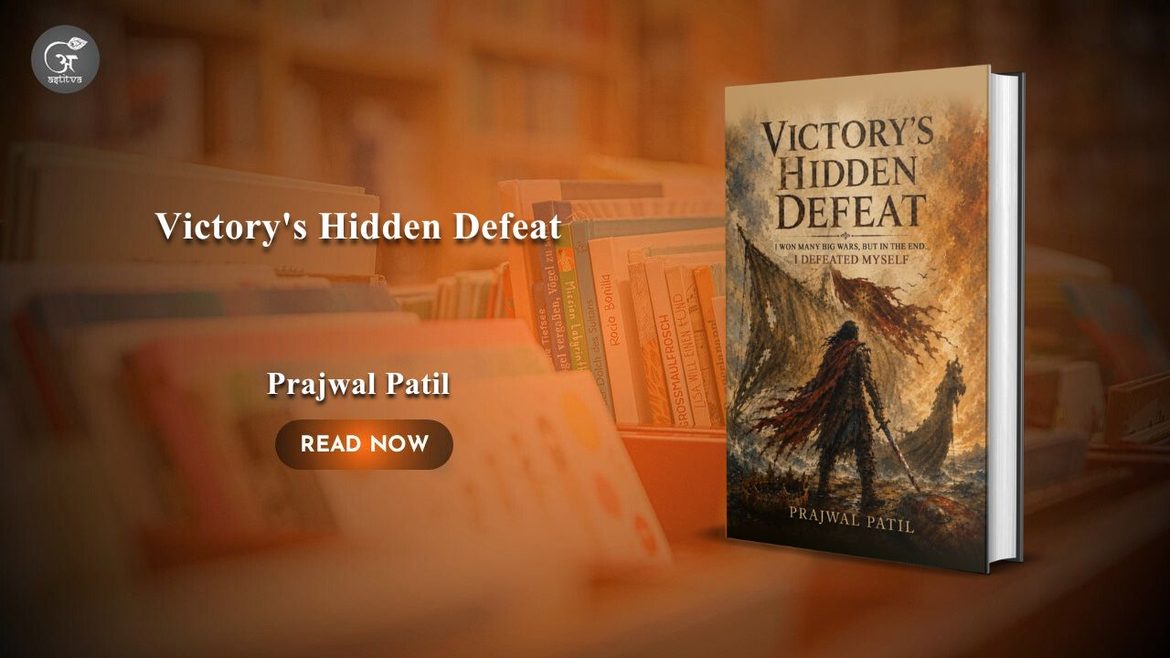
The release of Victory’s Hidden Defeat: I Won Many Wars but in the End I Defeated Myself by Prajwal Patil introduces readers to an ambitious historical fiction saga that explores the complex relationship between power, leadership, victory, sacrifice, and the human conscience. Set against the rich civilizational backdrop of Bharat, the novel combines grand battles and political intrigue with romance, philosophy, and questions of duty, creating a story in which the greatest conflicts are fought not only on battlefields but also within the minds of those who seek to lead.
At the centre of the narrative is Vikram, a young warrior who rises from obscurity following the fall of a mighty empire. Driven by a vision of restoring Dharma and challenging tyranny, Vikram embarks on a formidable journey alongside seven loyal companions. Together, they confront oppressive rulers, fight relentless campaigns, forge alliances among divided kingdoms, and work toward an extraordinary dream—the unification of the subcontinent under a righteous throne.
Yet the novel goes beyond the familiar triumphs of heroic warfare. Every victory comes with a price, and as Vikram’s ambitions begin to take shape, the consequences of his successes become increasingly difficult to ignore. Alliances are tested, political ambitions begin to replace loyalty, and the relationships built through years of struggle face new pressures. The empire created through courage and sacrifice gradually reveals vulnerabilities from within, forcing its leaders to confront an uncomfortable truth: defeating an external enemy does not necessarily mean winning the greater battle.
The central question of Victory’s Hidden Defeat is both powerful and timeless: Can a victory still be called a victory if it sows the seeds of its own downfall? Through this question, the novel examines the burden carried by those who hold power and the moral compromises that can accompany the pursuit of noble ideals. Vikram’s journey becomes not simply a story of conquest, but an exploration of conscience, responsibility, loyalty, ambition, and the consequences of leadership.
Inspired by the enduring ideals associated with Indian civilization—including Dharma, unity, courage, honour, sacrifice, and selfless leadership—the book seeks to bring historical imagination together with emotionally compelling storytelling. Its world of kingdoms, warriors, alliances, and rivalries provides an expansive setting, while its philosophical questions give the narrative relevance beyond its historical framework. The story invites readers to reflect on whether power can remain righteous when the desire to preserve it begins to compete with the principles upon which it was built.
The remarkable journey behind the novel is equally inspiring. Prajwal Patil wrote the first edition of Victory’s Hidden Defeat at just fourteen years of age, transforming his fascination with Indian history and its timeless ideals into an ambitious literary work. Now presenting the third edition, Prajwal continues to develop the story and has planned to bring its larger narrative to a conclusion through the sequel. His early entry into the world of historical fiction reflects an unusual combination of imagination, curiosity, and determination.
For Prajwal, history is not merely about remembering the past. Through fiction, he seeks to explore the human decisions that shape kingdoms, influence generations, and determine the legacy of civilizations. His storytelling aims to preserve the spirit of India’s historical heritage while presenting it through memorable characters and emotionally resonant narratives.
Victory’s Hidden Defeat marks the beginning of an ambitious literary saga, where every battlefield victory carries an unseen consequence and every triumph demands reflection. It is a story of warriors and kingdoms, but also of the internal battles that define true leadership. Ultimately, the novel reminds readers that the most difficult enemy may not be the one standing across the battlefield, but the one that quietly emerges within oneself.