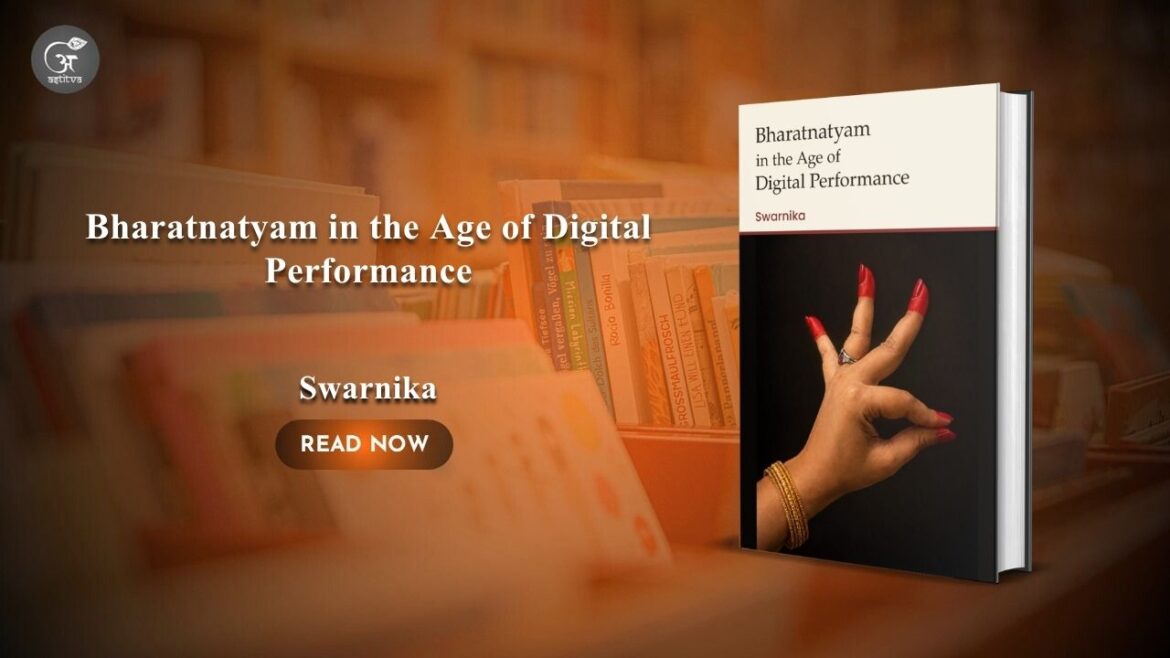
Bharatnatyam in the Age of Digital Performance by Swarnika offers a compelling exploration of how one of India’s most celebrated classical dance forms is evolving in an era shaped by cinema, recorded performances, and digital media. Examining the movement of Bharatnatyam from the traditional stage to the screen, the book investigates how technology influences the ways dance is performed, presented, experienced, preserved, and interpreted. It invites readers to reconsider the relationship between artistic tradition and modern forms of representation, revealing how the digital age is transforming not only the visibility of classical dance but also its cultural meaning.
Drawing upon the aesthetic principles of the Natyashastra and the Abhinaya Darpana, alongside the literary world of the Tamil epic Silappatikaram, particularly its “Arangetru Kathai,” the book establishes a foundation for understanding the relationship between the dancing body, performance space, and audience. These traditions demonstrate that Bharatnatyam has always relied on carefully structured gestures, movements, expressions, costumes, music, and spectatorship to communicate meaning. The arrival of the camera, therefore, represents not the beginning of mediation but a new stage in the continuing history of how dance is seen and understood.
One of the central arguments of the book concerns the influence of the camera on the experience of performance. In a live setting, spectators can choose where to direct their attention, observing the dancer’s expressions, movements, and relationship with the surrounding space. A camera, however, makes these choices on behalf of the viewer. Through close-ups, cuts, framing, and changes in perspective, it can intensify a facial expression or highlight a hand gesture while potentially separating it from the larger choreographic composition. The recorded performance consequently becomes more than a preserved version of the original; it becomes a distinct visual interpretation.
The book examines these transformations through cinematic examples, including Mayuri and Mee Raqsam, alongside the continuing cultural presence of the dance sequence in Bhool Bhulaiyaa. These examples illustrate how classical dance enters popular culture, where it may be reinterpreted, recreated, discussed, or criticised. As performances circulate through films, remakes, short-form videos, and online communities, questions of authenticity and cultural context become increasingly important. The dance form acquires new audiences while navigating changing expectations about how tradition should be represented.
Beyond cinema, Swarnika explores recorded performances, digital archives, screen-specific choreography, and the growing circulation of dance through social media. Digital technologies allow performances to be paused, replayed, slowed down, studied through tutorials, and preserved for future generations. Such possibilities can expand access to learning and contribute to the documentation of artistic traditions. At the same time, they raise important questions about what happens when a complete performance is reduced to a brief clip, who controls its interpretation online, and whether digital visibility encourages deeper engagement or privileges immediately recognisable movements and visual appeal.
Importantly, the book avoids treating technology as either an enemy of tradition or an automatic solution to the challenges of cultural preservation. Instead, it presents Bharatnatyam as a living artistic practice that continues to negotiate its identity through changing modes of performance and representation. Its central concern is not simply whether classical dance can be accommodated by digital platforms, but how those platforms have begun to influence the very ways the form is created, taught, watched, and remembered.
Swarnika brings a distinctive perspective to this inquiry through her academic expertise and practical experience in dance. She is an Assistant Professor in the Department of English at Zakir Husain Delhi College, University of Delhi. Her research interests include gender studies, detective fiction, film studies, popular literature, and the psychological dimensions of literary and cultural narratives. Her interdisciplinary approach examines questions of identity, power, memory, and representation across artistic forms.
As a trained Bharatnatyam and Kathak dancer, she also brings the perspective of an experienced practitioner to her academic exploration. Her engagement with movement, expression, embodiment, and spectatorship enables her to approach Bharatnatyam as both a classical tradition and an evolving cultural language.
Bharatnatyam in the Age of Digital Performance will appeal to students, researchers, dancers, scholars of performing arts, and readers interested in cinema and digital culture. By bringing classical aesthetics into conversation with contemporary media practices, Swarnika offers a thoughtful contribution to discussions about tradition, technology, and artistic identity. The book ultimately encourages readers to look beyond the screen itself and consider how digital mediation is reshaping the relationship between the performer, the performance, and the audience in the continuing story of Bharatnatyam.