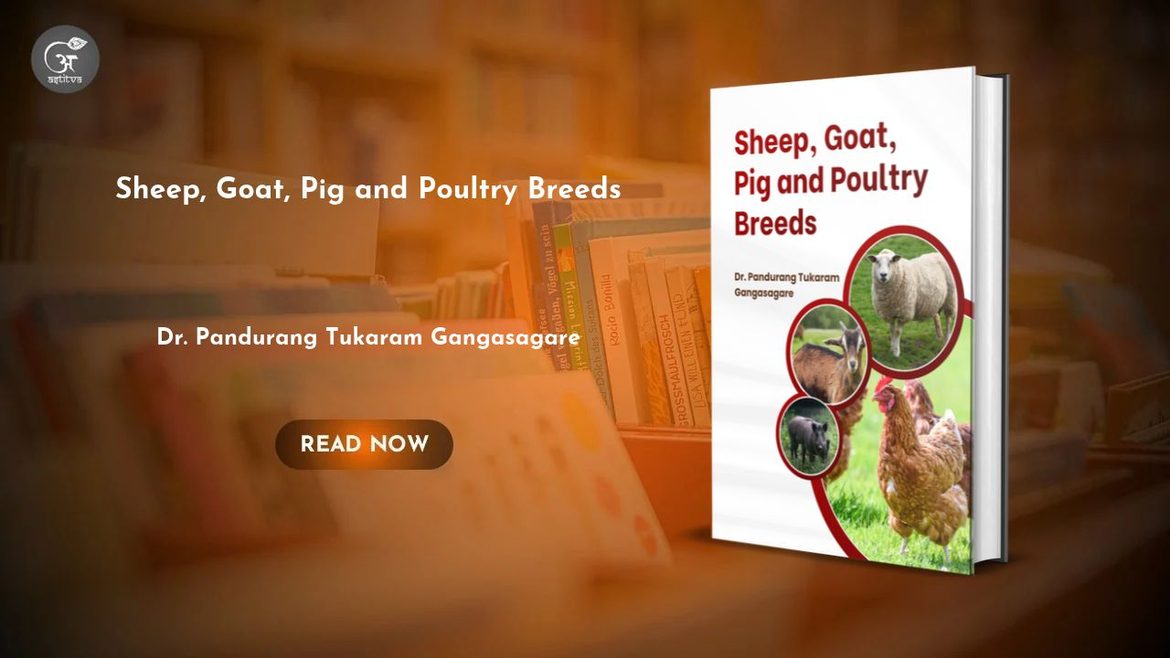
The book Sheep, Goat, Pig and Poultry Breeds, authored by Dr. Pandurang Tukaram Gangasagare, presents valuable insights into the importance of livestock in Indian agriculture and the economic well-being of farming communities. Livestock has long been an integral part of India’s mixed farming system, in which crop cultivation and animal husbandry complement each other. The resources and by-products generated by one enterprise often serve as inputs for the other, helping farmers improve productivity, optimize resource utilization, and strengthen their livelihoods.
The book highlights the significant role of sheep, goats, pigs, and poultry in supporting the rural economy. For many farming families, particularly those with limited financial resources, livestock serves as an important source of supplementary income and economic stability. Animals such as sheep and goats can provide financial assistance during emergencies and help families meet essential expenses, including children’s education, medical treatment, marriages, and house repairs. In this context, livestock is often regarded as a living asset and a form of financial security, enabling farmers to manage unexpected challenges. The expression “Goat is the ATM of the poor man and sheep is a bank on hooves” aptly reflects the economic significance of these animals in rural communities.
Beyond their financial contribution, livestock and poultry play an essential role in meeting nutritional requirements. Products such as milk, meat, pork, and eggs provide valuable sources of animal protein, contributing to the dietary needs of livestock-owning households and the wider population. Sheep, goats, pigs, and poultry also create opportunities for self-employment, small-scale entrepreneurship, and rural livelihood development. Furthermore, livestock holds social and cultural significance in many parts of India, where animals are often gifted during marriages and other important occasions. By highlighting these diverse contributions, the book emphasizes how animal husbandry can support food security, social well-being, and sustainable agricultural development.
Through its focus on sheep, goat, pig, and poultry breeds, the book offers a subject of interest to readers seeking to understand the livestock resources that contribute to India’s agricultural economy. Knowledge of different breeds is an important foundation for informed animal selection, effective livestock management, and the improvement of productivity in animal husbandry. The subject is particularly relevant to students, teachers, researchers, and individuals associated with veterinary and animal sciences, dairy science, agriculture, and rural development. It can also serve as a useful reference for those interested in understanding the relationship between livestock production and farmers’ economic progress.
The book is authored by Dr. Pandurang Tukaram Gangasagare, an accomplished academician and researcher in the field of Dairy Science. Born on 15 June 1973 in Bomnali, Taluka Mukhed, District Nanded, Maharashtra, Dr. Gangasagare has dedicated his professional career to teaching, research, and academic contributions. He is currently working as a Professor in the Department of Dairy Science at Adarsh Education Society’s Arts, Commerce and Science College, Hingoli, Maharashtra.
Dr. Gangasagare completed his Bachelor’s degree in General Science in 1994 and his Master’s degree in Dairy Science in 1996, securing first-class results from Dr. Babasaheb Ambedkar Marathwada University, Aurangabad, now known as Chhatrapati Sambhajinagar. He subsequently earned his Ph.D. in 2007 from Swami Ramanand Teerth Marathwada University, Nanded. His doctoral research focused on productivity measures for the improvement of the dairy industry in the Marathwada region of Maharashtra, reflecting his interest in enhancing dairy productivity and strengthening the agricultural sector.
With approximately 28 years of teaching experience at the undergraduate level, Dr. Gangasagare has made substantial contributions to academic instruction and research. He has authored several books covering important areas of animal and dairy sciences, including Animal Genetics and Breeding, Cattle and Buffalo Breeds, Processing of Milk, and A Textbook of Traditional Dairy Products. His scholarly contributions also include approximately 26 research articles published in national and international journals. In addition, he has completed a minor research project funded by the University Grants Commission (UGC). He has also served as Chairman of the Board of Studies in Dairy Science at Swami Ramanand Teerth Marathwada University, Nanded, demonstrating his involvement in academic leadership and curriculum development.
With his extensive teaching experience, research background, and publications in animal and dairy sciences, Dr. Gangasagare brings valuable academic knowledge to the subject of livestock breeds. His work reflects a continued commitment to education, scientific understanding, and the advancement of animal husbandry and dairy science.
Sheep, Goat, Pig and Poultry Breeds is a meaningful contribution to the field of livestock and agricultural education. By drawing attention to the importance of animal resources in farmers’ lives, the book underscores the connection between livestock management, rural economic security, nutrition, and agricultural sustainability. It is relevant to students and academicians as well as readers who wish to develop a deeper understanding of livestock and its role in strengthening India’s rural economy.
Through this publication, Dr. Pandurang Tukaram Gangasagare brings attention to a field that remains essential to millions of farming families. The book highlights the importance of livestock not merely as a source of agricultural production but also as a dependable asset that supports livelihoods, meets nutritional needs, and contributes to the overall socio-economic development of rural India.