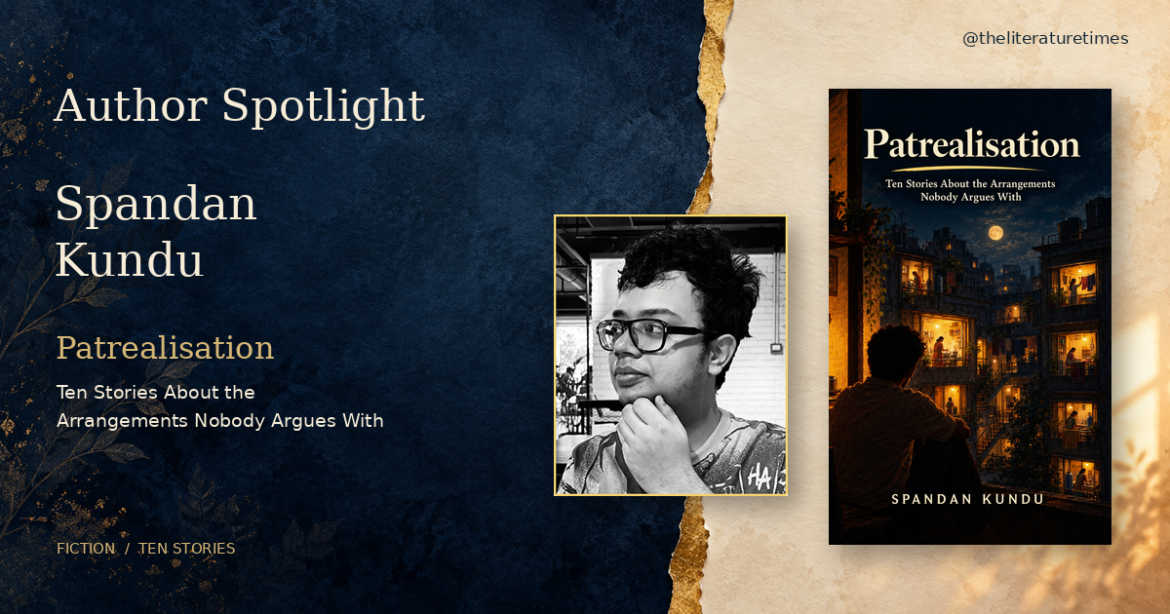
Patrealisation by Spandan Kundu
Ten Stories About the Arrangements Nobody Argues With
A woman can work in a household for fifteen years and remain unnamed to someone who has grown up beside her. In the opening story of Patrealisation, that failure belongs to the narrator. He knows the domestic worker’s routines and family circumstances, yet has never thought to ask her name. Spandan Kundu builds his first book around this uncomfortable distance between familiarity and attention. Its subtitle, Ten Stories About the Arrangements Nobody Argues With, identifies a subject that can hide in plain sight: the unequal expectations people continue to honour because they have come to feel ordinary.
Kundu is a computer science graduate of IIT (ISM) Dhanbad who works on artificial intelligence systems. His literary interests turn towards a different kind of system, the social roles maintained through repeated conversations and habits. The connection is useful as a way into his concerns, rather than a claim that family life can be reduced to an engineering problem. In these stories, an arrangement survives because people participate in it, often affectionately, and because its benefits can make its costs easy to overlook.
He grew up in Dhanbad, in a family with roots in Kolkata and a village house in Bengal. His author biography places his fiction in familiar interiors, including kitchens, drawing rooms and local trains. These locations matter because they bring large questions of power down to the scale of a meal, an errand or an interrupted conversation. A plate can establish who is entitled to be served first. A room prepared for visitors can reveal how much of a person’s life has already been decided before the visitors arrive.
Kundu’s reading is largely in sociology. He names Naila Kabeer, Uma Chakravarti, Bina Agarwal, Leela Dube and Sudhir Kakar among the writers who inform his interest in the Indian family. His biography also explains that he coined the title Patrealisation to name the belated recognition of an arrangement he had previously accepted without question. The book gives that idea a narrative form. Readers encounter the scene before they reach the explanation, and the person doing the noticing often has something uncomfortable to recognise about himself.
That choice of viewpoint distinguishes the collection from a succession of lessons delivered by an enlightened observer. In Little Dollops of Joy, a narrator studies the gendered packaging of chocolate eggs but leaves the packet intended for girls unopened in his drawer. In The Bride Next Door, his memories of a talented older girl include his own eagerness to take the most generous glass of the drink she pours. The details expose a gap between identifying an unfair convention and giving up the small advantage it offers.
Kundu also gives ordinary objects a role in telling the story. The Bride Next Door moves from mismatched glasses after childhood cricket games to identical cups as the girl’s life becomes more closely managed. Wrapped in a Newspaper follows the concealment surrounding menstrual products through a shop, a friendship and a relief distribution. These objects are useful because they carry expectations without requiring anyone to announce a rule. The surface remains familiar while its meaning becomes harder to dismiss.
The women in the collection are not made uniformly admirable to justify their importance. The bus driver in Vahini and Dhaakini handles floodwater with skill, speaks bluntly and unsettles the narrator’s carefully constructed idea of her. The woman who plays the Dhaak wants to know what she will be paid. His disappointment at this practical question reveals more about his wish for an inspiring story than about her work. Kundu’s interest lies partly in the demands that even sympathetic attention can place on another person.
The collection widens its inquiry in Conviction, where Neel must perform the version of masculinity his family and colleagues recognise. His financial obligations, postponed ambitions and discomfort during a marriage visit give the final story its pressure. The shift does not erase the unequal treatment of women in the earlier stories. It asks how the same expectations can also restrict a man’s capacity to make choices or show tenderness. A small exchange involving a child’s doll becomes more revealing than a declaration of independence would have been.
An epilogue makes the sociological connections explicit, placing concepts beside the situations the fiction has already made tangible. The stories themselves offer fewer assurances. Recognition does not reliably become action, and a narrator’s admission does not repair the harm he has watched. That resistance to an easy moral finish is central to Kundu’s authorial approach. Patrealisation introduces a writer attentive to the moments when kindness, habit and unequal power occupy the same room, and willing to leave the reader with the difficulty of telling them apart.