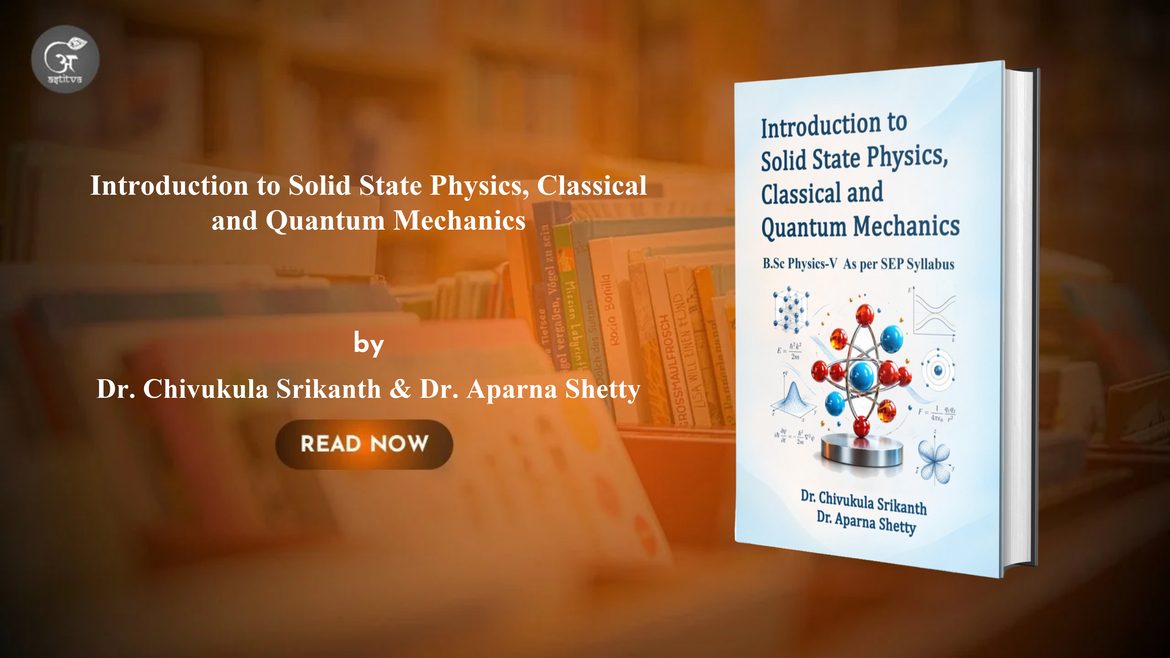
A comprehensive B.Sc. Physics textbook designed in accordance with the SEP syllabus of Gulbarga University, Kalaburagi, and Bidar University, Bidar, offering students a clear and systematic understanding of fundamental and modern physics.
The study of physics provides a deeper understanding of the natural world, from the structure of everyday materials to the complex behaviour of particles at the atomic and subatomic levels. To make these fundamental concepts more accessible to undergraduate students, Dr. Chivukula Srikanth and Dr. Aparna Shetty present their academic textbook, “Introduction to Solid State Physics, Classical and Quantum Mechanics.”
Developed specifically for B.Sc. Physics students, the book follows the State Education Policy (SEP) syllabus prescribed by Gulbarga University, Kalaburagi, and Bidar University, Bidar. It offers a carefully structured introduction to solid state physics, classical mechanics, and quantum mechanics, combining theoretical explanations, mathematical concepts, and illustrative diagrams to support effective learning.
The publication aims to simplify challenging topics without compromising their academic significance, making it a useful resource for students seeking conceptual clarity and a strong foundation in physics.
A Student-Centred Approach to Physics Education
Physics is often considered a challenging subject because of its mathematical complexity and abstract theoretical principles. Recognising these difficulties, the authors have adopted a student-friendly approach that emphasises simplicity, clarity, and systematic explanation.
The textbook has been developed to help undergraduate learners understand complex physical phenomena through accessible language, comprehensive discussions, and clearly presented diagrams.
Rather than introducing advanced concepts without adequate preparation, the book gradually develops students’ understanding, beginning with the structural properties of solids and progressing towards the fundamental principles of classical and quantum mechanics.
This carefully organised approach encourages students to connect theoretical knowledge with physical applications while strengthening their analytical and problem-solving abilities.
The authors have made every effort to ensure that the treatment of each topic remains simple yet comprehensive, allowing students to build confidence as they progress through the curriculum.
Eight Chapters Covering Essential Areas of Physics
One of the major strengths of the textbook is its systematic organisation into eight chapters, each addressing an important area of undergraduate physics.
The opening chapter, “Crystal Structure and X-Rays,” introduces students to the geometrical arrangement of atoms in crystalline solids. It explains fundamental concepts such as Bravais lattices, Miller indices, and X-ray diffraction. Through these topics, students gain an understanding of how scientists investigate the internal structure of materials and determine atomic arrangements using diffraction techniques.
The second chapter, “Band Theory of Solids,” explores the electronic behaviour of materials. It explains the formation of energy bands and the principles that distinguish conductors, semiconductors, and insulators. This chapter provides an essential foundation for understanding the electrical properties of solids and their relevance to modern electronic technology.
In “Free Electron Theory of Metals,” the third chapter, students examine the behaviour of electrons within metallic materials. The discussion introduces the classical Drude-Lorentz model and its quantum modifications, explaining how these theories contribute to understanding electrical and thermal conductivity. By comparing classical and quantum approaches, the chapter helps students appreciate the development of theoretical models in solid state physics.
The fourth chapter, “Defects in Solids,” focuses on imperfections in crystalline materials. It examines point defects, line defects, and surface imperfections, explaining how these structural irregularities influence the physical and mechanical properties of solids. The chapter also highlights how controlled defects can be used to modify material behaviour and improve performance in practical applications.
The fifth chapter, “Superconductivity,” introduces one of the most fascinating phenomena in modern physics. Students learn about the disappearance of electrical resistance and the phenomenon of perfect diamagnetism under appropriate low-temperature conditions. The chapter also discusses the significance and applications of superconductivity, helping readers understand its potential importance in advanced scientific and technological systems.
Connecting Classical Principles with Modern Physics
The textbook moves beyond solid state physics to introduce students to the fundamental principles governing motion and physical systems.
Chapter Six, “Classical Mechanics,” revisits the foundational laws of motion and develops an understanding of more advanced analytical methods. Beginning with the familiar framework of Newtonian mechanics, the chapter introduces the energy-based formulation of Lagrangian mechanics.
This transition helps students recognise how physical problems can be approached through different mathematical frameworks. It also establishes an important conceptual foundation for understanding the mathematical methods used in modern the