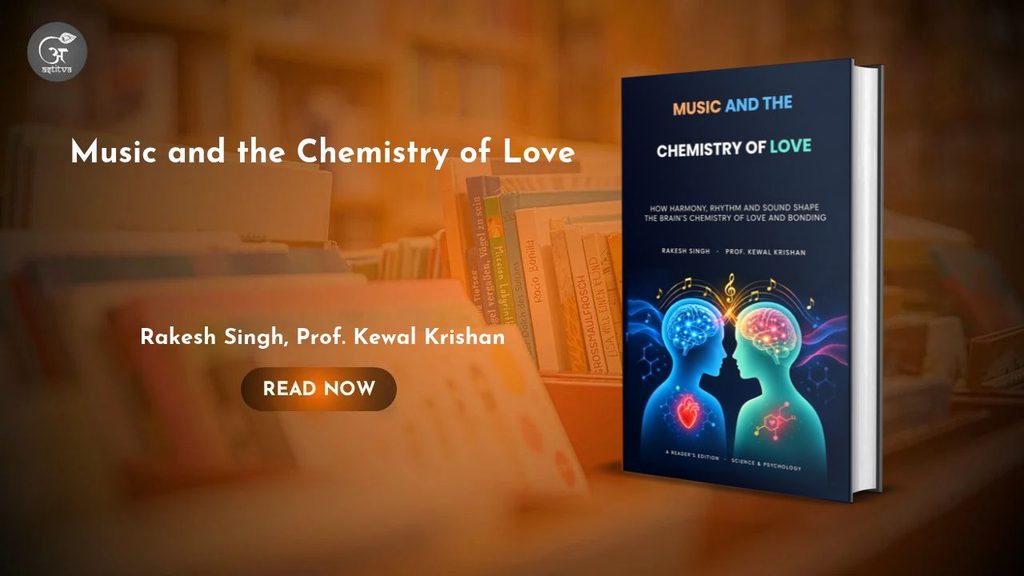
Music has a remarkable ability to touch human emotions, create connections, and bring people closer. A familiar melody can evoke memories, strengthen relationships, and generate feelings that are sometimes difficult to express in words. But what actually happens inside the human brain and body when music moves us? Exploring this fascinating relationship between sound, emotions, and human bonding, authors Rakesh Singh and Prof. Kewal Krishan present their insightful book, ‘Music and the Chemistry of Love: How Harmony, Rhythm and Sound Shape the Brain’s Chemistry of Love and Bonding.’
The book takes readers on an interdisciplinary journey into the relationship between music, neuroscience, psychology, and human relationships. It examines how musical experiences influence the body’s chemical processes and how certain chemical messengers contribute to emotional connections, affection, and social bonding. By connecting scientific research with the universal experience of music, the authors offer readers a deeper understanding of why melodies and rhythms can have such a powerful impact on human life.
At the centre of the book are four important chemical messengers associated with love and human bonding: oxytocin, dopamine, serotonin, and vasopressin. Each of these molecules plays a distinct role in the complex functioning of the human brain and body. The authors explain what these chemical messengers are, where they are produced, how they function, and what scientific research reveals about their possible connections with music and relationships.
Rather than presenting music as merely an artistic or recreational experience, the book explores its potential significance in shaping emotional and psychological responses. It examines how rhythm, harmony, and sound may influence feelings of pleasure, attachment, trust, and emotional connection. Through discussions of controlled research and scientific findings, readers are encouraged to understand both the possibilities and limitations of current knowledge.
One of the notable aspects of ‘Music and the Chemistry of Love’ is its effort to distinguish scientific evidence from popular assumptions. The relationship between music and human emotions is fascinating, but understanding the biological processes behind it requires careful investigation. The authors approach this subject by examining research findings and explaining what science actually supports. This evidence-oriented approach makes the book particularly relevant for readers interested in understanding the relationship between musical experiences and human behaviour.
The book also highlights the interdisciplinary nature of contemporary research. Music is often studied through artistic expression, performance, and cultural traditions, while chemistry and neuroscience explore the biological mechanisms behind human experiences. By bringing these perspectives together, the authors create an engaging discussion that connects the world of performing arts with scientific inquiry.
Rakesh Singh, a PhD Research Scholar in the Department of Performing Arts (Theatre and Music) at Lovely Professional University, Phagwara, Punjab, brings an important perspective from music research and cultural studies. He also serves as Chairman of the Duggar Culture Bridge Society. His doctoral research focuses on the influence of folk songs from the Duggar region of Jammu on the psychological well-being of schoolchildren. His academic work includes research and publications related to music, mental health, and cultural heritage. His interests reflect a commitment to understanding how music can contribute to individual and community well-being.
Co-author Prof. Kewal Krishan is an Assistant Professor of Mathematics at Government Degree College, Reasi, Jammu and Kashmir. With teaching experience spanning school and higher education since 2010, he brings an academic background rooted in analytical thinking and research. He qualified the CSIR-UGC National Eligibility Test (NET) in Mathematical Sciences in 2013. His contribution to this book reflects a shared interest in exploring the scientific dimensions of music through evidence, measurement, and rigorous investigation.
Together, the authors present a subject that connects scientific curiosity with an experience shared across cultures and generations. Their work encourages readers to look at music not only as a source of entertainment and artistic expression but also as an important area of scientific exploration.
‘Music and the Chemistry of Love’ is a valuable read for students, researchers, musicians, psychology enthusiasts, and anyone curious about the connection between music, the brain, and human relationships. By exploring the chemistry behind emotional experiences, the book opens new avenues for understanding why music can move hearts, influence feelings, and strengthen human connections.
Ultimately, this book reminds us that music is more than a combination of sounds, rhythms, and melodies. It is an experience that brings together the mind, body, and emotions, offering a fascinating glimpse into the science behind one of humanity’s most powerful forms of expression.







Your perspective matters
Share your thoughts respectfully. Comments are moderated.