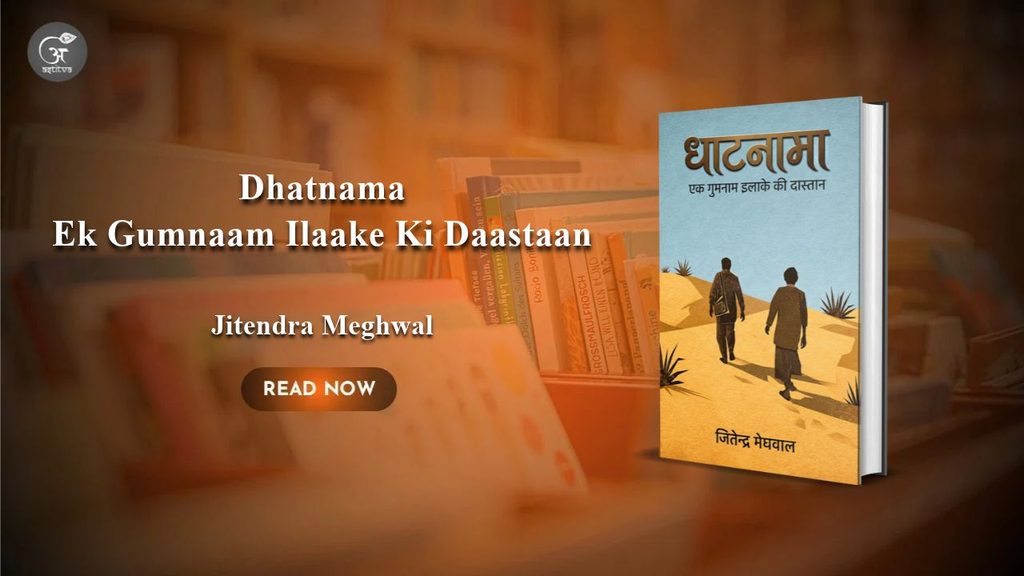
Every region has a history that extends beyond official records, political boundaries and familiar historical narratives. Much of it survives through family memories, folk traditions, the accounts of elders and the stories of communities whose contributions often remain overlooked. Dhatnama: Ek Gumnaam Ilaake Ki Daastaan by Jitendra Meghwal is an effort to bring these forgotten histories into the wider public consciousness. Through historical research, cultural documentation and personal narratives, the book explores the identity and heritage of Dhat, the desert region associated with the Thar, stretching between Sindh in Pakistan and Marwar in India.
Organised into 13 chapters, Dhatnama brings together family histories, interviews with elders and research into historical texts. It presents a region shaped by migration, political change, social struggles, craftsmanship and enduring cultural connections. Rather than treating history as a collection of dates and events, the book approaches it through the lived experiences of ordinary people and communities.
One of its significant themes is the impact of Partition in 1947. According to the book, approximately 70 per cent of Dhat became part of Pakistan, while 30 per cent remained in India. This division transformed the lives of families and communities, leaving behind memories of displacement and separation. The book also recalls the suffering experienced by displaced families during the India–Pakistan wars of 1965 and 1971, locally remembered as the “Bhajad battles.” These accounts give the political history of the region a deeply human dimension.
The work also preserves narratives of social pride, ancestry and community identity. It recounts the historical story of Rana Khinvra of Amarkot arranging the royal marriage of Sanwal Meghwal and granting special privileges to the Gadhveer (Gandher) community. The account of the author’s ancestral village, Jhanjhtal, alongside the social and political struggles of his father, Suresh Chand Gadhveer, adds a personal dimension to this wider historical exploration.
Another important contribution of the book is its recognition of individuals who helped shape Dhat’s cultural and intellectual heritage. It highlights Chataram Gadhveer’s contribution to the region’s renowned embroidery art, Bharat; the historical work of Raichand Rathore, author of Registan Ji Tawarikh; the spiritual legacy of Sufi saint Shah Abdul Latif Bhittai; and the contribution of freedom fighter Rana Ratansingh. The book further documents the electoral history of the Chohtan Assembly constituency from 1957 to 2008, folk tales of the sand dunes, verses preserved in the records of Bhat Veerchand, and the traditions of brotherhood and hospitality that define the region’s social character.
The commitment to preserving overlooked histories is closely connected to the author’s own background. Jitendra Meghwal comes from a humble family of agricultural labourers and embroidery artisans in Sanwa village, Barmer district, Rajasthan. After completing his early education at the village government school, he pursued higher education at Zakir Husain Delhi College, University of Delhi, where he also serves as Joint Secretary of the college student union.
A regular writer for the web portal Forward Press, Meghwal focuses on social issues, Bahujan consciousness, education and contemporary politics. His writing reflects an awareness of the challenges faced by ordinary people and a strong sense of social responsibility. His connection to his roots and community struggles gives Dhatnama a distinctive personal and social significance.
Ultimately, Dhatnama: Ek Gumnaam Ilaake Ki Daastaan is more than a historical account of a geographical region. It is an attempt to preserve collective memory, recognise forgotten contributors and honour the cultural identity of communities whose stories deserve to be remembered. By bringing together history, folk culture, politics and family narratives, Jitendra Meghwal offers readers an opportunity to discover Dhat through the voices and experiences of its people.


Your perspective matters
Share your thoughts respectfully. Comments are moderated.