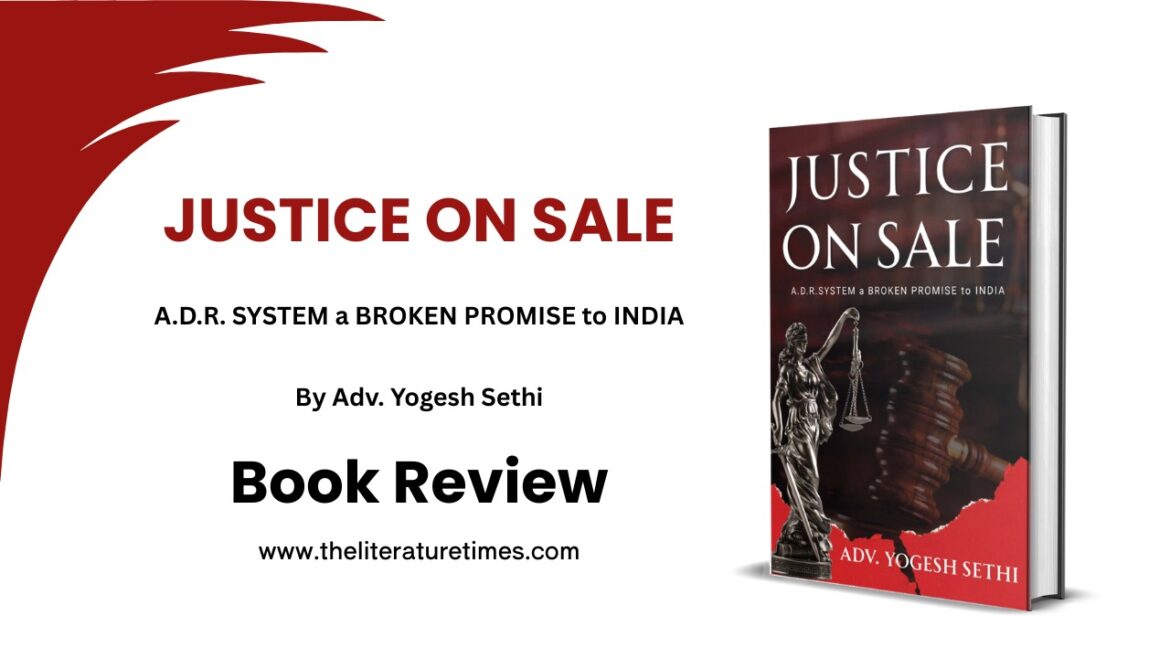
Advocate Yogesh Sethi’s Justice on Sale: A.D.R. System — A Broken Promise to India is not merely a book — it’s a legal autopsy. With the precision of a courtroom argument and the conviction of a reformer, Sethi dismantles India’s much-touted Alternative Dispute Resolution (ADR) system to reveal a deeply flawed structure that has strayed far from its original promise of speedy, fair, and inexpensive justice.
The author writes not as a detached observer but as an insider — a practising advocate who has seen the “machine of justice” grind ordinary citizens under its weight. This lends the work an authenticity rarely found in academic critiques. The opening chapters provide historical context, tracing ADR’s evolution from ancient Indian jurisprudence and Western models to its current institutionalization through Lok Adalats, mediation centres, and conciliation boards. Yet, Sethi’s tone soon shifts from academic to accusatory, as he meticulously exposes how inflated statistics, manipulated reports, and career-driven compromises have hollowed out the credibility of ADR in India.
What stands out is Sethi’s fearlessness. He names the rot: the obsession with “disposal rates,” the post-retirement rehabilitation of judges through ADR forums, and the pressure on litigants to “settle” rather than seek justice. His metaphor comparing litigants’ expectations to a passenger bound for Mussoorie but dropped off in Saharanpur captures the disillusionment of millions who enter the system with hope and leave with despair. The prose oscillates between the rational and the poetic — a balance that keeps the narrative both intellectually stimulating and emotionally resonant.
Yet, the book is not without excess. Sethi’s passion sometimes borders on polemic; his tone can feel incendiary rather than reformist. At times, the critique risks alienating moderate readers who might view the judiciary’s systemic flaws as more nuanced than malicious. However, this intensity also gives the book its power — it shakes complacency and demands accountability.
In a country where judicial delays and inefficiencies are normalized, Justice on Sale serves as both an exposé and a wake-up call. It compels legal professionals, policymakers, and the public to question whether “compromise” has become the new currency of justice. Sethi’s concluding chapters offer no easy solutions, but his moral clarity is undeniable: a justice system obsessed with numbers over truth is a betrayal of its own people. This book should be read — and debated — by every citizen who still believes in the sanctity of India’s courts.
Verdict: A scathing, necessary, and courageous critique — unsettling yet essential.