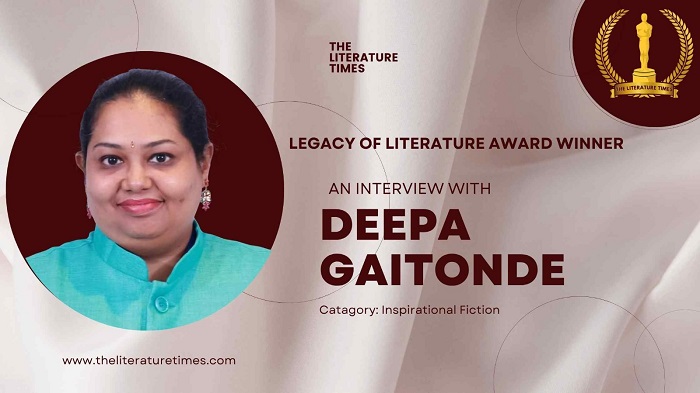
Deepa Gaitonde is a powerful voice in contemporary Marathi literature, known for her sensitive yet bold storytelling. With a keen eye for social realities and a deep empathy for the struggles of women across generations, her writing often sheds light on uncomfortable truths that society prefers to ignore. In her novel “Sati: Sangharsha ‘Ti’chya Astitvacha”, she crafts a haunting narrative that explores the horrors of the historical Sati practice and the strength of a woman who dares to defy it. Through fictional storytelling rooted in real social issues, Deepa Gaitonde continues to challenge readers to think, feel, and question.
The Literature Times: What inspired you to write a novel on such a difficult and emotionally intense subject like Sati?
Deepa Gaitonde: Roop Kunwar’s story as a Sati had a deep impact on me. At that time in 1987, I read every article I could find about it—it stayed with me for a long time. Recently, I came across another article on Sati, and it brought back all the memories of Roop Kunwar. That’s when the character of Uma suddenly came to my mind. Her story began to take shape from that moment.
The Literature Times: Your protagonist, Uma, feels incredibly real and layered. Was she inspired by any historical figure or personal story?
Deepa Gaitonde: Uma is a blend of many women I have personally observed in my life, as well as women from history. Her character is shaped by real emotions, struggles, and strength that I’ve seen in those around me. I also studied the mentality and social conditions of women during that era to bring authenticity to her thoughts and behavior.
The Literature Times: How did you balance historical accuracy with creative storytelling while writing this novel?
Deepa Gaitonde: While writing this novel, I made sure to respect historical accuracy by thoroughly researching the time period, cultural norms, and events. At the same time, I allowed myself creative freedom to build characters, emotions, and situations that could connect with today’s readers. I used facts as the foundation, but imagination helped me bring those facts to life through Uma’s journey. My goal was to stay true to the spirit of the era while telling a heartfelt, engaging story.
The Literature Times: Do you think remnants of the Sati mindset still exist in modern Indian society? How do you see it manifesting today?
Deepa Gaitonde: Yes, I do believe remnants of the Sati mindset still exist in modern Indian society—not in the literal sense, but in more subtle and emotional ways. Even today, many women are expected to sacrifice their dreams, desires, and identities for the sake of family, reputation, or tradition. The idea that a “good woman” must always suffer silently or live only for others still lingers in some minds. This emotional and mental conditioning is a modern reflection of the old Sati mindset. Through Uma’s story, I wanted to question these deep-rooted beliefs and spark conversations about a woman’s right to live fully—for herself.
The Literature Times :What kind of research did you do before writing “Sati: Sangharsha ‘Ti’chya Astitvacha”?
Deepa Gaitonde: Before writing “Sati: Sangharsha ‘Ti’chya Astitvacha”, I immersed myself in both historical and emotional research. I read extensively about the practice of Sati, its origins, its social and religious justifications, and its impact on women and society. I studied real-life cases like that of Roop Kunwar, as well as writings by historians and reformers who fought against the practice.
Alongside historical facts, I also explored the mindset of women during those times. How they were raised, what they believed, and how they coped with oppression. I observed women in my own life and reflected on the generational pain that still exist. This mix of factual study and emotional observation helped me create a character like Uma who feels both historically rooted and emotionally real.
The Literature Times: As a female writer addressing patriarchal norms, have you faced resistance or criticism?
Deepa Gaitonde : No, I haven’t faced any direct resistance or criticism so far. In fact, many people have been supportive and curious about the subject. Readers get connected with it rather than feel attacked. My focus was to create awareness
I want readers,especially young women to understand that change begins with awareness and courage. Uma was once a victim of a system, but when Appasaheb rescued her, she chose not to remain silent. Instead, she turned her pain into purpose by helping save other girls from the same fate. I hope young women take away the message that even if life pushes you into darkness, you can still rise, rebuild, and become a source of light for others. Strength is not just in fighting for yourself, but in lifting others too.
The Literature Times: Can you share how writing this book affected you personally? Did it change your perspective on any aspect of history or society?
Deepa Gaitonde:Writing this book left a deep imprint on me. As I shaped Uma’s world, I began to feel the emotional weight carried by women across generations. It opened my eyes to how tradition can sometimes silence individuality. I also became more sensitive to the quiet ways society still controls women’s choices. This process made me more observant, more questioning, and more committed to telling stories that challenge outdated beliefs.