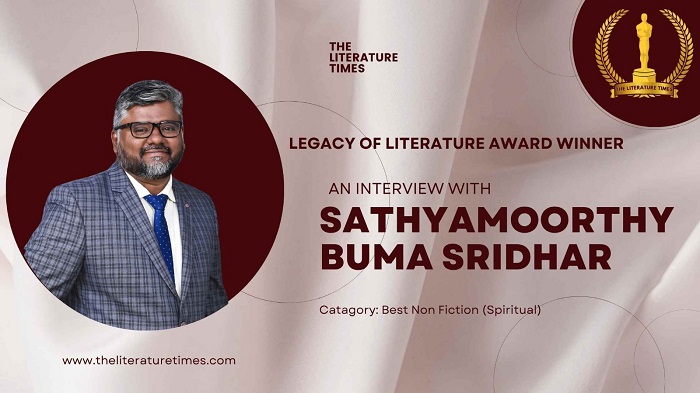
Sathyamoorthy Buma Sridhar is a spiritual thinker, mindfulness practitioner, and author devoted to guiding individuals toward inner peace and conscious living. With a deep understanding of human emotions, mental patterns, and spiritual principles, he weaves Eastern wisdom with practical life experiences to offer readers meaningful tools for self-discovery. His book The Conscious Compass: Navigating Life’s Journey with Inner Wisdom reflects his belief that surrender, gratitude, and awareness can transform how we engage with life’s challenges and lead to a more peaceful, purposeful existence.
The Literature Times: What inspired you to write The Conscious Compass, and how did your own life journey influence its creation?
Sathyamoorthy Buma Sridhar: I was inspired to write “The Conscious Compass” by my own life experiences, particularly after reaching the age of forty-five, where I have observed that life’s challenges, such as pain and panic, could be transformed through a “playful surrender to the universe”. My personal journey, which included navigating professional demands in the IT sector and dedication to mental well-being, led me to recognize the importance of shifting from an “autopilot” mode of living to one guided by intention and inner wisdom.
My own experiences, such as an early morning walk described in the introduction, reinforced the idea that peace is always accessible in simple moments and that cultivating gratitude, acceptance, and a mindful approach can transform adversity into growth. This led me to identify and elaborate on the five fundamental pillars of Acceptance, Letting Go, Surrender, Gratitude, and Awareness, which are central to the book’s message.
The Literature Times: You center the book around five core principles—Acceptance, Letting Go, Surrender, Gratitude, and Awareness. Which of these was most challenging for you personally to practice?
Sathyamoorthy Buma Sridhar: Considering “Awareness” as the most important factor is well-supported by me. It’s presented as the initial step towards inner peace, enabling the conscious application of other principles like Acceptance, Letting Go, Surrender, and Gratitude. Without awareness of one’s inner state and external influences, it would be challenging to intentionally practice any of the other pillars.
The Literature Times: How do you define the “Conscious Compass,” and how can someone know they are truly using it in daily life?
Sathyamoorthy Buma Sridhar: The “Conscious Compass” is defined as an inner guide that helps individuals navigate life by distinguishing between external pressures and the subtle guidance of intuition. Someone can know they are truly using it in daily life when they shift from an “autopilot” mode of making decisions based on unexamined thoughts and external pressures to making choices that genuinely resonate with their purpose and core being. This is characterized by intentionality, presence, and a deep connection to universal wisdom.
The Literature Times: The book includes powerful real-life stories like Sonam’s and Sarah’s. How did you select or shape these narratives to illustrate your key teachings?
Sathyamoorthy Buma Sridhar: In my book utilizes Sonam’s and Sarah’s stories to illustrate key teachings by showcasing transformations from adversity to inner strength. Sonam’s narrative highlights moving from anger and control in a painful family issue to letting go, acceptance, and surrender to the divine, ultimately leading to healing and new connections. Sarah’s story demonstrates a shift from longing and perceived deficit after a separation to empowered self-realization through cultivating gratitude, self-development, and letting go of the desire for a partner, emphasizing that well-being and a positive mindset are paramount. These narratives are shaped to show the tangible power of the five fundamental pillars—Acceptance, Letting Go, Surrender, Gratitude, and Awareness—in real-life scenarios.
The Literature Times: You speak of surrender as a strength rather than weakness. How can someone struggling with control begin to embrace surrender?
Sathyamoorthy Buma Sridhar: For someone struggling with control, embracing surrender begins with realizing that rigidly holding onto life makes it incredibly difficult, while a playful surrender transforms it into a dynamic dance. It involves understanding that true ease and manifestation unfold when aligned with the universe, and conscious effort only partially contributes. The journey to embracing surrender hinges on five fundamental pillars: Acceptance, Letting Go, Surrender itself, Gratitude, and Awareness. By recognizing that some things are beyond immediate control and choosing to release a tight grip on them, one can begin to practice surrender.
The Literature Times: “The Three Poisons”—comparison, attachment, and desire—are central to your message. How can readers begin to recognize and reduce their influence?
Sathyamoorthy Buma Sridhar: Readers can begin to recognize and reduce the influence of the “three poisons”—comparison, attachment, and desire—by cultivating mindful awareness. This involves paying attention to when they find themselves comparing, clinging, or relentlessly craving, simply noticing these patterns without judgment. Shifting focus from what is lacking to what is already possessed by cultivating gratitude can counter the negativity of comparison. Embracing impermanence helps alleviate the pain of attachment by understanding that change is constant. Finally, pursuing goals with passion while detaching happiness from the outcome, and practicing empathy to diminish the urge to compare, are also key strategies.
The Literature Times: How do early morning practices like mantra or meditation shape the rest of one’s day, and why do you emphasize their importance?
Sathyamoorthy Buma Sridhar: Early morning practices like mantra or meditation shape the rest of one’s day by cultivating a sense of peace, clarity, and purpose that can carry through any challenges. I emphasize their importance due to the unique stillness of these “Ambrosial Hours” (Brahma Muhurta), when the mind is naturally calmer and more receptive. These practices offer an undisturbed window for focus, enhance intuition, reduce stress, boost energy, and deepen spiritual connection, setting a positive tone for the entire day.
The Literature Times: If there’s one key transformation you hope readers experience after reading The Conscious Compass, what would it be?
Sathyamoorthy Buma Sridhar: The key transformation I hope readers experience is a shift from living on “autopilot, driven by external pressures and unexamined thoughts, to one guided by intention, presence, and a deep connection to universal wisdom”. This ultimately leads to readers finding inner peace and charting a course authentically aligned with their true purpose.