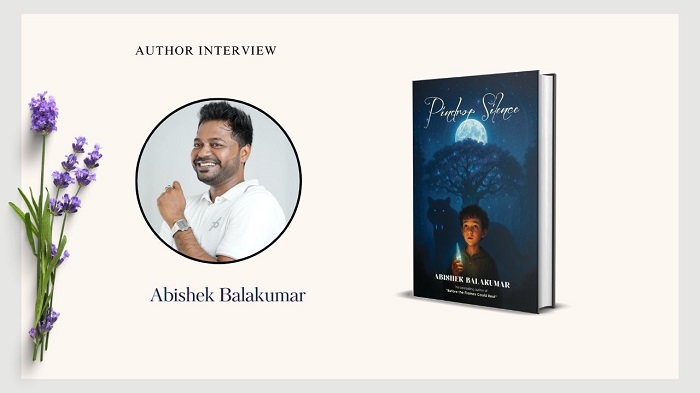
The Literature Times: Abishek Balakumar, Pindrop Silence blends futuristic science with myth and magic. What inspired you to combine these two seemingly opposite worlds?
Abishek Balakumar: I have always felt like I live in two different worlds at once. During the work week, I’m deep in the logic of marketing automation and scientific research—much like the scene in my photos where I’m sitting at a cafe table with a laptop and a phone, focused on the fast-paced digital world. But on the weekends, I’m at CVR Green Grocer in Chengalpattu, surrounded by the earthy, real-world rhythm of people and community.
In the story, I imagined Chennai in 2050 as a place where these worlds finally collide. I wanted to see what happens when a high-tech “Aero-Skimmer” flies over a temple that has stood for a thousand years. Science and magic aren’t opposites to me; they are just different ways of trying to understand the universe. It’s about finding that balance between the “code” we write and the “magic” of where we come from.
The Literature Times: The idea of machines that can remember plays a central role in the story. How do you personally define “memory,” and why was it important for this theme to lead the narrative?
Abishek Balakumar: In marketing, we use data to build customer profiles, but that data is cold. To me, memory is the warm, living connection we have to our own history. It’s what gives us a soul. In the book, when machines start “remembering,” they start to develop a conscience, and that’s a very dangerous line to cross. I wanted memory to lead the story because it’s the only thing that a digital monster like Nullith can’t truly steal without destroying who we are. When you see me in my photos, looking away from the screens and lost in the pages of a book, that’s me choosing memory over data. It’s our ultimate defense.
The Literature Times: Juno is portrayed as a “glitch” in a highly advanced world. What does Juno represent to you on a symbolic level?
Abishek Balakumar: Juno is a mirror for anyone who has ever felt like they didn’t fit into the “perfect” plan. In my own journey—from a conservative upbringing to driving my own vision in adulthood—I’ve learned that being a “glitch” isn’t a mistake. It’s a miracle. Juno represents the human spirit that refuses to be categorized by an algorithm. He is the bridge between the cold, predictable logic of a machine and the messy, beautiful power of destiny. He shows us that our uniqueness is our greatest strength, even if the rest of the world calls it an error.
The Literature Times: Canopy Haven is rich with elemental princes and princesses. How did you develop their powers and personalities, and do any of them reflect parts of yourself?
Abishek Balakumar: They are all fragments of my own personality, usually reflecting different moods. There’s a photo of me standing tall against a dark wall, looking strong and a bit mysterious—that’s the energy I gave to the Princes like Peo or Tair. I took my own human flaws—like being a bit too proud sometimes or wanting to isolate myself when I’m working hard—and turned them into elemental powers. These characters aren’t perfect; they are siblings who have to learn that they are only powerful when they stop fighting alone and start working together. They show that we are at our best when we turn our weaknesses into a shared shield.
The Literature Times: Nullith is a unique antagonist that feeds on information rather than life. What real-world concerns influenced the creation of this entity?
Abishek Balakumar: As a marketing professional, I see how much of our personal lives we “feed” to the digital cloud every single day. Nullith is basically that hunger for data turned into a world-eating monster. I worry that we are losing our “silence”—that private, sacred space inside our own heads—because we are always connected. If we let technology consume all our private memories and quiet moments, we eventually become empty. Nullith is a warning of what happens when the digital world finally finishes its meal and there’s nothing of “us” left.
The Literature Times: The diamond-toothed crystal tiger is one of the most striking figures in the book. What does this creature symbolize, and how early did it emerge in your imagination?
Abishek Balakumar: The Crystal Tiger is the guardian of balance. He appeared in my mind the moment I realized that truth can be as hard as a diamond but as beautiful as magic. If you look at the book cover I’m holding in the photos, you see him there—he’s not a weapon; he’s a key. He symbolizes the quiet strength that sits behind a storm. I’ve carried the image of a majestic tiger in my heart since I was a boy in Chennai, and in this story, he represents the fact that some secrets are meant to be guarded, not consumed.
The Literature Times: The story is framed as a tale told to your niece and nephew. Why was it important for you to tell this epic narrative through such an intimate, familial lens?
Abishek Balakumar: My niece Katt and my son Aarush are the reason I do everything. In my life, I strive to be the “cool uncle” who brings them stories of wonder. Using this framing device reminds the reader that no matter how big or scary the world gets, the most important thing we can do is pass down our stories and our values. It turns a massive Dystopian epic into a shared family secret. When I’m sitting on the grass in my photos, relaxed and smiling, that’s the feeling I want the book to have—the feeling of a safe, warm moment where magic is possible.
The Literature Times: Your book speaks to both younger readers and adults. How did you approach writing a story that works across generations?
Abishek Balakumar: I don’t believe in talking down to children. I write “up” to their imagination. Kids instinctively understand things like bravery and sacrifice. For them, it’s a high-stakes adventure with elemental heroes. For the adults, it’s a deeper look at the ethics of AI and the importance of preserving our history. I wanted to create something that a parent and child could read together—where the child is excited about the lightning and the tiger, and the parent is moved by the message of protecting our memories.
The Literature Times: Many readers see Pindrop Silence as a cautionary tale about technology and ambition. What message do you hope stays with readers after they finish the book?
Abishek Balakumar: The core message is the book’s first line: “Silence isn’t empty. It’s the beginning.” In our incredibly noisy world, we all need to find our own quiet place to breathe. My grandfather, CV Rajabathar, taught me to believe only in myself. I want readers to finish the book and realize that their own memories and their own self-belief are their ultimate power. Don’t let the “Nullith” of the world drown out the sound of your own heart.
The Literature Times: Looking ahead, do you see the world of Pindrop Silence expanding further, or are there new realms and stories already forming in your mind?
Abishek Balakumar: The Star Gate is wide open, and the adventure is just beginning. The world of Canopy Haven is vast, and there are so many “memories they forgot” that are still waiting to be told. When you see me in my photos looking toward the horizon, that’s me dreaming up the next chapter. This launch on December 18th is just the first step into a much larger universe. The writing adventure will definitely continue!