Interviewer: Two More Minutes, Please? is such a poetic and emotional title. What inspired the name, and what do those “two minutes” symbolize for you?
Arpan Prakash Sahoo: You know, I’ve always been fascinated by how fragile time feels when you’re with someone you love. Two minutes. On paper it sounds like nothing. But when you’re standing at the edge of goodbye, or holding on to a moment you know won’t come back, those two minutes can feel like eternity.
The title came from that ache, the human desire to stretch time just a little longer, to live in that pause between holding on and letting go. For me, “Two More Minutes, Please?” isn’t just about love between two people; it’s about the moments we all wish we could return to, before life moves us forward again.
Interviewer: The story beautifully connects art, memory, and love across continents. How did the idea for this novel first come to you?
Arpan Prakash Sahoo: The idea began years ago when I visited Ramchandi Beach. It was quiet and untouched, and we pulled over at this small tea stall where a little boy was helping his grandmother serve tea. Behind them was a tiny garden that had a few plants and flowers growing stubbornly against the salt and wind. That scene stayed with me. It felt like art, not because it was perfect, but because it was deeply human.
I think I’ve always been drawn to the thought that art holds pieces of us long after we’ve moved on, like a quiet witness to who we once were. From there, the story grew naturally. I wanted to explore what happens when love outlives time, when distance and silence become part of its language. The settings of Odisha, Paris, Lisbon, Kyoto, all became brushstrokes on that canvas.
At its core, the book began with one question: what if a work of art could bring two souls back together, not to change the past, but to finally understand it?
Interviewer: Your characters, Anwesh and Élise, express themselves through flowers and paintings. How did you develop such an artistic form of communication between them?
Arpan Prakash Sahoo: I’ve always believed that love doesn’t always need words to exist. Sometimes it hides in gestures, in what we create, or even in what we choose not to say. For Anwesh and Élise, art became their shared language because both of them are people who feel more than they can express.
The idea of flowers and paintings came from that: two different mediums carrying the same emotion. He speaks through what fades, and she through what endures. A flower wilts, but a painting preserves it forever. Their dialogue isn’t built on conversation, it’s built on creation. And I think that’s what makes their connection both fragile and timeless. At its core, their art is their confession. Every petal, every brushstroke, a way of saying I remember you without ever having to say the words.
Interviewer: The novel moves through Odisha, Paris, Lisbon, and Kyoto. Why did you choose these locations, and what do they represent in the story?
Arpan Prakash Sahoo: Each place in the story represents a different moment in the life of love. Odisha is where it begins as something simple, unspoken, and pure, much like first love. Paris brings in longing and nostalgia, the ache of what was left behind. Lisbon, with its rooftops and ocean light, reflects a sense of rediscovery, of learning to see beauty again. Kyoto carries reflection and stillness, where love matures into something quieter and deeper.
I didn’t want the settings to just be backdrops; I wanted them to mirror the emotional journey of the characters. Every city holds a different rhythm, a different silence. Together, they form a kind of an emotional map, one that traces how love evolves across time, distance, and memory.
Interviewer: You balance a career in software engineering with your passion for art and storytelling. How do you merge logic and creativity in your life?
Arpan Prakash Sahoo: I’ve never really seen logic and creativity as opposites. To me, they’re just two ways of understanding the same world. Coding and storytelling both start with a blank space. One fills it with logic, the other with emotion. In both, you’re building something that has structure, rhythm, and purpose.
Working in software teaches me discipline and clarity, while art reminds me to look for meaning beyond the obvious. I like to think of it as God’s way of showing that reason and beauty can coexist. One helps me make sense of the world, and the other helps me feel it. And somewhere between the two, I find balance.
Interviewer: Faith plays a quiet but powerful role in your work. How has your spirituality influenced your writing?
Arpan Prakash Sahoo: My first idea of love began when I learned about the love of Jesus. The kind that gives even when there’s nothing to receive in return, that chooses grace even when we don’t deserve it. That became the foundation for how I understand love in all its forms, and that same understanding shapes the way I see the world and the characters I create.
When I write about longing, forgiveness, or the quiet endurance of love, it all comes from that place of knowing what perfect love looks like. Jesus’ love taught me that even the most fragile moments can carry beauty, and that hope can be found in the simplest things.
And to the one reading or listening, I just want to say this: Jesus loves you. More deeply and completely than you could ever imagine.
Interviewer: You’ve described yourself as an old-school romantic. How does that perspective shape the love stories you tell?
Arpan Prakash Sahoo: Honestly, I think my idea of love is stuck about twenty or thirty years in the past. In today’s world of social media where everything happens at the speed of light, where everything moves so fast and feelings are almost always fleeting, I find myself drawn to the slower kind of love. The kind where people wrote letters instead of texts, waited days just to hear a voice, or stayed up late staring at the ceiling replaying a single conversation.
There was something beautifully human about that time. Love wasn’t about constant updates; it was about those quiet little moments. Walking home together without saying much, sharing a song on a mixtape, waiting by a landline for a call that might never come. It wasn’t perfect, but it was real.
That’s the kind of love I write about. The kind of love that lingers, that breathes. The kind that makes time slow down, even if just for two more minutes.
Interviewer: The prose in your book feels almost cinematic. Do you visualize your scenes as paintings or films before writing them?
Arpan Prakash Sahoo: That’s a beautiful observation, and yes, almost always. I tend to see before I write. Sometimes it comes as a still image, like a painting bathed in a certain light, and other times it moves like a slow, lingering shot in a film. The visual tone, colors, atmosphere, composition; all of those things often guide the emotional tone of the scene. I might not start with dialogue or plot, but with an image like a silhouette against the sea, rain falling on a window, two hands brushing in passing.
I think cinema and art teach us how to observe the world with reverence, how to dwell on moments that others might overlook. My writing tries to capture that same sense of quiet spectacle where even the smallest gesture can feel like the center of the frame.
Interviewer: What was the most challenging part of writing Two More Minutes, Please?, creatively or emotionally?
Arpan Prakash Sahoo: Honestly, the hardest part was learning to stay vulnerable through the process. Two More Minutes, Please? came from a deeply personal place that was born out of grief, nostalgia, and the kind of love that lingers long after it’s gone. There were days when revisiting certain memories felt like reopening old wounds, but I knew I couldn’t write it any other way.
Creatively, the challenge was balancing honesty with restraint. I didn’t want the book to read like an open diary, but I also didn’t want to hide behind clever language or structure. I had to keep asking myself, How much truth can I bear to tell, and how do I tell it beautifully without softening its edges? That tension between exposure and elegance, that’s what shaped the heart of the book.
Interviewer: Which character or moment in the book do you feel most personally connected to?
Arpan Prakash Sahoo: That’s a tough one, because every character carries a piece of me in some way. But if I had to choose, it would be the quiet moments when Anwesh just sits in silence, wrestling with the weight of things left unsaid. Those pauses, those in-between spaces, feel the most like me.
There’s a scene where he’s standing on a railway platform, watching the train and maybe the entire city move on as if nothing has happened, and he realizes that healing isn’t loud, it’s often invisible. That moment came straight from my own life. I’ve lived that silence, that ache of watching the world move while you’re still trying to make sense of your own heart. So, while the story is fiction, that stillness, that search for meaning in the middle of pain, feels the most personal to me.
Interviewer: Where can readers buy the book?
Arpan Prakash Sahoo: The book will be available both as a paperback and an eBook on all major platforms like Amazon.in, Amazon.com, Kindle, Flipkart and Google Books. It will also be up on the Literatureslight Store, both online and offline. And hopefully, in time, maybe you will find it in a few local bookstores as well.
Interviewer: Finally, what message do you hope readers take away from Two More Minutes, Please?, and what can we look forward to next from you?
Arpan Prakash Sahoo: I hope readers take away a sense of stillness and wonder, to see the beauty in fleeting things like flowers, art, and all the little moments we often overlook. More than just a story about love, “Two More Minutes, Please?” is also about chasing what sets your soul on fire, about daring to follow a dream even when it feels too fragile to name. Writing this book has been that dream for me; a long, humbling, and deeply fulfilling journey.
As for what’s next… I am already working on something new, though I’ll leave it at that for now. All I can say is, if “Two More Minutes, Please?” found a home in your heart, I think you probably would want to stay around for what comes next.
Thank you for reading, for listening, and for being part of this little piece of my world. Until next time, see you between the pages.
About the Author
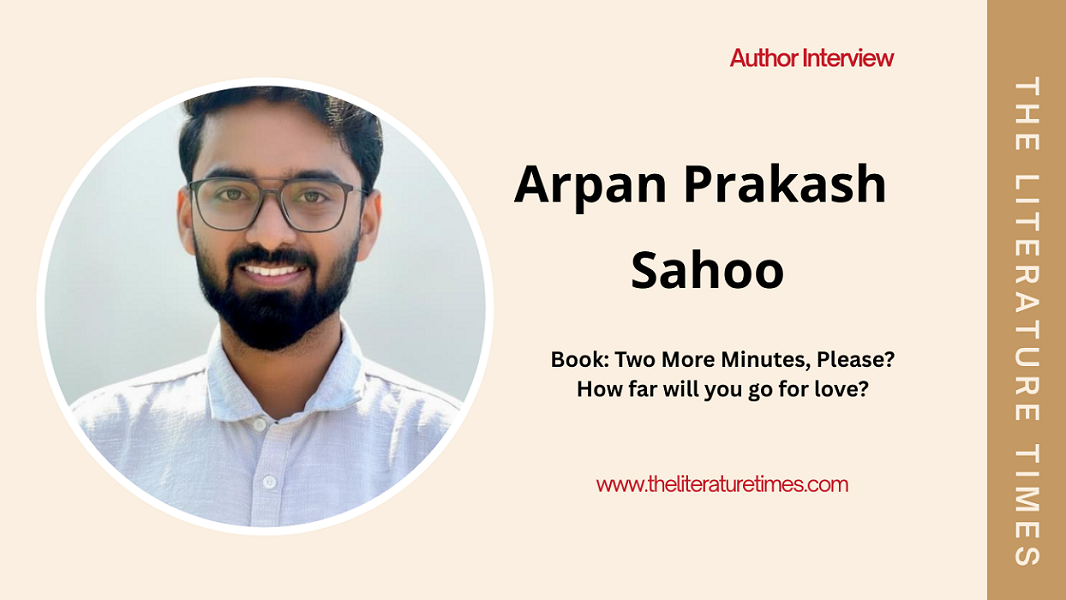
Arpan Prakash Sahoo was born and raised in Cuttack, Odisha. He holds a master’s degree in computer applications and works as a software engineer by day. But beyond his profession, he is an artist and a storyteller at heart, someone who finds poetry in the ordinary and beauty in the unseen. His fascination with art began long before his career in technology, and he has always believed that logic and creativity can coexist as expressions of God’s divine design.
A musician guided by faith, Arpan finds delight in worshipping and praising the Lord in his church. Outside of writing and music, he loves to read, reflect, and talk about life, faith, and all the things that make us human.
An old-school romantic, he believes and writes about love the way it once was: timeless, patient, and pure. His debut novel, Two More Minutes, Please?, is an extension of that reflection: a poetic exploration of love, loss, and the enduring beauty of memory.
For Arpan, writing is a way to slow down, to listen, and to remind the world that life itself is the greatest work of art, crafted, in every detail, by the hands of God.