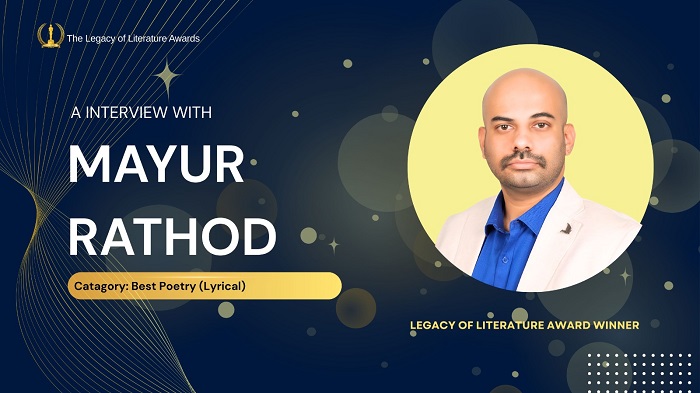
Mayur Rathod is an Information Technology Consultant by profession and a writer by passion. Armed with an MBA in Applied Finance, Leadership, and Strategy from the Narsee Monjee Institute of Management Studies in Mumbai, he helps guide businesses through their digital transformation journeys. Beyond the world of technology, Mayur finds inspiration in books and the serenity of nature—places where his thoughts take poetic form. Echoes of the Soul, his debut collection of poems, reflects his introspective journey through life’s emotions, relationships, societal truths, and the timeless quest for wisdom.
The Literature Times: What inspired you to write Echoes of the Soul, and how did the idea for tracing a soul’s journey from innocence to wisdom originate?
Mayur Rathod: We all are on this journey called Life where the destination is known, but the roads taken to reach there are un-known. Every person is walking his or her own unique path. So, the experience or outcome of the same journey is different for everyone. Overtime, these experiences accumulate and shape us in to the person that we are today. This thought of the same experience being lived and re-lived by every person in his or her unique way has always intrigued me. The most beautiful ornament that every childhood is adorned with is innocence. Over time, life teaches us with experiences – we rise, we fall and we learn to pick ourselves up. With every rise, we gain immense confidence, with every fall, we gain immense strength and wisdom. That’s how Life works. This understanding about Life ignited the idea of tracing a soul’s journey from innocence to wisdom.
The Literature Times: Many of your poems explore contrasts—love and pain, hope and struggle, unity and division. What draws you to these dualities?
Mayur Rathod: Over time I realised that most people like to see only one aspect of life or an event. Every experience like a coin has two sides. Just like day is incomplete without the night, joy without sorrow, love without pain, success without failure and death without life, it is very important to see life as a whole rather than seeing just one aspect of life which pleases us while neglecting the other aspect that makes us un-comfortable. To fully comprehend the meaning and depth of life, one needs to live and experience everything that life has to offer. This is something that is missing for most people. The poems in this book invite readers to understand and live all the facets of life without any bias towards any specific thought or expression or emotion.
The Literature Times: Your professional world is rooted in technology and strategy. How does your career influence your writing, if at all?
Mayur Rathod: Writing for me is a way to get in touch with my inner self. I’ve always enjoyed nature’s company. The oceans appeal me the most. I sometimes just sit on the beach and look at the vastness of the ocean as the wind loves me with its gentle touch. In those moments where time becomes still, ideas are born. The more technology driven our lives become, the greater the urge to stay in touch with the nature. One can learn a great deal of things from nature, the balance, the timing of seasons, and so on. Nature shows us the biggest contrasting ideas, a snake carries immense beauty, yet also carries venom, dark clouds can appear frightening, yet bring life on the Earth. So, working in technology space has made me appreciate the nature ever more.
The Literature Times: Several poems address societal flaws, shifting loyalties, and forgotten human values. Why was it important for you to highlight these themes?
Mayur Rathod: Most people I meet every day, at a subconscious level seek validation and approval from the society. People get affected by the opinion society carries about them. I want the readers to understand that society bows to power and interest. A person flaws will be ignored if he or she proves somewhat useful to someone. We live in a world where being weak is a sin, relationships are based on interests and human values have been reduced to mere words. In such a society, it is important for all individuals to understand their own strengths, and focus on what really matters, family. Through these poems, I want the readers to understand that you will never be enough for everyone, loyalty is conditional and human values is a card used when it suits people. While these words may not be pleasant to the ears, they are timeless truths to be realized and understood.
The Literature Times: Love appears in many forms throughout the book—from tender admiration to heartbreak to impossible connections. How has your personal understanding of love shaped these poems?
Mayur Rathod: Love is the simplest yet the most powerful of all emotions. One can either draw immense strength from love or can totally ruin his/her own life if not handled properly. Such a powerful emotion deserves a special place in a book that covers a soul’s journey. In order to understand life to it’s fullest, one must experience love in his/her life. Love finds its expression in many ways like the gentle touch of a new born on your face, the firm hold of your father when you first try to walk, a simple phone call from your lover asking how was your day or a simple text from a friend asking if you are alright, love has many forms and is present in every day life. Yet its mighty presence is ignored and is reduced to mere romantic gestures. I believe that the modern society is more focused on finding love in the outward grand gestures when love can be found in the simplest of things and moments. While love is like a flower that can sprout anywhere under impossible of the circumstances, it requires tender care and continuous effort to sustain and blossom. Hence, love is often compared to a war and we need to fight everyday for love to grow and flourish. I want the readers to understand that love can come in different forms and idealizing love as just a romantic gesture is like trying to describe the ocean with just a glass of water.
The Literature Times: Nature seems to be a recurring source of strength and symbolism in your writing. What role does nature play in your creative process?
Mayur Rathod: As mentioned earlier, nature holds a special place in my life. I’ve always felt a special connection with mother nature. Even as a child, I would spend my vacation playing in the garden or under a tree. The idea of building my own treehouse has always intrigued me. Someday, I want to own a piece of land with a big tree and build my own tree house where I would rest and enjoy the nature’s quiet. The fresh air, the cold breeze, the chirping of the birds, the morning sun, the rustling of the leaves, the fragrance of the wet earth and the calmness of the night sky are things that I deeply cherish. I also feel very deeply connected to the ocean and sometimes spend my entire day just looking and admiring it. The sound of the waves crashing, the wind, and the occasional sound of the birds is something that every person must experience. Most of my poems revolve around nature in some form. I draw my source strength and creativity from nature.
The Literature Times: Poems like Beneath the Weight of Time and The Rise and Fall of the Prideful Tree carry strong emotional and moral undertones. How do you balance storytelling with lessons or reflections?
Mayur Rathod: Women play a very important role in my life be it my mother, my sisters, my friends or my colleagues. Beneath the Weight of Time is a tribute to the battles that I see these women fight every single day. Women too have dreams, while some openly share theirs, many keep them hidden in some deep corner of their heart. Over time, they get buried further under the pile of responsibilities, expectations and duties. Yet, I’ve seen women keep their dreams alive amidst all these battles while time keeps slipping away from their hands like the sand in an hourglass. Every woman today is fighting this unseen battle towards keeping their dreams alive and I believe that as men it is our duty to support the women in our lives to help them achieve their dreams. This poem is an acknowledgement to the unseen battles of women and serves as a reminder to all the men to understand and support their battles and grow together as partners.
Throughout history, the biggest reason for the fall of greatness is Pride. The Rise and Fall of the Prideful Tree depict just that. I once read a quote, “When you are winning, you are not as good as you think you are and when you are losing, you are not as bad as you think you are.” This line is deeply rooted in everything that I do. When one experiences success for the very first time, it is a basic human tendency to develop pride and arrogance in your mind and in that moment, we often tend to ignore the ones who fought by us in those battles. This pride eventually leads to one’s demise. The poem carries this message depicting the tree as the prideful one and the stream as the ones who supported us during difficult times only to be ignored later in the success.
The Literature Times: Was there any particular poem in this collection that was the hardest for you to write emotionally? Why?
Mayur Rathod: While all poems represent some aspect of my life experiences, there are some poems like The Unbreakable Ocean, The Ocean and the Shore and Trust, that are really impactful and powerful. Of all the poems, The Unbreakable Ocean was the most difficult to write as it compares the heart and the emotions to the ocean. I’ve seen most of my friends struggle to manage their emotions. I once too faced this challenge. This specific poem is an actual conversation that I had many years back with someone. I never thought that the conversation I had over a cup of coffee would find it’s expression through this poem. I believe that every reader needs to understand the deeper meaning of this poem. It always feels good to love and feel loved, but if the price of love is your peace or wellbeing then its not love but a bondage that’s weighing down on your progress. No one should have the right to take away your peace and if someone’s words or actions can impact your mood or the state of mind negatively, then its not love but a bondage or slavery. Love should feel like freedom. The poem compares the heart to the ocean, the ocean being so vast and powerful that nothing can move or shake its core. I want all my readers to understand the deeper meaning of this poem and try to bring the message in their lives.
The Literature Times: As a debut poet, what do you hope readers carry with them after completing Echoes of the Soul?
Mayur Rathod: In Echoes of the Soul an attempt has been made to cover multiple aspects of life, like birth, childhood, youth, love, painful separations, second chances, hope, struggle, societal expectations, importance of family, the duality of society and modern-day relationships. I believe that every reader will be able to connect to multiple aspects of this book. I’ve tried to express my experiences through poems and hope that my readers will be able to connect to the deeper meaning and message that each poem carries. These poems are not just lyrical lines but words of wisdom, if implemented in one’s life will surely help the readers live and experience their life with a deeper understanding and fullness. I hope that the book adds these values in the lives of the readers.
The Literature Times: Looking forward, do you plan to continue writing poetry, or are there other genres you hope to explore next?
Mayur Rathod: Yes. Poetry is an important part of my life and I’ll continue writing poems. Echoes of the Soul is the first of many books that I intend to write in due course. I’m currently, working on a fictional novel and if everything works as planned, I intend to finish the first draft of my novel before monsoon of 2026. Let’s keep our fingers crossed and wish me luck. I also thank all my readers for showing their support by reading this book and I express my gratitude to The Literature Times for recognizing my work. I will continue putting my efforts to contribute to the world of literature and adding values to the lives of my readers through my work.