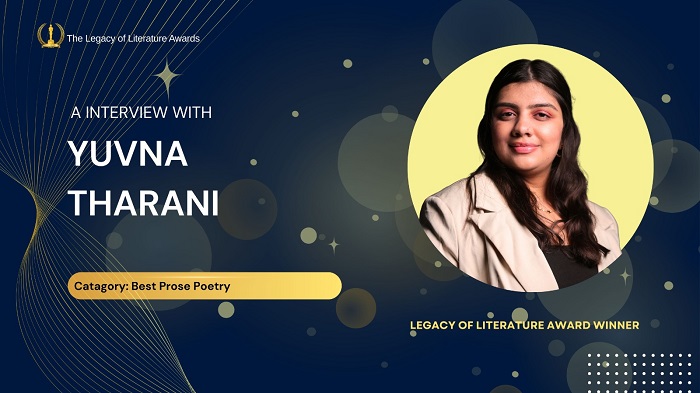
Yuvna Tharani is a writer who gathers stories from the quiet corners of memory, emotion, and longing. Her work unfolds like a whispered confession—intimate, atmospheric, and steeped in nostalgia. With a voice shaped by the spaces between joy and sorrow, she writes to unearth the truths that linger beneath silence.
Whether wandering through old bookshops or listening to the language of storms, Yuvna draws inspiration from the fragile details of life: half-remembered moments, fleeting melodies, and the shadows memories leave behind. Her writing is both a refuge and a revelation—an exploration of the heart’s deepest echoes.
The Literature Times: Your writing feels deeply rooted in memory and emotion. What first drew you to exploring nostalgia as a central theme?
Yuvna Tharani: Nostalgia has always felt like the language my heart speaks most fluently. Even as a child, I was fascinated by the way certain moments left echoes long after they ended. Writing became a way to trace those echoes—to understand why some memories soften with time, while others continue to burn quietly beneath the surface. I think I was drawn to nostalgia because it reveals who we’ve been, who we’ve lost, and who we’re still becoming
The Literature Times: You’ve said you “write to remember what you’ve never truly known.” Can you explain what that means for your creative process?
Yuvna Tharani: So much of what shapes us isn’t something we can consciously recall. It’s the unrealized longing, the inherited silences, the emotions that brushed past us before we had words for them. Writing helps me reach toward those unnamed truths. I’m not trying to reconstruct events as they happened—I’m trying to understand the emotional landscapes that formed around them. In that sense, I write to remember the versions of myself that never had the chance to speak.
The Literature Times: How do quiet moments—like wandering bookshops or walking through storms—influence the mood and tone of your work?
Yuvna Tharani: Quiet moments strip life down to its essentials. In a bookshop, surrounded by other people’s words, I’m reminded of the weight of my own. In a storm, the world feels raw and honest, as if everything unnecessary has been washed away. Those moments teach me how to listen—to myself, to the world, to the things that tremble between sound and silence. They shape the atmosphere of my writing by allowing me to breathe in the stillness before the story arrives.
The Literature Times: Much of your writing carries a sense of longing. Do you see longing as a kind of beauty, a kind of wound, or both?
Yuvna Tharani: Both—absolutely. Longing is the place where beauty and ache meet. It reminds us that we are capable of wanting deeply, of loving beyond logic or distance or time. But longing can also be tenderly painful, because it exposes the spaces within us that remain unfulfilled. I try to write from that space, where the wound is softened by the beauty of the desire that created it.
The Literature Times: When you sit down to write, do you begin with a specific memory, an emotion, or simply an atmosphere?
Yuvna Tharani: Usually, I begin with an atmosphere—a mood that feels like it’s trying to settle into words. From there, an emotion begins to form, and only later does a specific memory rise to meet it. For me, writing is less about retelling and more about rediscovering. I follow the feeling first, and the memory arrives when it’s ready.
The Literature Times: The imagery in your work is delicate and haunting. What inspires your fascination with subtle, fleeting details?
Yuvna Tharani: I’m drawn to the small moments because they reveal more truth than the grand ones ever do. A slight hesitation, a half-forgotten melody, the way light lingers on someone’s shoulder—these details hold entire stories inside them. They remind me that life is always whispering to us, inviting us to look closer, to feel deeper. I think hauntingness comes from recognizing how easily these moments slip away.
The Literature Times: Do you feel that writing helps you heal, or does it deepen your connection to pain and nostalgia?
Yuvna Tharani: It does both. Writing can be a wound reopening and a balm applied at the same time. It asks me to face emotions I might otherwise outrun, but it also gives me the language to soften them. Healing, for me, isn’t about erasing pain—it’s about transforming it into something meaningful, something I can finally hold without fear
The Literature Times: How do you navigate the balance between personal truth and universal emotion in your storytelling?
Yuvna Tharani: I focus on emotional honesty rather than literal accuracy. When a feeling is true, it becomes universal almost effortlessly. I don’t try to write for everyone—I write from a place that feels authentic to me. And somehow, in the vulnerability of the specific, readers often find themselves reflected. I think that’s the quiet magic of storytelling.
The Literature Times: Many readers describe your style as poetic. Do you intentionally craft your language this way, or does it emerge naturally through your voice?
Yuvna Tharani: It isn’t something I consciously strive for—it’s simply the way the words arrive. I’ve always felt that language has its own rhythm, its own pulse, and when I write, I’m trying to follow that internal music. If it sounds poetic, it’s because emotion rarely speaks in straight lines. It curls and drifts and lingers, and my writing tries to mirror that movement.
The Literature Times: If your memories could speak back to you, what do you imagine they would say?
Yuvna Tharani: I think they would tell me to be gentle with myself. To stop trying to fix what was never broken, and to cherish the moments I dismissed as ordinary. They would remind me that even the quietest days hold meaning, and that nothing is ever truly lost—not the people, not the emotions, not the time. Everything leaves a trace. And maybe they’d whisper, “You remember more than you think.”