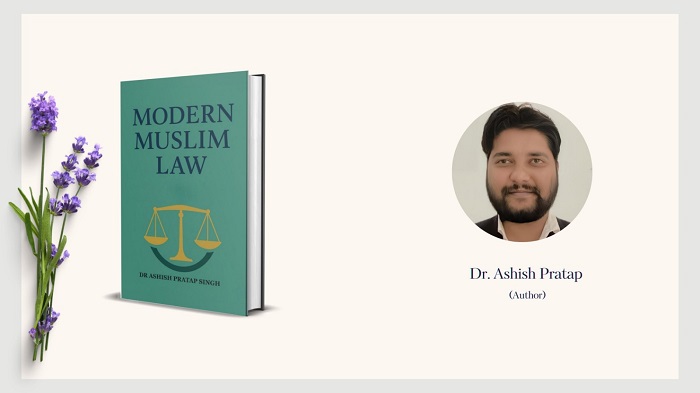
In a time when the intersection of faith, law, and modernity demands greater understanding, Dr. Ashish Pratap Singh’s book “Modern Muslim Law” emerges as a vital scholarly contribution to contemporary legal literature. Clear, analytical, and deeply researched, the book explores how the rich traditions of Islamic jurisprudence continue to shape — and adapt within — the frameworks of modern legal systems.
More than a mere textbook, “Modern Muslim Law” is a comprehensive study that bridges the historical and the contemporary. It delves into the evolution of Muslim personal law, from its classical roots in Sharia to its interpretation and implementation in present-day constitutional democracies. By covering essential areas such as marriage, divorce, inheritance, maintenance, guardianship, and property rights, the author ensures that the book serves as both a foundational guide and a modern analysis.
What sets this work apart is its balanced approach. Dr. Singh does not confine himself to a single school of thought or historical lens; instead, he presents a comparative and contextual study, illustrating how traditional Islamic doctrines coexist and sometimes conflict with modern legal standards and social realities. His lucid explanation of complex legal principles allows readers — whether students, scholars, or practitioners — to grasp not only the technical aspects of Muslim law but also its moral and philosophical underpinnings.
Through a meticulous examination of judicial precedents, legislative developments, and constitutional perspectives, “Modern Muslim Law” offers readers insight into how Islamic personal law interacts with evolving concepts of gender equality, human rights, and social justice. The book’s analysis of reforms and reinterpretations highlights how law, when viewed dynamically, becomes a living entity — responsive to the needs of time while rooted in enduring principles.
For law students and academicians, this book is an invaluable resource — one that promotes critical thinking, comparative reasoning, and ethical analysis. For practitioners and policymakers, it serves as a reference point in understanding how personal laws must evolve alongside changing societal values while maintaining respect for religious identity.
Behind this important work is a seasoned academician. Dr. Ashish Pratap Singh, holding an LL.M. and Ph.D. in Law, brings over 11 years of teaching experience to his writing. His extensive engagement with the discipline has made him a respected figure in the academic community. Known for his clarity of thought, scholarly precision, and pedagogical dedication, Dr. Singh has guided countless students to approach law not only as a profession but as a means of justice and service. His research interests span multiple branches of legal studies, reflecting a holistic understanding of both the spirit and structure of law.
In “Modern Muslim Law”, Dr. Singh achieves what every legal scholar aspires to — clarity without oversimplification, depth without obscurity, and relevance without compromise. His work reinforces the importance of understanding legal pluralism in a globalized world and underscores how tradition and modernity can coexist through informed dialogue.
Ultimately, “Modern Muslim Law” stands as a bridge between past and present — a testament to Dr. Singh’s commitment to fostering legal awareness, cultural sensitivity, and academic excellence. It is a must-read for anyone seeking to understand not only the principles of Muslim personal law but also the ongoing evolution of justice in a diverse society.