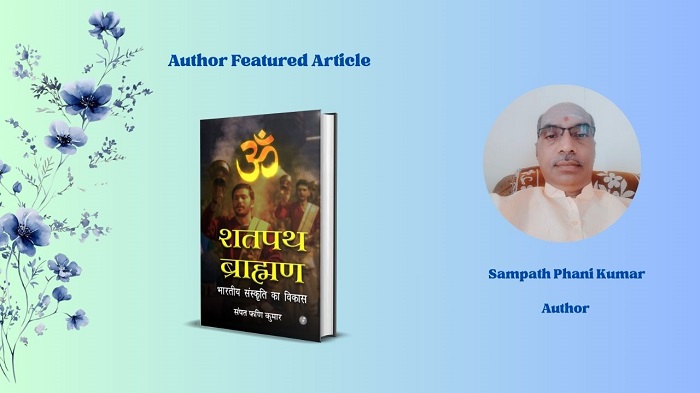
The journey of Sampath Phani Kumar, author of Satapatha Brahmanam, is rooted in a quiet yet powerful pursuit of knowledge—one that bridges ancient wisdom with modern inquiry. With a distinguished background in Indology and cross-cultural studies, he has carved a unique niche among contemporary researchers striving to illuminate the lesser-explored dimensions of India’s spiritual and intellectual heritage. His academic contributions include numerous research papers delving into the hidden layers of Vedic literature and the profound philosophy of Kashmir Shaivism. His work stands out for its depth, originality, and commitment to retrieving and interpreting ancient knowledge that often remains inaccessible or overlooked.
Before dedicating himself fully to research, Sampath Phani Kumar accumulated more than three decades of experience as a manager in a reputed public-sector financial organization, supported by his engineering postgraduate qualification. This unusual combination of technical training, administrative experience, and spiritual curiosity has shaped a perspective that is both analytical and intuitive. Today, as Director of the Shree Gayathri Jyotish Vidya Peeth in Hyderabad, he leads an institution engaged in a remarkable scholarly effort: determining the chronological setting of Indian epics by analyzing the star constellations mentioned within them. This work reflects his belief that ancient narratives, when examined through scientific and cultural lenses, reveal insights that connect humanity across time and geography. His dedication to understanding the world’s spiritual and cultural fabrics lends his writing a universal tone, inviting readers from diverse backgrounds to appreciate the interconnectedness of traditions.
His book, Satapatha Brahmanam, emerges from this lifelong commitment to exploring the foundations of Vedic knowledge. At the heart of the book is an exploration of the Brahmana literature—an often-neglected yet profoundly significant segment of the Vedic corpus. Each of the four Vedas contains the Samhita, Brahmana, Aranyaka, and Upanishadic sections; however, much of the Brahmana material has been lost over time, leaving fewer than twenty texts surviving today. These remaining works hold extraordinary historical, ritualistic, and philosophical value. They illuminate the transitional period between the early Vedic era and the later phases represented by the Aranyakas and Upanishads, offering essential descriptions of ritual procedures, interpretations of mantras, and the evolution of Vedic thought.
This book underscores the importance of the Satapatha Brahmana, a monumental text rich with detailed knowledge of fire rituals, Soma sacrifices, Pashu-bandha rites, and the Ashvamedha. Through careful study and accessible interpretation, Sampath Phani Kumar seeks to revive interest in Brahmana literature and highlight its indispensable role in shaping India’s spiritual foundations. He invites readers to trace the cultural footprints of Vedic Hinduism and rediscover a period that coexisted with early Zoroastrianism, the lifetimes of the Buddha and Mahavira, and other transformative chapters of world history.
With Satapatha Brahmanam, the author aims to guide modern readers toward a deeper understanding of ancient Indian wisdom. His scholarly dedication and passion for preserving cultural memory offer a meaningful pathway for anyone wishing to explore the roots of Indian civilization.