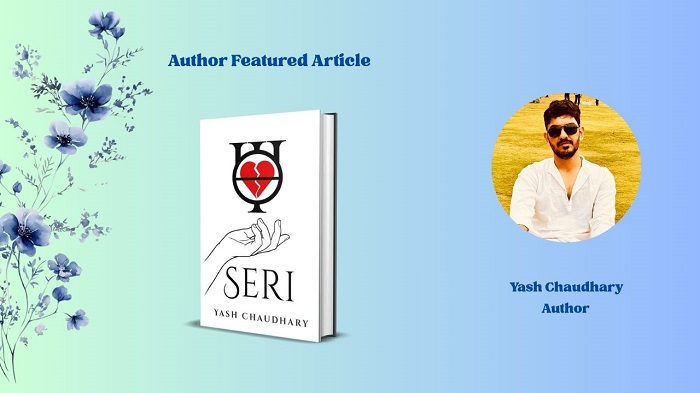
Yash Chaudhary, the author of Seri, represents a rare fusion of discipline and sensitivity—a civil engineer who navigates the structured world of technical work while nurturing a deep connection with art and emotion. His journey as a writer emerges not from traditional literary circles but from a life shaped by introspection, observation, and an unwavering belief in the profound power of emotions. Through Seri, he introduces readers to a world where feelings are not merely reactions but intricate narratives of their own.
Chaudhary hails from Chhatrapati Sambhajinagar (Aurangabad), Maharashtra, a city known for its cultural depth and historical richness. Yet his personal world is shaped as much by creativity as by professional commitment. As a civil engineer, he approaches life with precision and methodical thought. But beyond the blueprints and calculations lies a thinker who listens deeply—to people, to silence, and to the stories that emotions whisper. This duality forms the foundation of his writing identity.
His journey as a writer did not begin with the intention of creating literature. Instead, it emerged from his desire to understand emotions—not just his own, but the emotional landscapes of those around him. Chaudhary has an intuitive grasp of the fact that emotions hold different meanings for every individual. To one person, love feels like comfort; to another, it may feel like fragility. Anger, grief, joy, resentment, hope—each emotion is interpreted through the lens of personal experience. This understanding shapes the emotional authenticity that permeates his work.
In conversations, Chaudhary speaks of emotions not as abstract concepts but as living entities that influence every moment of human existence. He sees them as the core of connection, the universal medium through which human beings relate to one another. “The only medium that binds everyone is an emotion,” he often reflects—a belief that becomes the philosophical backbone of Seri. For him, emotions are the architecture of life, the invisible framework upon which relationships, decisions, and memories are built.
Seri itself grew from a personal turning point in his emotional journey. The word “Seri,” introduced to him during a significant moment, became a symbol of reassurance, grounding, and emotional clarity. It represented a language of love where one phrase could offer warmth strong enough to quiet the storms within. This resonated so deeply with him that the word became the muse for an entire book. Through Seri, he wanted to share the feeling that no matter the weight of life’s challenges, the heart holds the capacity to illuminate the path forward.
As a writer, Chaudhary’s voice is gentle yet deeply resonant. His words carry an introspective calm, guiding readers into the quiet spaces of their own hearts. Unlike many authors who rely on complex plots or expansive narratives, he focuses on emotional truth. His storytelling is intimate, often resembling a conversation between the reader and their inner self. He believes that when writing comes from a place of emotional honesty, it has the power to heal and transform.
His artistic sensibilities are shaped not only by personal reflection but also by his understanding of human behavior. Chaudhary often observes how people handle emotions differently—some suppress, some express, some overthink, and some detach. These differences intrigue him, prompting him to explore them through words. For him, writing is not merely an act of expression but a tool for understanding the unexplored corners of the heart.
Despite his engineering background, Chaudhary has always been guided by art. Whether through poetry, reflective writing, or emotional interpretation, he finds himself drawn to the subtle connections between feeling and meaning. His life is a testament to the idea that art and logic are not opposites—they coexist beautifully, each enriching the other.
In Seri, readers witness the culmination of his emotional insight and artistic passion. The book does not simply share a story; it shares an emotional philosophy. It acknowledges the pain that fractures identity, the confusion that clouds perception, and the healing power of reassurance. It reminds readers that emotions, though often overwhelming, are also the source of life’s greatest clarity.
As an emerging author, Chaudhary embodies a new kind of literary voice—one rooted in empathy, introspection, and emotional intelligence. He does not seek to impress with complexity but to connect through sincerity. His work resonates with readers who look for meaning beyond words, who understand that sometimes a single phrase—like Seri—can echo louder than entire paragraphs.
Looking ahead, Chaudhary’s path as a writer holds enormous promise. His ability to articulate emotional intricacies positions him as a voice capable of touching hearts across generations. With Seri, he has not only introduced himself as an author but also as a storyteller of the soul. His work serves as a reminder that in a world that often rushes past its own feelings, there is immense value in pausing, reflecting, and saying—Seri, everything will be okay.